Hello! Welcome to the final lesson in our module on Communication Systems.
In our last session, we delved into the fascinating process of analog-to-digital conversion, understanding how continuous real-world signals like your voice are transformed into discrete streams of 1s and 0s. This raised a crucial question: once we have this digital data, how can we send it across a vast, complex, and sometimes unreliable network like the internet and be sure that it arrives at its destination complete and in the correct order?
The answer lies in a set of rules and procedures that govern this exchange. This brings us to the learning outcome for today's lesson: to describe the role of protocols in ensuring reliable communication over the internet. Since your goal for this topic is to build a deep conceptual understanding, we will focus on the principles and logic behind these systems, without getting into heavy mathematical detail.
What are Protocols? The Rules of the Road
Imagine trying to have a conversation with someone where you both speak different languages, have different ideas about when to speak and when to listen, and use different gestures. It would be chaos. For successful communication, you need a shared language and a set of agreed-upon conventions.
In computer networks, these rules are called protocols. They are a formal set of conventions that govern how data is formatted, transmitted, and received between devices.
To get a clear introduction to this idea, let's start with a short video.
TCP IP Model Explained | TCP IP Model Animation | TCP IP Protocol Suite | TCP IP Layers | TechTerms
The video 'TCP IP Model Explained' provides a great analogy, comparing network protocols to a common language that computers must share to communicate successfully.
Please watch from the beginning to 01:10. This clip will establish why protocols are the essential foundation for any network communication.
The most important set of protocols for the internet is the TCP/IP suite. Think of it as the internet's "universal playbook." It organizes the complex task of communication into a set of layers, where each layer has a specific job.
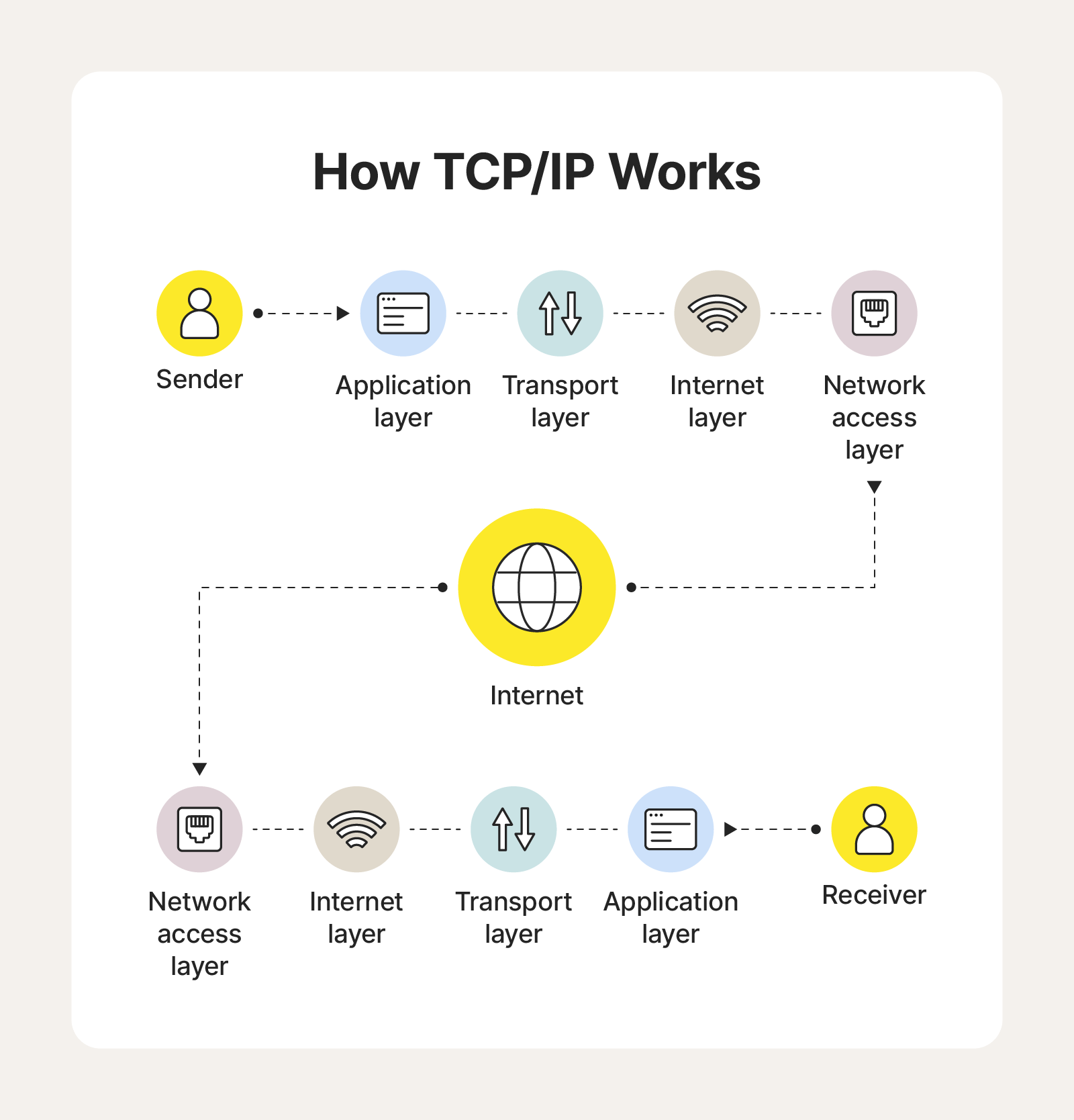
The Layered Architecture: A Team of Specialists
The TCP/IP model divides the communication process into four conceptual layers. When you send data (like an email), it starts at the top Application layer and moves down, with each layer adding its own wrapper of information—a process called encapsulation.

For our discussion on reliability, we will focus on two key players that operate in the middle layers:
-
IP (Internet Protocol): Operates at the Internet Layer. Its job is to act like a postal service. It takes small chunks of data called packets, labels them with a destination address (the IP address), and sends them out on the network. IP provides a "best-effort" delivery service—it tries its best to get the packet to its destination but makes no guarantees about whether it will arrive, arrive in order, or arrive uncorrupted.
-
TCP (Transmission Control Protocol): Operates at the Transport Layer, just above IP. This is our reliability expert. Its job is to take a stream of data from an application (like a web browser), manage its transmission, and ensure it is delivered to the corresponding application on the other end reliably and in order.
Think of it this way: IP is the mail carrier who delivers individual letters, while TCP is the logistics manager who tracks the entire shipment, ensures all boxes arrive, are undamaged, and are opened in the right sequence.
How TCP Achieves Reliability
So, how does TCP turn IP's unreliable, "best-effort" service into a reliable communication channel? It uses several clever mechanisms. The following video provides an excellent and detailed explanation of these features.
TCP IP Model Explained | TCP IP Model Animation | TCP IP Protocol Suite | TCP IP Layers | TechTerms
Let's return to the 'TCP IP Model Explained' video. This longer segment dives into the specifics of the Transport Layer, detailing exactly how TCP provides its guarantee of reliability. It also introduces TCP's counterpart, UDP.
Please watch from 12:40 to 17:30. As you watch, focus on understanding these key reliability mechanisms of TCP: Connection Establishment: The 'Three-Way Handshake'. Error-Free Transfer: The role of the 'Checksum'. Ordered-Data Transfer: The use of 'Sequence Numbers'. Retransmission: How 'Acknowledgements' (ACKs) are used to handle lost data.
Let's summarize those critical functions:
-
1. Establishes a Connection: Before sending any data, TCP performs a "three-way handshake" (SYN, SYN-ACK, ACK). This is like making a phone call and waiting for the other person to say "hello" before you start talking. It ensures both the sender and receiver are ready to exchange data. Because of this, TCP is known as a connection-oriented protocol.
-
2. Breaks Data into Segments and Numbers Them: TCP takes the data stream from an application and breaks it into manageable chunks called segments. It then adds a header to each segment containing a sequence number. This is like putting page numbers on a long document.
-
3. Guarantees Order: The receiver uses the sequence numbers to reassemble the segments in their original order, even if the underlying IP network delivers them out of sequence.
-
4. Checks for Errors: The TCP header includes a checksum. This is a calculated value based on the data in the segment. The receiver recalculates the checksum upon arrival. If the values don't match, it means the data was corrupted during transit, and the segment is discarded.
-
5. Confirms Delivery and Retransmits if Necessary: For every segment (or group of segments) it receives correctly, the receiver sends back an acknowledgment (ACK) message. If the sender doesn't receive an ACK within a certain time, it assumes the segment was lost or corrupted and retransmits it. This ACK-and-retransmit mechanism is the core of TCP's ability to deal with packet loss on the internet.
The Alternative: UDP
As the video mentioned, TCP is not the only option at the Transport Layer. Its main alternative is UDP (User Datagram Protocol). UDP is the polar opposite of TCP: it is connectionless and unreliable. It simply takes data, puts it in a datagram, and sends it out without any handshakes, sequence numbers, or acknowledgments.
Why would anyone use an "unreliable" protocol? Because it's fast. All of TCP's reliability mechanisms add overhead and latency. For applications where speed is more important than perfect reliability, UDP is the better choice.
Test your understanding!
For each of the following applications, would you expect it to use TCP or UDP? Justify your choice based on the application's need for reliability versus speed.
- Sending an email.
- A live video conference call.
- Downloading a software update file.
- Playing a fast-paced online game.
Show answer
-
Sending an email (TCP): An email must arrive completely and without any errors. A single missing or corrupted bit could make the entire message or an attachment unreadable. The absolute need for data integrity makes TCP the only choice. A slight delay in sending is acceptable.
-
A live video conference call (UDP): In a live video call, speed is critical. You want the audio and video to be as close to real-time as possible. If a small packet of data is lost, it might cause a momentary glitch or pixelation, which is far more acceptable than the entire stream pausing to wait for a retransmission. Therefore, UDP is preferred.
-
Downloading a software update file (TCP): Similar to an email, a software file must be 100% complete and correct. Even one wrong bit could corrupt the entire program, causing it to fail or behave unpredictably. Reliability is paramount, so TCP is used.
-
Playing a fast-paced online game (UDP): In online gaming, latency is the enemy. Information about your character's position and actions needs to reach the server as quickly as possible. If an old packet is retransmitted, it's already outdated and useless. It's better to miss one update and get the next one quickly than to pause the game waiting for a lost packet. UDP's low latency is ideal here.
Conclusion
Today, we've pulled back the curtain on how the internet achieves something remarkable: reliable data transfer over an inherently unreliable global network. We saw that this isn't magic, but the result of a well-defined set of rules called protocols.
Key Takeaways:
- Protocols are the agreed-upon rules that allow different devices to communicate effectively. The internet is built on the TCP/IP protocol suite.
- The TCP/IP model uses a layered architecture, where complex tasks are broken down into simpler jobs handled by specific protocols.
- IP (Internet Protocol) acts as a basic delivery service, routing packets to their destination with no guarantee of success.
- TCP (Transmission Control Protocol) provides the crucial layer of reliability on top of IP. It does this through:
- Establishing a connection (three-way handshake).
- Using sequence numbers to ensure data is ordered correctly.
- Using checksums to detect data corruption.
- Using acknowledgments (ACKs) and retransmissions to ensure no data is lost.
- The choice between a reliable protocol like TCP and a fast, low-overhead protocol like UDP depends entirely on the application's requirements.
This lesson concludes our journey through the fundamentals of communication systems. You have built a strong conceptual foundation, starting from how radio waves propagate, through the need for modulation, the structure of cellular networks, how analog signals become digital, and finally, how that digital data is reliably transported across the internet. I hope this has satisfied your passion for understanding the deep workings of modern technology