Hello! Welcome to your next lesson in our journey through Communication Systems.
In our previous lesson, we saw how satellite communication uses a single, powerful repeater in space to cover a vast area, solving the problem of long-distance, line-of-sight communication. Today, we turn our attention from the sky back to the ground. How do we provide reliable mobile phone service to millions of people clustered in cities or spread across the countryside? Using one giant transmitter for an entire city is not feasible due to signal limitations and, more importantly, a massive shortage of available radio frequencies.
Our learning outcome for this lesson is to describe the cellular concept in mobile telephony. We will uncover the ingenious strategy that allows a limited number of frequencies to serve billions of mobile phones worldwide. As with our previous lessons on communication, we'll focus on the core principles and conceptual understanding, which aligns with your interest in the "why" and "how" of technology.
1. The Core Challenge: Frequency Scarcity
Imagine you had to give every single mobile phone user in your city their own unique radio channel to make calls. The amount of radio spectrum required would be enormous and simply doesn't exist. This is the fundamental challenge of mobile communication: frequency scarcity.
To understand the scale of this problem, let's look at a short article that breaks it down.
Cellular Concept - GeeksforGeeks
The article 'Cellular Concept' from GeeksforGeeks starts by explaining why simply assigning a frequency to every user is impossible. This section sets the stage for why a more clever solution is needed.
Please read the section titled 'Frequency Scarcity Problem'. Pay attention to the example calculation to appreciate how quickly the bandwidth requirement becomes unmanageable.
As you saw, even with channel sharing, a large area with many users would require a massive, unavailable block of frequencies. This limitation led to the development of the cellular concept.
2. The Cellular Solution: Divide and Conquer
Instead of using one high-power transmitter to cover a large geographic area, the cellular concept does the opposite: it divides the area into a mosaic of smaller regions called cells. Each cell is served by its own low-power base station (the "cell tower").
This video provides a great introduction to the basic idea.
How does your mobile phone work? | ICT #1
The video 'How does your mobile phone work?' gives a quick, clear visualization of this core idea.
Please watch from 01:35 to 02:11. This short clip introduces the idea of dividing a geographic area into hexagonal cells, each with its own tower.
By using low-power transmitters, the signal from a base station is largely confined to its own cell. This prevents it from interfering with distant cells, a crucial feature that enables the most important aspect of cellular technology: frequency reuse.
3. The Key Ingredient: Frequency Reuse
The true genius of the cellular concept is that it allows the same set of frequencies to be used over and over again within the same network. Because the signals are low-power, a frequency channel used in one cell can be reused in another cell that is sufficiently far away without causing significant interference.
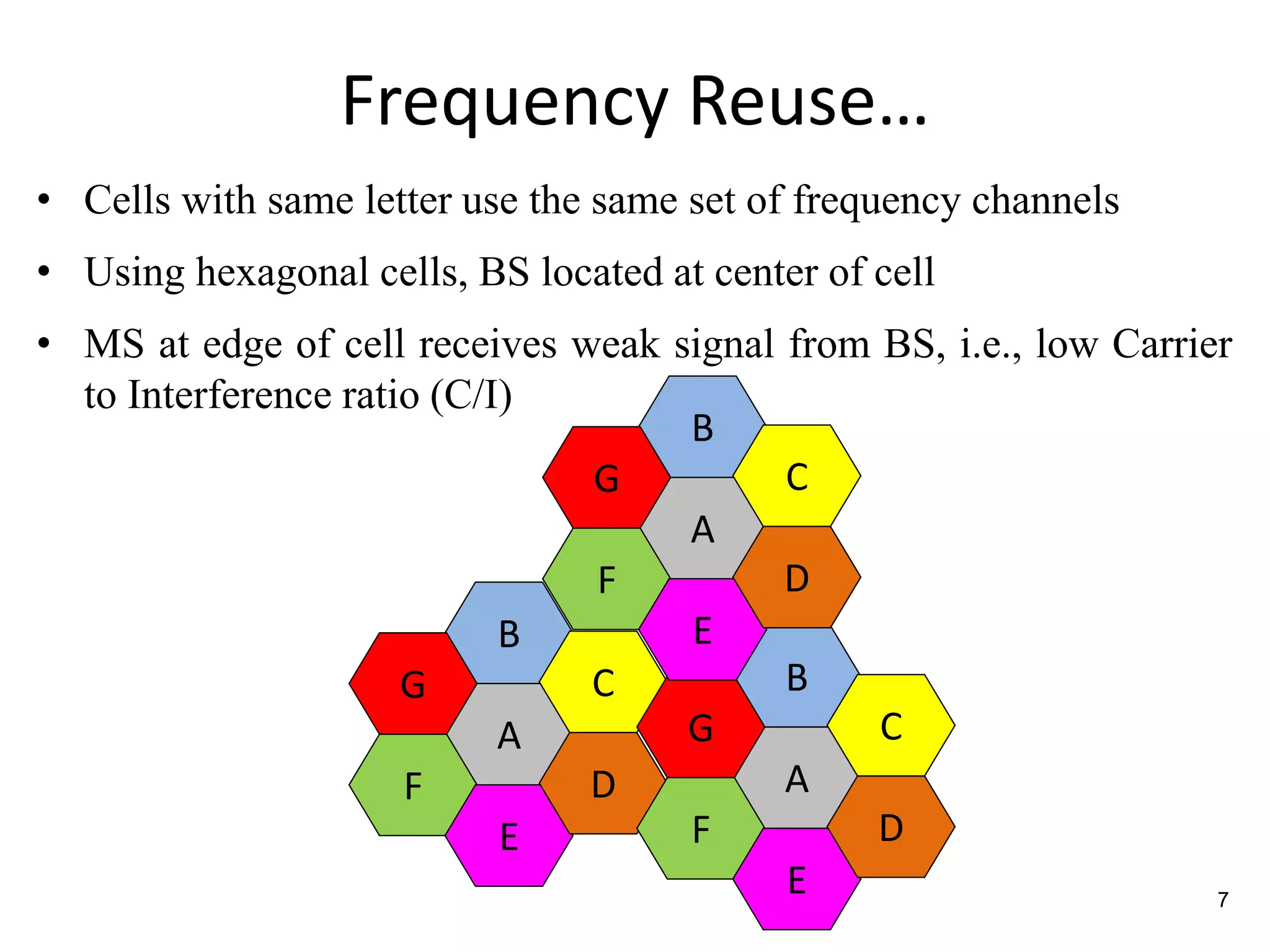
A group of cells where the entire set of available frequencies is used exactly once is called a cluster. In the diagram above, the 7 cells (A-G) form a cluster. The entire pattern can then be repeated, allowing the network to cover a vast area.
Let's watch a video that explains this critical concept.
Mobile Communication - Frequency Reuse - Cell Splitting - Handoff Procedure
The video 'Mobile Communication - Frequency Reuse...' explains this concept very clearly.
Watch from the beginning until 01:03. Focus on how frequency reuse works and the potential disadvantage it introduces: co-channel interference.
Co-channel interference is the interference between cells that use the same set of frequencies. Network engineers carefully design the reuse pattern to keep this interference at an acceptable level.
4. Making the Network "Mobile": The Handoff
The cellular structure works well for stationary users, but what happens when you're on a call and moving in a car from one cell to another? The system must be able to transfer your call from the first base station to the second without you even noticing. This process is called a handoff (or handover).
The handoff procedure is the key to seamless mobility. As your phone moves away from one base station, its signal gets weaker. At the same time, the signal from the base station you are moving towards gets stronger. The network detects this and automatically switches your connection to the new cell.
This next video explains the handoff procedure in an intuitive way.
Mobile Communication - Frequency Reuse - Cell Splitting - Handoff Procedure
Using the same video, we can now understand the handoff process.
Watch the segment from 01:17 to 03:28. Visualize the process of your phone's connection being 'handed over' from one tower to the next as you move across cell boundaries.
5. Managing Network Capacity
The cellular system needs to be able to adapt to changing user demands. Two important techniques for managing capacity are cell splitting and trunking.
Cell Splitting
What happens when a cell in a busy urban area becomes too congested with users? The solution is cell splitting. The congested cell is divided into several smaller cells, often called "microcells," each with its own base station. This multiplies the capacity of that area because each new microcell can reuse the available frequencies.
Mobile Communication - Frequency Reuse - Cell Splitting - Handoff Procedure
Let's return to the 'Mobile Communication' video one last time to see how cell splitting works.
Watch from 01:03 to 01:31. This section explains the concept of cell splitting to increase network capacity.
Trunking
Cellular networks also gain efficiency through trunking. Instead of assigning a specific channel to each phone permanently, there is a pool of channels available at each base station. When you make a call, you are temporarily allocated a channel from this pool. When you hang up, the channel is returned to the pool for someone else to use. This sharing allows a relatively small number of channels to serve a much larger number of users.
Cellular Concept - GeeksforGeeks
The GeeksforGeeks article provides a clear, concise explanation of trunking.
Please read the short section titled 'Trunking' to understand this principle of channel sharing.
Test your understanding!
A new shopping mall is built in a previously quiet suburban area. The local cell tower, which was once sufficient, is now frequently overloaded, and users complain about dropped calls and slow data. Based on what you've learned, what two strategies could a network operator use to solve this problem?
Show answer
- Cell Splitting: The operator could install several new, lower-power base stations within the mall and the surrounding area, effectively splitting the original large cell into multiple smaller microcells. This would dramatically increase the capacity in that specific high-traffic zone.
- Add More Channels (Trunking): The operator could increase the number of channels available in the shared pool for that cell's base station. While this doesn't create new cells, it increases the size of the channel pool that users share via trunking, allowing more simultaneous connections. Often, cell splitting is the more scalable long-term solution.
6. The Network's Brain: The Mobile Switching Center (MSC)
Finally, how does all this get coordinated? The base stations aren't acting alone. They are all connected to a central hub called the Mobile Switching Center (MSC). The MSC is the brain of the cellular network. It manages tasks like:
- Setting up and routing calls.
- Coordinating handoffs between cells.
- Keeping track of your phone's location.
- Connecting the cellular network to the regular public telephone network, so you can call landlines.
To see how the MSC fits into the bigger picture, let's watch one last video segment.
How does your mobile phone work? | ICT #1
The video 'How does your mobile phone work?' explains the role of the MSC in routing a call from one person to another.
Watch from 03:08 to 05:44. Focus on understanding how the MSC finds the person you are calling and connects the call through the appropriate cell towers.
Conclusion
Today, we've explored the cellular concept, the foundational principle behind modern mobile communication. Instead of a single, powerful transmitter, it uses a network of low-power base stations in small cells, which enables the efficient reuse of limited radio frequencies.
Key Takeaways:
- The cellular concept solves the problem of frequency scarcity by dividing a service area into smaller cells.
- The core mechanism for efficiency is frequency reuse, where the same frequencies are used in non-adjacent cells.
- Handoff ensures seamless communication as a user moves from one cell to another.
- Network capacity is managed through techniques like cell splitting (for high-traffic areas) and trunking (efficient channel sharing).
- The Mobile Switching Center (MSC) acts as the central coordinator for the entire network.
Preview of the Next Lesson:
So far in our study of communication, we've mostly treated signals like voice as they are—analog waves. However, modern communication, from your phone to the internet, is overwhelmingly digital. In our next lesson, we will dive into a fundamental process of this digital world: analog-to-digital conversion, where we'll explore how a smooth analog wave is transformed into a series of numbers (1s and 0s).