Hello! Let's dive into our next lesson on wave phenomena.
In our last session, we investigated what determines the speed of a sound wave, , in different media. We found that it depends on the medium's elastic and inertial properties. Today, we'll use that wave speed, , as a key parameter to explore one of the most interesting effects in wave physics: the apparent change in a wave's frequency when there's motion involved.
Our learning outcome is to apply the Doppler effect formula for various source-observer scenarios. You've likely experienced this phenomenon yourself—think of the pitch of an ambulance siren getting higher as it rushes towards you and then dropping as it moves away. Mastering the calculations behind this effect is essential for your NEET preparation.
1. The Doppler Effect and the General Formula
The Doppler effect is the change in the observed frequency of a wave due to relative motion between the wave source and the observer.
The relationship between the actual frequency emitted by the source () and the frequency perceived by the observer () is described by the general Doppler effect formula:
Where:
- is the observed frequency (what the listener hears).
- is the source frequency (the actual frequency emitted).
- is the speed of sound in the medium (which we studied last lesson, typically ~343 m/s in air unless specified otherwise).
- is the speed of the observer.
- is the speed of the source.
The most crucial—and often confusing—part is choosing the correct signs in the numerator and denominator. Memorizing rules like "towards is positive" can be unreliable. A much more robust method is to use physical reasoning.
2. A Logical Approach to Sign Convention
The core principle is simple:
- When the source and observer move closer to each other, the wave crests arrive more frequently, so the observed frequency increases.
- When the source and observer move away from each other, the wave crests arrive less frequently, so the observed frequency decreases.
To apply this, think of the term in the parenthesis, , as a fraction that modifies the source frequency.
- To increase , you need to make the fraction larger. You can do this by increasing the numerator or decreasing the denominator.
- To decrease , you need to make the fraction smaller. You can do this by decreasing the numerator or increasing the denominator.
The following video provides an excellent walkthrough of this logical method.
How To Solve Doppler Effect Physics Problems
The video 'How To Solve Doppler Effect Physics Problems' by The Organic Chemistry Tutor explains this logical sign convention method very clearly.
Please watch from 05:03 to 13:00. Pay close attention to how the speaker relates increasing/decreasing the numerator and denominator to the expected change in frequency. This reasoning is key to solving any Doppler effect problem without confusion.
Let's break down the logic for each component:
-
Numerator (Observer's motion, ):
- Observer moves towards source increases Make numerator larger Use .
- Observer moves away from source decreases Make numerator smaller Use .
-
Denominator (Source's motion, ):
- Source moves towards observer increases Make denominator smaller Use .
- Source moves away from observer decreases Make denominator larger Use .
This image provides a great visual summary of these rules.
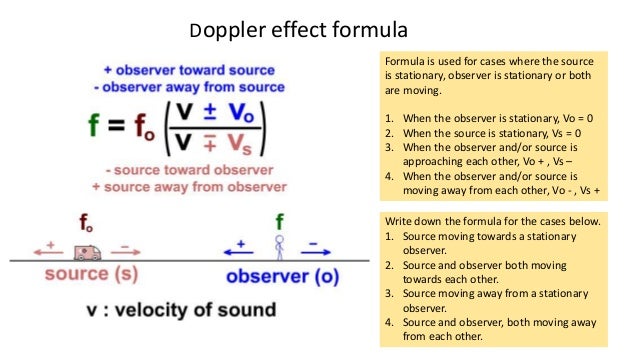
3. Solving Problems: The Four Key Scenarios
Let's apply this logic to the main scenarios you'll encounter in problems. For each one, try to derive the specific formula from the general one before looking at the answer.
Scenario 1: Source Moving, Observer Stationary ()
A police car with its siren on moves towards a stationary person.
- Motion: Towards each other.
- Expected outcome: Observed frequency increases.
- Logic: To increase the fraction, we must decrease the denominator.
- Formula:
Now, the police car moves away from the person.
- Motion: Away from each other.
- Expected outcome: Observed frequency decreases.
- Logic: To decrease the fraction, we must increase the denominator.
- Formula:
This case is worked out in the video from 15:54 to 21:04.
Scenario 2: Observer Moving, Source Stationary ()
A person runs towards a stationary ambulance with its siren on.
- Motion: Towards each other.
- Expected outcome: Observed frequency increases.
- Logic: To increase the fraction, we must increase the numerator.
- Formula:
Now, the person runs away from the ambulance.
- Motion: Away from each other.
- Expected outcome: Observed frequency decreases.
- Logic: To decrease the fraction, we must decrease the numerator.
- Formula:
This case is demonstrated in the video from 21:04 to 26:00.
Scenario 3: Source and Observer Both Moving
This is where the logical method truly shines. Consider two trains moving towards each other.
- Observer's motion: Towards the source Increases Use in the numerator.
- Source's motion: Towards the observer Increases Use in the denominator.
- Combined Formula:
Now consider the trains after they cross and are moving away from each other.
- Observer's motion: Away from the source Decreases Use in the numerator.
- Source's motion: Away from the observer Decreases Use in the denominator.
- Combined Formula:
The video covers a scenario with both objects moving from 26:00 to 30:43.
Test your understanding!
A source is moving away from a stationary observer. The observer then starts moving away from the source as well. What happens to the frequency heard by the observer when they start moving?
Show answer
When the observer starts moving away, this adds another factor that decreases the perceived frequency. The frequency heard by the observer will decrease further.
- Initially (observer stationary):
- Finally (observer also moving away):
Since is smaller than , the fraction becomes smaller, and .
4. NEET-Style Problem Solving
Let's apply this to some typical problems you might face in the NEET exam.
Problem 1: Two Engines Crossing
This is a classic problem. Let's use the example from the NEET Concept Notes.
Concept Notes on Waves for NEET
This problem from the 'Concept Notes on Waves for NEET' by Disha Publication is a perfect example of a two-part Doppler effect question.
Read 'Example 7' on page 322. Follow the solution for both parts: 'before crossing' and 'after crossing'.
Let's walk through the logic:
-
Given: m/s, km/hr m/s, Hz.
-
Part 1: Before Crossing (Moving Towards Each Other)
- Observer moves towards source: use in the numerator.
- Source moves towards observer: use in the denominator.
- Hz.
-
Part 2: After Crossing (Moving Away From Each Other)
- Observer moves away from source: use in the numerator.
- Source moves away from observer: use in the denominator.
- Hz.
Problem 2: The Echo (Reflection) Problem
A very common and slightly trickier variation involves sound reflecting off a surface (like a cliff or wall). You should treat this as a two-step Doppler problem:
- Step 1: The original source sends sound to the reflector. The reflector acts as a "stationary observer."
- Source Observer (Reflector)
- Step 2: The reflector immediately re-emits the sound it "heard." The reflector becomes a new "source," and the original source (now the listener) is the "observer."
- Source (Reflector) Observer (Original Source)
Let's solve Question 72 from the Disha Publication notes (Exercise 2, page 333):
A train moving at a speed of 220 ms⁻¹ towards a stationary object, emits a sound of frequency 1000 Hz. Some of the sound reaching the object gets reflected back to the train as echo. The frequency of the echo as detected by the driver of the train is (speed of sound in air is 330 ms⁻¹).
Step 1: Train (Source) to Stationary Object (Observer)
- Source (train) is moving towards a stationary observer (object).
- m/s, , Hz, m/s.
- We use the formula .
- The frequency "heard" by the object is:
Step 2: Stationary Object (Source) to Train (Observer)
- Now, the object acts as a stationary source emitting at Hz.
- The observer (train) is moving towards this new stationary source.
- , m/s, new Hz.
- We use the formula .
- The final frequency heard by the driver is:
The correct answer is 5000 Hz. This two-step process is crucial for all echo-type problems.
Conclusion
Today, we've broken down the Doppler effect, a topic that frequently appears on the NEET. By focusing on a logical approach rather than rote memorization, you can confidently tackle any scenario presented to you.
Key Takeaways:
- The Doppler effect describes the apparent change in frequency due to relative motion between a source and an observer.
- The general formula is .
- The Golden Rule: Always decide the signs based on whether the motion should increase or decrease the observed frequency.
- Motion towards increases.
- Motion away decreases.
- Echo problems are two-step Doppler calculations: (1) source-to-reflector, then (2) reflector-to-observer.
Preview of the Next Lesson:
We will continue our exploration of wave superposition by looking at what happens when two waves of slightly different frequencies interfere. This creates a distinctive throbbing sound pattern known as beats. We will learn how to calculate the beat frequency, a concept with applications ranging from tuning musical instruments to radar technology.