Hello! Welcome back to our study of wave optics.
In our last lesson, we established the conceptual foundation for what is to come. We learned about wavefronts, how to predict their movement using Huygens' principle, and the crucial condition of coherence—that waves must have a constant phase difference to produce a stable interference pattern.
Today, we get to the mathematical heart of interference. Building on those concepts, we will answer the question: what are the precise conditions that lead to bright and dark spots when light waves interfere? Our goal is to derive the conditions for constructive and destructive interference for light waves. This derivation is fundamental for your NEET preparation, as it forms the basis for solving problems in Young's double-slit experiment and other interference phenomena.
1. The Principle of Superposition: A Visual Start
When two or more waves overlap in space, the resulting disturbance at any point is the algebraic sum of the individual disturbances. This is the principle of superposition. Let's visualize what this means.

As you can see, the outcome depends entirely on how the waves align:
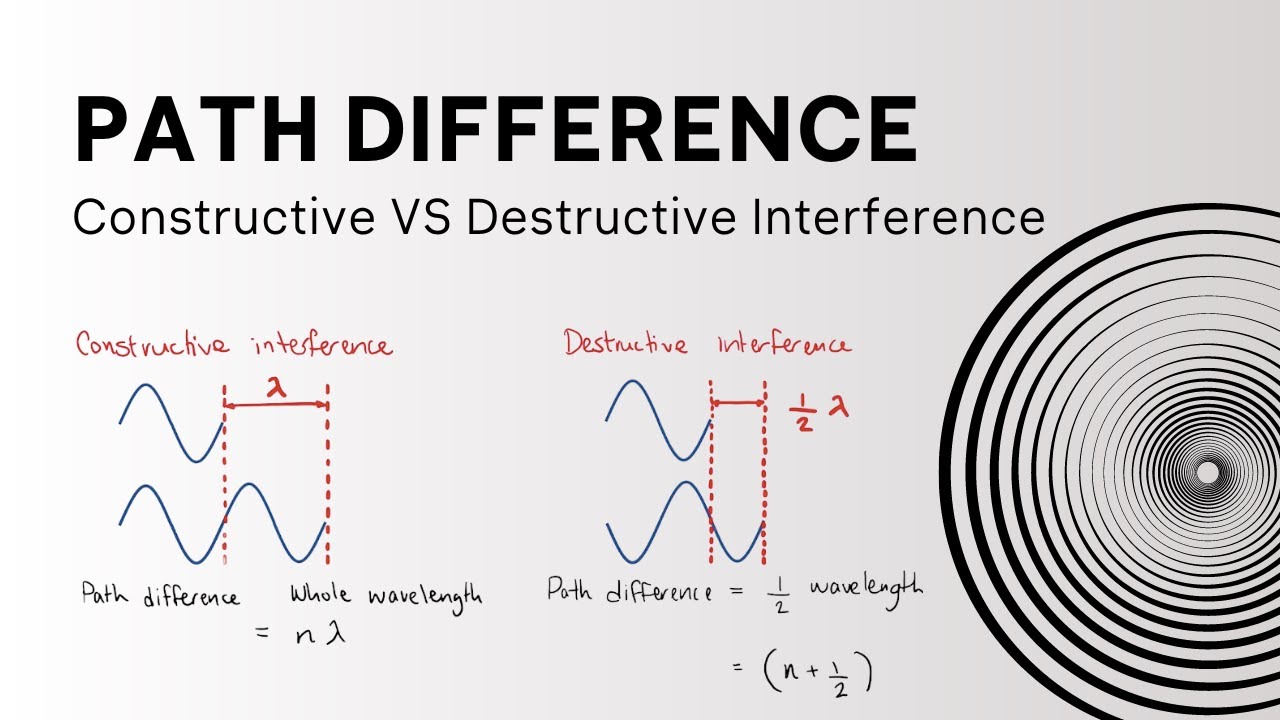
- Constructive Interference: If the crest of one wave meets the crest of another, they reinforce each other, creating a wave with a larger amplitude.
- Destructive Interference: If the crest of one wave meets the trough of another, they cancel each other out, resulting in a wave with a smaller amplitude, or even zero.
Before we dive into the mathematics, let's build a strong conceptual intuition for this. The following video from Khan Academy brilliantly explains interference using clear animations.
Constructive and Destructive interference | Physics | Khan Academy
This video provides an excellent conceptual and visual introduction to interference, showing how waves combine and linking phase difference to a physical path difference.
Please watch the video from the beginning to 07:47. Focus on: The visual representation of constructive and destructive interference. The key insight that a path length difference (one wave traveling farther than another) is a common cause of phase difference. The condition for constructive interference (path difference = an integer number of wavelengths, nλ). The condition for destructive interference (path difference = a half-integer number of wavelengths, (n + 1/2)λ).
The video introduces a critical concept: path difference (). If two waves start in phase from two different sources but travel different distances to reach a point, they may arrive out of phase. The difference in the distance they travel is the path difference.
2. The Mathematical Derivation of Interference Conditions
Now that we have the conceptual picture, let's satisfy your goal for a "vigorous" mathematical treatment. We will derive these conditions from first principles.
Consider two coherent light waves, represented by the displacements and , arriving at a point. Since the sources are coherent, they have the same angular frequency and a constant phase difference . We can write their equations as:
Here, and are the amplitudes of the individual waves.
According to the superposition principle, the resultant displacement is:
Our goal is to find the amplitude of this new resultant wave, . To do that, we need to combine these two sine functions.
The following video provides a clear, step-by-step derivation. Follow along as the presenter combines the wave equations and derives the formula for the resultant amplitude.
Condition for Constructive and Destructive Interference, Chapter 10, Wave Optics, Class 12 Physics
This video from Dynamic Vidyapeeth will guide you through the complete mathematical derivation of the resultant amplitude and the conditions for interference. Follow the trigonometric and algebraic steps carefully.
Watch the video from the beginning to 10:48. Focus on the mathematical steps used to combine the two wave equations and arrive at the expression for the resultant amplitude, R (or A in some notations).
After applying the trigonometric identity for and some algebraic rearrangement, we arrive at the equation for the resultant wave, which has the form , where is the resultant amplitude. The derivation shows that the square of the resultant amplitude is:
This is a monumentally important formula for interference. It shows that the resultant amplitude depends directly on the phase difference between the waves.
Condition for Constructive Interference (Maximum Amplitude)
The amplitude will be maximum when has its maximum value, which is +1.
This occurs when the phase difference is an integer multiple of :
Substituting into the amplitude formula gives the maximum possible amplitude:
Condition for Destructive Interference (Minimum Amplitude)
The amplitude will be minimum when has its minimum value, which is -1.
This occurs when the phase difference is an odd integer multiple of :
Substituting gives the minimum amplitude:
The absolute value is used because amplitude cannot be negative.
You can watch the derivations for these specific conditions in the next segment of the same video.
Condition for Constructive and Destructive Interference, Chapter 10, Wave Optics, Class 12 Physics
Continue with the video to see how the general formula for resultant amplitude is used to find the specific conditions for maximum (constructive) and minimum (destructive) interference.
Watch from 10:48 to 15:15. This part explicitly shows the derivation for R_max and R_min based on the values of cos(φ).
3. From Phase Difference to Path Difference
In experiments, it's often easier to measure lengths than phases. So, we must convert our phase difference conditions into path difference () conditions.
The relationship between phase difference () and path difference () is based on the fact that a path difference of one full wavelength () corresponds to a phase difference of radians.
Let's use this to translate our conditions:
-
For Constructive Interference:
This confirms our conceptual finding: constructive interference occurs when the path difference is an integer multiple of the wavelength. -
For Destructive Interference:
This also confirms our conceptual finding: destructive interference occurs when the path difference is a half-integer multiple of the wavelength.
The final part of the video walks through this exact conversion.
Condition for Constructive and Destructive Interference, Chapter 10, Wave Optics, Class 12 Physics
This last segment connects the derived phase conditions back to the more practical path difference conditions.
Watch from 15:15 to the end (17:12) to see the derivation of the path difference conditions from the phase difference conditions.
4. A Note on Intensity
For many NEET problems, you'll work with intensity () rather than amplitude (). The key relationship is that intensity is proportional to the square of the amplitude ().
Using this, our resultant amplitude equation can be rewritten for intensity:
From this, we get the maximum and minimum intensities:
- Maximum Intensity (Constructive):
- Minimum Intensity (Destructive):
This ratio is a very common subject of numerical problems.
Test your understanding!
Two coherent light sources have an intensity ratio of 81:1. They interfere to produce fringes. Calculate the ratio of the maximum intensity to the minimum intensity in the interference pattern.
Show answer
Let the intensities be and . We are given .
We know that intensity is proportional to the square of the amplitude (), so .
Therefore, the ratio of the amplitudes is:
Let and for some constant .
The ratio of maximum to minimum intensity is:
Substituting our amplitude values:
Simplifying the fraction gives:
So, the ratio of maximum to minimum intensity is 25:16.
Conclusion
Today, we built the mathematical engine that drives wave interference. By applying the principle of superposition to two coherent waves, we derived the all-important conditions for when they will reinforce or cancel each other.
Key Takeaways:
- The resultant amplitude of two interfering waves depends on their individual amplitudes () and their phase difference (): .
- The resultant intensity follows a similar formula: .
- Constructive Interference (bright fringe) occurs when:
- Phase difference
- Path difference
- Destructive Interference (dark fringe) occurs when:
- Phase difference
- Path difference
Preview of the Next Lesson:
We are now perfectly equipped to analyze the most famous demonstration of light's wave nature: Young's Double-Slit Experiment (YDSE). In the next lesson, we will apply today's formulas to the specific geometry of the double-slit setup to derive expressions for the location, spacing, and width of the interference fringes seen on a screen.