Hello! Welcome to your third lesson.
In our last session, we focused on reshaping data that was already inside Alteryx, using the Transpose and Cross Tab tools to switch between wide and long formats. Today, we're taking a significant step outside of our local workflows to learn how we can pull data from the vast universe of web services.
This lesson covers the learning outcome: Explain core REST API concepts (endpoints, methods, authentication). This is a purely conceptual lesson, but it's the essential theoretical foundation you'll need for the next few practical lessons where we'll use Alteryx to interact with live APIs. Understanding this "language" of the web is a crucial skill for any advanced data professional.
1. What is an API? The Language of the Web
Before diving into REST APIs, let's start with what an API is in the first place. An Application Programming Interface (API) is a set of rules that allows different software applications to communicate with each other.
A great analogy is ordering food at a restaurant:
- You (the client) want to get a dish (the data).
- The kitchen (the server) is where the dish is prepared.
- You can't just walk into the kitchen. Instead, you use a menu to see what's available and give your order to a waiter. The waiter (the API) acts as an intermediary, taking your structured request to the kitchen and bringing the food back to you.
The API defines the "menu" of what you can request and the proper way to ask for it. REST (REpresentational State Transfer) is the most common architectural style for designing these APIs for the web.
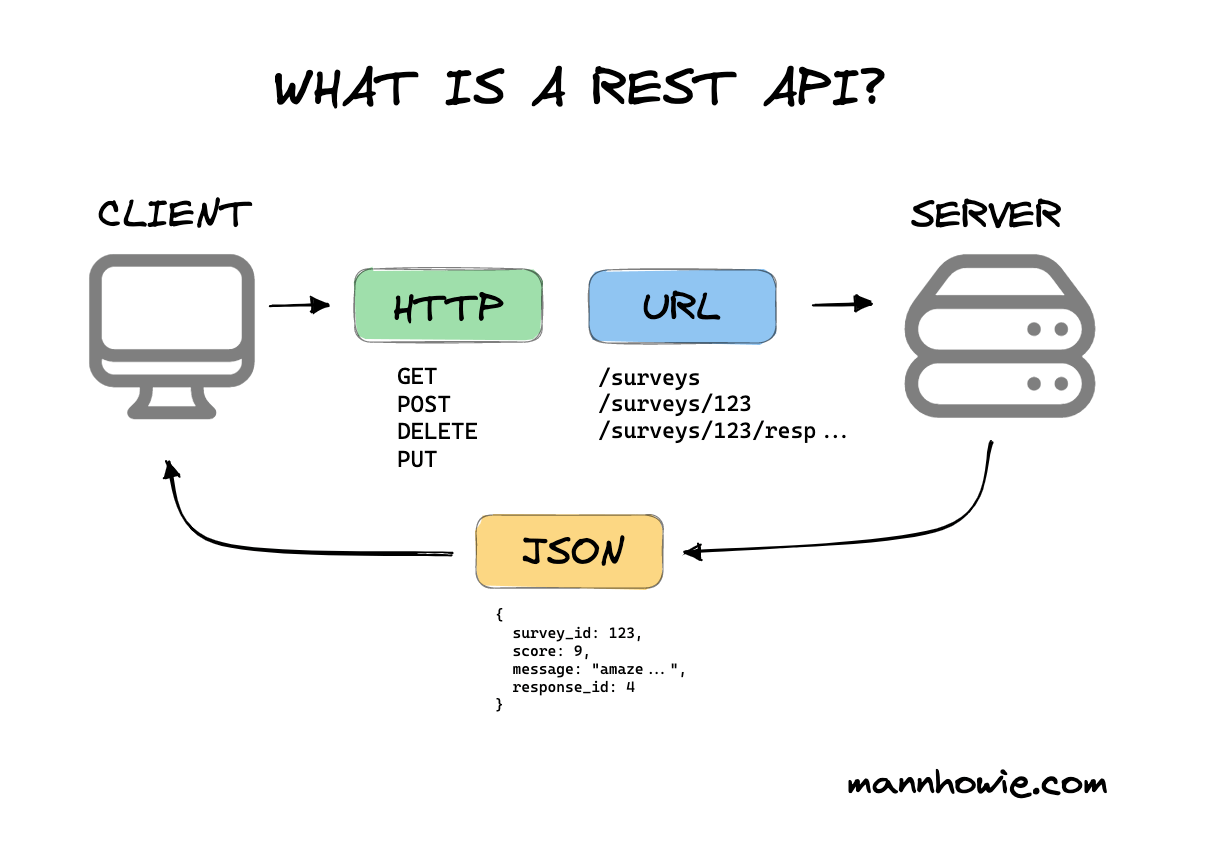
To get a comprehensive overview of what a REST API is, its key characteristics, and the components of a request, please watch the following video.
This video from IBM Technology provides an excellent and concise explanation of all the fundamental concepts of REST APIs, using a simple ice cream shop analogy to make the ideas clear.
Watch from 00:31 to 08:45. Pay close attention to the definitions of resources, endpoints, HTTP methods, and the examples of how different requests (GET, PUT, POST) are structured.
2. Core Principles and Components of a REST API
As you saw in the video, REST isn't a strict protocol but a set of guiding principles. The most important one is statelessness: the server doesn't remember anything about the client from one request to the next. Every request must contain all the information needed to process it. This makes REST APIs highly scalable.
Let's now break down the core components of an API request in more detail.
What is a REST API? Beginner's Guide + Examples Using Strapi
This article from Strapi provides a clear, written breakdown of the concepts introduced in the video. It will serve as a great reference guide for the key terminology.
Please read the sections: 'REST API Principles', 'Anatomy of a REST API Endpoint', and 'REST API Request Structure'. These sections will solidify your understanding of the principles and the specific parts of an API call.
Let's summarize the two most critical components you'll work with in Alteryx:
-
Endpoints: An endpoint is the URL that identifies a resource. A resource is simply a piece of data (an object or a collection of objects), like "users" or "products". A well-designed endpoint is like a clear signpost.
/api/usersmight point to a collection of all users./api/users/123might point to the specific user with ID 123.
-
Methods: The HTTP Method or "verb" tells the server what action to perform on the resource. The main ones correspond to CRUD (Create, Read, Update, Delete) operations:
- GET: Read a resource. (e.g., Get user 123's details).
- POST: Create a new resource. (e.g., Add a new user).
- PUT / PATCH: Update an existing resource. (e.g., Change user 123's email).
- DELETE: Remove a resource. (e.g., Delete user 123).
Connecting Theory to Alteryx
It's helpful to see where these concepts will appear in Alteryx. While we'll use these tools in the next lesson, take a look at how Alteryx structures these ideas.
REST API Connections - Alteryx Help
This Alteryx Help page shows how you configure connections to REST APIs. You don't need to understand everything yet, but look for the terms we've just discussed.
Skim the section titled 'Configure Endpoints'. Notice how you must explicitly choose a 'Method' (GET, POST, PUT) and specify the 'URL Endpoint', directly corresponding to the concepts you just learned.
3. API Authentication: Proving Your Identity
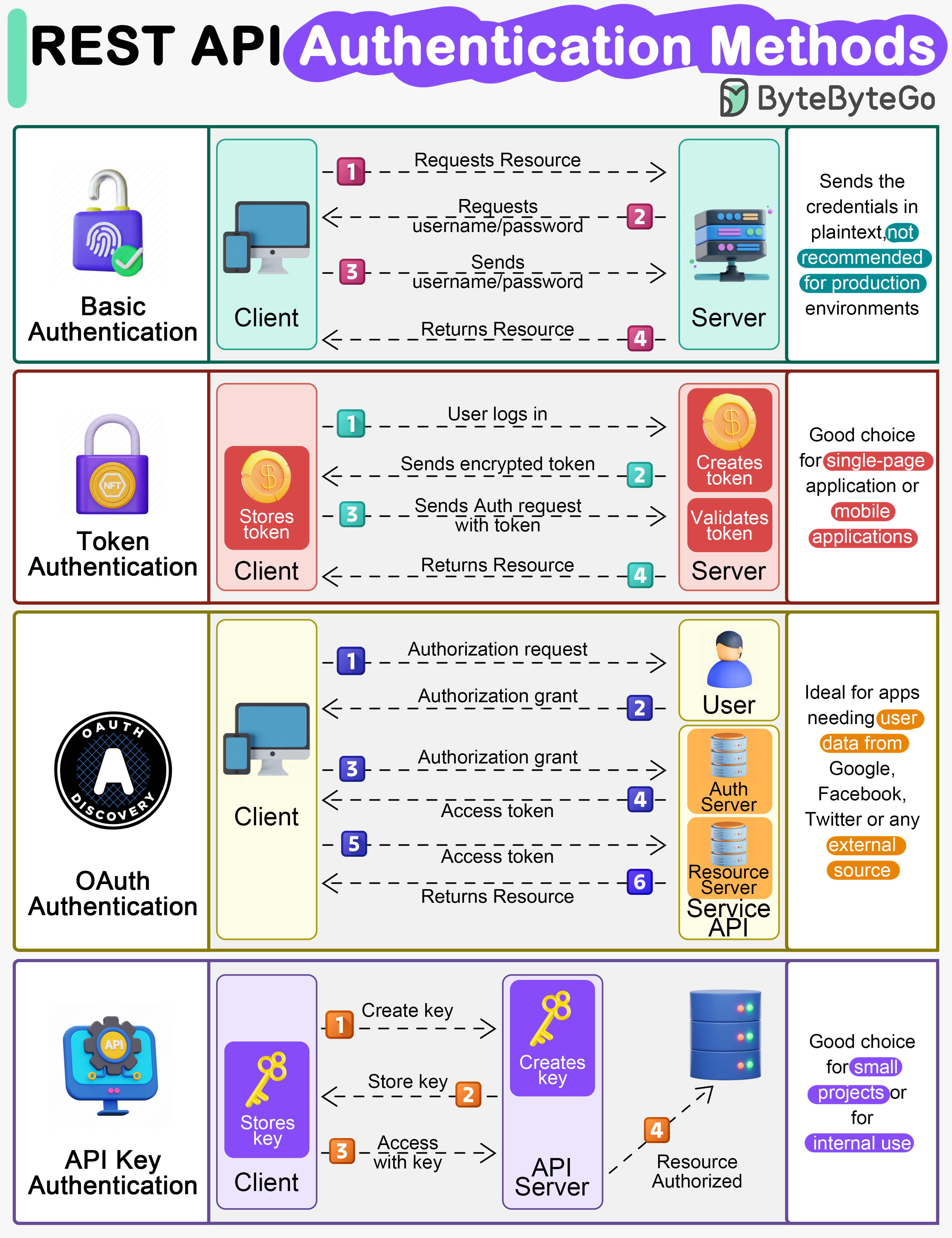
Most APIs aren't open to the public; they require you to identify yourself to ensure you have permission to access or modify data. This process is called authentication. There are several common methods.
What is a REST API? Beginner's Guide + Examples Using Strapi
Let's return to the Strapi article to learn about the most common ways APIs handle authentication.
Read the section 'Authentication in REST APIs'. Focus on understanding the difference between API Keys, Bearer Tokens, and OAuth 2.0.
Here is a visual summary of the common authentication patterns:
Authentication in Alteryx
Once again, let's see how these general concepts map to the Alteryx environment. The way you provide an API key or token in Alteryx falls into specific categories.
REST API Connections - Alteryx Help
The Alteryx Help page lists the authentication types it supports. You'll see a direct correspondence to the methods you just read about.
Read the section 'Authentication Types'. Notice the following: 'Basic Authentication' is a simple username/password. 'HTTP Header Based Authentication' is how you would typically provide a Bearer Token or some types of API Keys. 'HTTP Query Based Authentication' is for when the key is part of the URL itself. OAuth 2.0 is also listed as a more complex, but common, option.
Conclusion
In this lesson, we've laid the essential groundwork for interacting with web services. While entirely theoretical, a solid grasp of these concepts is non-negotiable for the Alteryx Advanced Certification and for building robust, real-world data workflows.
Here are the key takeaways:
- A REST API is a standardized way for applications to communicate over the web, built on the client-server model.
- Interactions are centered around resources (nouns, like
/users) which are located at endpoints (URLs). - The action to be performed is specified by an HTTP method (a verb, like
GET,POST). - Authentication is required to prove your identity and permissions, commonly handled via API keys, bearer tokens, or OAuth 2.0.
In our next lesson, we'll finally put this theory into practice. We will use the Alteryx Download tool to make an authenticated GET request to a real API and parse the data it returns.