Hello! Welcome to our final lesson on LLC converters.
In the previous lesson, we explored how LLC converters use frequency modulation to regulate their output voltage and how this strategy directly impacts their efficiency. We learned that operating at the resonant frequency is ideal, while operating above or below it involves trade-offs in efficiency due to switching losses or circulating currents.
Today, we'll broaden our perspective. Your goal is to be able to review and optimize PCBs, which often means understanding why a particular design choice was made. With that in mind, our objective is to compare the primary advantages and limitations of LLC converters versus Phase-Shifted Full-Bridge (PSFB) converters. These are two of the most prominent ZVS topologies in high-power applications, and knowing when to use which is a crucial piece of design wisdom.
A Tale of Two Topologies
At a glance, the full-bridge LLC and PSFB converters look similar. Both use a full-bridge of four MOSFETs on the primary side to drive a transformer. However, their methods for achieving ZVS and regulating power are fundamentally different, leading to distinct performance characteristics.

To start, let's get a high-level overview of the key differences from an expert at Infineon.
Developing Clean Efficient Power with LLC Resonant Converters with Infineon
This video segment provides a concise, direct comparison between the LLC and PSFB topologies, setting the stage for our detailed analysis.
Please watch from 03:20 to 05:11. Pay attention to the initial points made about soft-switching capability, light-load efficiency, and design complexity.
As the video highlighted, the LLC is a fully resonant converter, while the PSFB is a soft-switching converter. This distinction is the source of all their differences. Let's break down what this means in practice.
Head-to-Head Comparison: LLC vs. PSFB
We'll compare these two topologies across several critical design parameters. A great source for this is a detailed document from Texas Instruments that directly compares them.
Phase-Shifted Full-Bridge Converter Fundamentals
This document from Texas Instruments provides an excellent starting point for a detailed comparison. It immediately lays out the strengths and weaknesses of each topology.
Read the first two paragraphs of the introduction. Focus on the statements about voltage regulation method, efficiency, and suitability for wide input/output ranges. This introduces the core trade-offs.
Building on that introduction, let's dissect the key differences point-by-point. We'll use insights from both the TI document and a practical discussion from an Infineon engineering forum.
FB-LLC vs PSFB for converter with variable load
This forum discussion provides a real-world perspective on choosing between the two topologies, covering many practical aspects.
Read the first response from the Infineon moderator (Anshika_G), which lists seven points of comparison. We will explore these in more detail, so use this reading to get a broad overview of the factors involved.
Here is a detailed breakdown of those comparison points:
1. Control Method & Operating Range
-
LLC Converter:
- Method: Uses Variable Frequency Control. The controller adjusts the switching frequency to change the resonant tank's gain, thereby regulating the output voltage.
- Operating Range: This method works best with a stable input voltage (like from a PFC stage). The gain range is limited, so it's not well-suited for applications with a very wide input voltage swing.
-
Phase-Shifted Full-Bridge (PSFB) Converter:
- Method: Uses Fixed Frequency, Phase-Shift Control. The switching frequency is constant. Regulation is achieved by adjusting the phase shift between the two legs of the H-bridge, which controls the effective duty cycle applied to the transformer.
- Operating Range: This control method allows the PSFB to operate over a very wide input and output voltage range, a significant advantage over the LLC.
2. Efficiency and ZVS Performance
This is the most critical point of comparison.
-
LLC Converter:
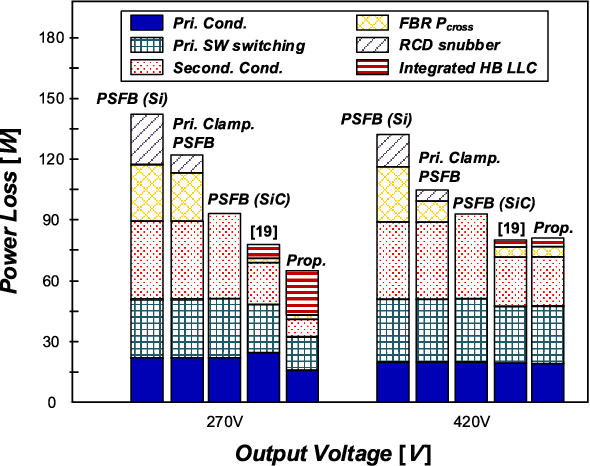
- Efficiency: Can achieve the highest peak efficiency. It provides ZVS for the primary MOSFETs and can achieve Zero Current Switching (ZCS) for the secondary-side rectifiers, nearly eliminating their switching losses.
- ZVS Range: ZVS is achieved by the resonant tank and is not dependent on the load current. This means LLC converters maintain very high efficiency even at light loads.
-
PSFB Converter:
- Efficiency: High efficiency, but generally lower than an LLC at its optimal point. It achieves ZVS on the primary, but the secondary rectifiers are hard-switched. It also suffers from "circulating currents" during the freewheeling periods, which increase conduction losses.
- ZVS Range: ZVS is highly load-dependent. The energy to discharge the MOSFET output capacitance comes from the inductor current. At light loads, there may not be enough current to achieve ZVS, causing the converter to revert to hard switching and reducing efficiency.
This difference in efficiency is not just theoretical. The following chart shows measured power losses, clearly demonstrating the LLC's advantage.
3. Transient Response
-
LLC Converter:
- The resonant tank acts like a high-Q filter, which makes it inherently slower to respond to abrupt load changes. The controller needs time to sweep the frequency to find the new required gain.
-
PSFB Converter:
- The control loop can be much faster. With peak current-mode control, the PSFB has a very fast transient response, making it ideal for loads that change suddenly and dramatically, such as modern processors.
Test your understanding!
You are reviewing a PCB for a high-performance AI server power supply. The specifications call for powering a GPU that has extremely fast and large changes in power consumption. Between an LLC and a PSFB, which topology would you expect to see and why?
Show answer
You would expect to see a Phase-Shifted Full-Bridge (PSFB) converter. Its fixed-frequency, phase-shift control allows for a much faster transient response compared to the frequency-sweeping control of an LLC. This is critical for maintaining a stable voltage rail for a component like a GPU with rapid load steps.
4. EMI and System Integration
-
LLC Converter:
- EMI: Generates less EMI because its resonant nature produces smoother, more sinusoidal current and voltage waveforms (lower and ). However, the noise is spread across a range of frequencies (due to frequency modulation), which can complicate EMI filter design.
- System Integration: The variable frequency makes it difficult to synchronize multiple converters or to implement current sharing for paralleled modules.
-
PSFB Converter:
- EMI: Generates more EMI due to its trapezoidal waveforms with sharper edges. However, the noise is concentrated at the fixed switching frequency and its harmonics, making the EMI filter design easier.
- System Integration: The fixed frequency makes it simple to synchronize multiple converters and to implement active current sharing. This is a major advantage in very high-power systems that use multiple parallel power stages.
Summary Table
Here is a summary of the key trade-offs, which can serve as a quick reference when you're evaluating a design.
| Feature | LLC Resonant Converter | Phase-Shifted Full-Bridge (PSFB) |
|---|---|---|
| Control Method | Variable Frequency | Fixed Frequency, Phase Shift |
| Peak Efficiency | Excellent. ZVS on primary, ZCS on secondary. | Very Good. ZVS on primary, hard switching on secondary. |
| Light-Load Efficiency | Excellent. ZVS is load-independent. | Fair to Poor. Loses ZVS at light loads. |
| Input Voltage Range | Narrow. Best for fixed input (e.g., after PFC). | Wide. Excellent for variable input (e.g., battery). |
| Transient Response | Slow | Fast, especially with current-mode control. |
| EMI Performance | Lower noise (sinusoidal waveforms). | Higher noise (trapezoidal waveforms). |
| EMI Filter Design | More complex (variable frequency). | Simpler (fixed frequency). |
| System Integration | Difficult to synchronize and parallel. | Easy to synchronize and parallel. |
| Design Complexity | High. Resonant tank design is an iterative process. | Moderate. More straightforward design process. |
Conclusion: Which Topology is "Best"?
As with most engineering decisions, there is no single "best" topology. The optimal choice depends entirely on the application's priorities.
-
Choose an LLC converter when:
- The absolute highest efficiency and power density are the primary goals.
- The input voltage is stable and well-regulated (e.g., in a server PSU with a PFC front-end).
- The load is relatively steady, or light-load efficiency is critical.
- Common Applications: Data center and telecom power supplies, high-efficiency AC/DC adapters, LED lighting.
-
Choose a PSFB converter when:
- The application requires operation over a wide input voltage range.
- A fast response to load transients is critical.
- System-level features like synchronization and paralleling are needed for very high power levels.
- Common Applications: Electric vehicle (EV) battery chargers, renewable energy inverters, industrial power systems.
Key Takeaways:
- The LLC converter is a fully resonant topology that excels in peak and light-load efficiency but is best suited for stable inputs and has a slower transient response.
- The PSFB converter is a soft-switching topology that excels in handling wide input voltage ranges and providing a fast transient response, but its efficiency suffers at light loads.
- The choice between them is a classic engineering trade-off: LLC prioritizes raw efficiency, while PSFB prioritizes operational flexibility and dynamic performance.
This lesson concludes our deep dive into specific ZVS topologies. You now have a solid understanding of how Active Clamp Flyback, Phase-Shifted Full-Bridge, and LLC converters work and the trade-offs between them.
In our next module, we will shift focus to the practical aspects of designing and optimizing these converters. The first lesson will cover how to select the critical components—like MOSFETs and resonant inductors/capacitors—that make ZVS operation possible.