Introduction
In our previous lesson, we used the Hawk-Dove game to analyze conflict over a single, contested boundary, introducing the concept of an Evolutionarily Stable Strategy (ESS) as a stable mix of aggressive and conciliatory behaviors. This provided a powerful lens for understanding how a dominance pattern might emerge on a specific issue within a couple.
Today, we will significantly broaden that perspective. We move from analyzing a single conflict to modeling an entire social ecosystem. What happens when multiple, distinct relationship strategies compete within a community? For instance, how do styles like monogamy, various forms of polyamory, and relationship anarchy coexist and evolve over time? This lesson will equip you with the tools to answer such questions by using the concept of replicator dynamics. You will learn how to model the long-term prevalence of different strategies in a population, connecting the static idea of an ESS to the dynamic process of social evolution.
From Individual Strategies to Community Ecology
First, let's expand our definition of a "strategy." In the Hawk-Dove game, the strategies were simple actions: escalate or yield. In a community context, a strategy can be a complete philosophical approach to relationships.

Consider the styles in the chart above as competing strategies within a population (e.g., a local community or an online dating pool). The success of adopting a "Relationship Anarchy" strategy, for example, depends heavily on the composition of the rest of the population. If the pool is dominated by individuals practicing "Hierarchical Polyamory," the anarchist may struggle to find compatible partners and thus receive a low "payoff." Conversely, in a community of other anarchists, the strategy would thrive.
The central question becomes: how do the proportions of these different strategies change over time?
Replicator Dynamics: The Engine of Evolution
To model this, we turn to replicator dynamics, a cornerstone of evolutionary game theory. The core idea is intuitive: strategies that are more successful (i.e., yield a higher average payoff) will see their prevalence increase, while less successful strategies will decline. People will tend to emulate or adopt the strategies that they perceive as working best.
The following video provides an excellent high-level introduction to this concept.
This video from the Systems Innovation Network introduces the concept of replicator dynamics, explaining how it models the changing proportions of strategies in a population based on their relative success.
Please watch from the beginning to the end of the main explanation. Focus on the core logic: the growth rate of a strategy is proportional to the difference between its payoff and the average payoff of the entire population.
As the video explains, the change in the proportion of a strategy depends on its "fitness." In our context, the fitness of a strategy is simply its average payoff, calculated against all other strategies in the population, weighted by their current frequencies.
Given your background, you'll immediately recognize the mathematical formulation. Let be the proportion of the population playing strategy at time , and let be the payoff matrix where is the payoff to strategy when interacting with strategy .
- The fitness (expected payoff) of strategy is:
- The average fitness of the entire population is:
The replicator equation then states that the rate of change of the proportion of strategy is:
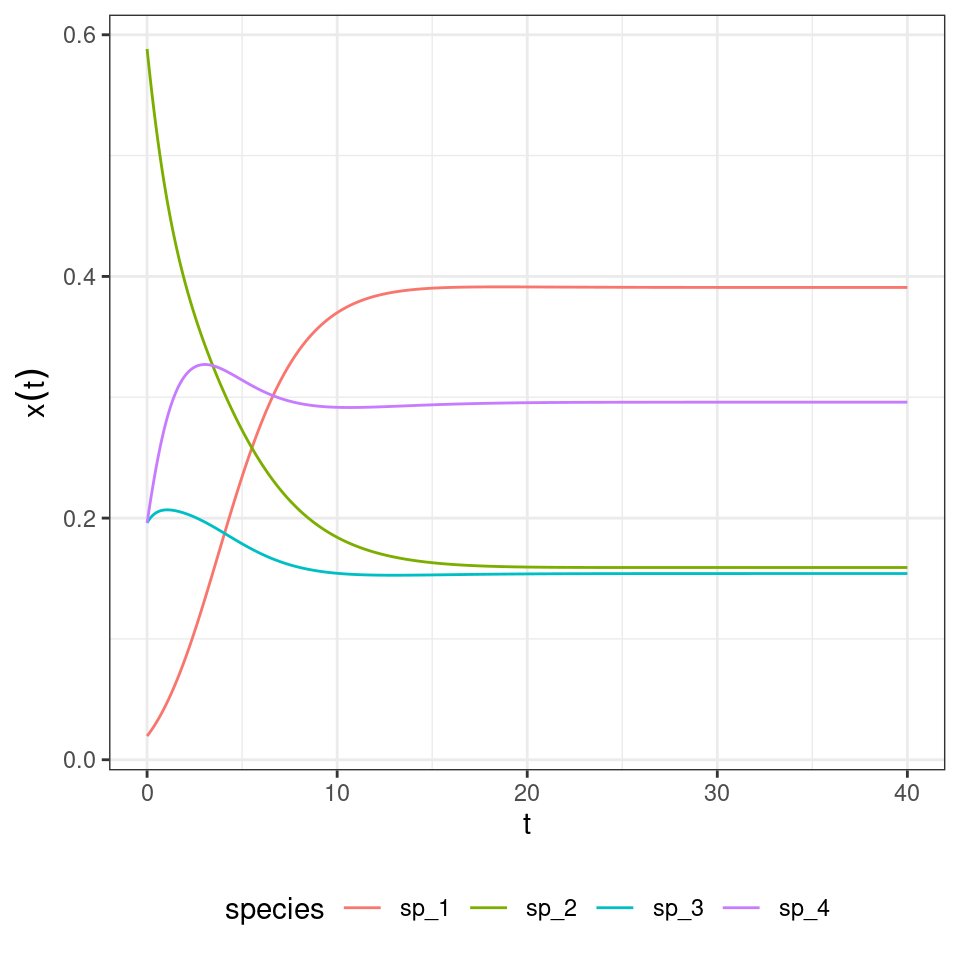
This elegant equation captures the essence of social evolution: a strategy's share of the population grows if its fitness is above average and shrinks if it's below average. The process is dynamic because as the proportions change, the average fitness also changes, affecting the evolutionary pressures on all strategies.
The following graph visualizes this process. Imagine starting with four different strategies. The replicator dynamics show how their proportions evolve over time until they reach a stable equilibrium mix.
The Link Between Stability and Dynamics
Now we can connect the static concepts of Nash Equilibrium (NE) and Evolutionarily Stable Strategy (ESS) to these dynamics. The relationship is fundamental and is a key result in evolutionary game theory.
Lecture 6 Game theory and replicator dynamics
This online lecture chapter by Stefano Allesina provides the formal mathematical bridge between game theory concepts and replicator dynamics. It's an excellent resource for formalizing the intuitions we've discussed.
First, quickly read the introduction in Section 6.1 (the first paragraph) to see the historical context connecting von Neumann, Nash, and Maynard Smith. Next, read the sections on "Evolutionary stable strategies" (6.2.5) and "Replicator dynamics" (6.3) (to this point). This is the most critical part. Focus on the definition of the replicator equation and the concluding statement: a Nash Equilibrium is an equilibrium of the replicator equation, and an ESS is a stable equilibrium of the replicator equation. Finally, read Section 6.3.1 "Nash equilibria are equilibria of the RE" and Section 6.3.2 "ESS are globally stable equilibria of the RE" (read these two subsections). Given your background, the proofs using Lyapunov functions to demonstrate stability will be of particular interest. They formally show why an ESS is a state that the system will naturally return to after being perturbed.
The reading confirms two profound points:
- Nash Equilibria are Fixed Points: Any Nash Equilibrium of the underlying game is a stationary point for the replicator dynamics. If the population's strategy mix corresponds to a NE, the proportions will not change.
- ESS are Stable Attractors: An Evolutionarily Stable Strategy is more than just a fixed point; it's a stable one. If the population is at an ESS and a small group of "mutants" playing a different strategy is introduced, the dynamics will pull the population back to the original ESS. The mutant strategy will fail to invade and will die out.
This is precisely what allows us to predict long-term prevalence. An ESS represents a resilient social norm or a stable mix of relationship styles that can withstand invasion by alternative strategies. A non-ESS Nash equilibrium, on the other hand, is a fragile state. While it is a fixed point, the slightest perturbation could cause the population to careen towards a different equilibrium entirely.
Complicating the Model: A More Realistic View
The replicator dynamics model is a powerful, deterministic framework. However, as your expertise in statistics and experimental design suggests, real-world systems are rarely so simple. The assumption that a "strategy" is a fixed, genetically-coded trait with a simple payoff matrix is a useful simplification, but it has its limits.
The following paper, which discusses alternative mating tactics and polyandry in biology, provides a crucial layer of sophistication.
Polyandry and alternative mating tactics - PMC - NIH
This paper from Philosophical Transactions of the Royal Society B reviews the evolution of alternative mating tactics (AMTs), critiques the simpler game theory models, and proposes a more unified framework. It brings a necessary dose of reality to our modeling.
First, read the section that introduces the debate between a mixture of pure strategies (the classic ESS model) and a single, conditional strategy (read this paragraph). The key idea here is that individuals might not be playing a fixed "strategy" but are instead using a decision rule based on their condition (e.g., "if high status, be assertive; if low status, be accommodating"). Next, read the sections discussing the problems with the traditional models (read to the end of this paragraph). This highlights the false dichotomy between "genetic" and "environmental" causes and introduces the importance of genotype-by-environment (G x E) interactions. Finally, read the concluding summary of the unified framework (read the first two paragraphs of the conclusion). The main takeaway is that reality is a continuum. Pure ESS and pure conditional strategies are extremes; most real-world scenarios fall in between, with fitness landscapes that are constantly shifting.
The paper's insights are directly applicable to our context. A person's choice of relationship strategy isn't a simple coin flip or a fixed trait. It's a complex, conditional choice influenced by:
- Status/Condition: Their own attractiveness, financial security, emotional intelligence, and local social standing.
- Environment: The composition of the local dating pool, prevailing social norms, and the availability of potential partners.
This means we should not always expect to find a population at a perfect, stable equilibrium with equal fitness for all surviving strategies. Instead, we should expect a dynamic system where the fitness of different relationship styles is constantly shifting, influenced by both individual attributes (G) and the social context (E).
Conclusion
In this lesson, we have scaled our analysis from a single conflict to a whole community. By using the framework of replicator dynamics, we can now model how the prevalence of different, competing relationship strategies evolves over time.
Key Takeaways:
- Replicator Dynamics provide a mathematical model for how strategy frequencies change in a population, with more "fit" (higher payoff) strategies growing at the expense of others.
- An Evolutionarily Stable Strategy (ESS) is a stable equilibrium of the replicator dynamics. It represents a resilient mix of strategies that can resist invasion by alternatives, making it a powerful predictor of long-term social norms.
- The real world is more complex than simple models suggest. Strategies are often conditional, based on an individual's status and environment, and the fitness of any given strategy is subject to constant change.
Preview of the Next Lesson:
Our model of fitness has so far relied on objective, numerical payoffs. However, human decision-making is famously non-linear, especially in high-stakes emotional negotiations. In the next lesson, we will incorporate insights from behavioral economics by applying prospect theory. This will allow us to model how psychological biases, particularly loss aversion, can dramatically alter how individuals perceive the "payoffs" in a negotiation, leading to behaviors that a purely rational model cannot predict.