Introduction
In our last lesson, we explored how the "shadow of the future" in repeated games can foster cooperation, using the Tit-for-Tat strategy as a model for building and repairing trust. That framework is powerful for analyzing situations where mutual benefit is possible. However, not all disagreements are cooperative in nature. Sometimes, you face a direct conflict over a contested boundary where preferences are diametrically opposed, and one person’s win is another’s loss.
This lesson delves into precisely those scenarios. We will use the Hawk-Dove game, an essential model from evolutionary game theory, to analyze the strategic calculus of conflict. You will learn to determine when it is rational to escalate a confrontation and insist on your preference (playing "Hawk") versus when it's better to de-escalate and yield (playing "Dove"). This will provide you with a formal framework for understanding how dominance patterns can emerge over specific, contested issues within a relationship.
The Anatomy of Conflict: The Hawk-Dove Game
Imagine a couple, Alex (cuckold) and Beth (hotwife), negotiating a new boundary. Alex feels strongly that any new partner Beth meets should not stay overnight at their shared home. Beth, however, feels this restriction is impractical and limits the spontaneity of her experiences. This isn't a misunderstanding to be cleared up; it's a direct clash of desires over an indivisible resource: the rule itself.
This is the classic setup for the Hawk-Dove game, also known as the "Game of Chicken." Each partner has two choices:
- Hawk (H): Be aggressive. Insist on your preference, even if it leads to a major, relationship-damaging fight.
- Dove (D): Be conciliatory. Yield to your partner's preference to avoid a costly conflict.
The outcomes are straightforward:
- If one plays Hawk and the other plays Dove, the Hawk wins and gets their preferred outcome.
- If both play Dove, they compromise. In our scenario, this might mean a temporary "no overnight" rule to be revisited later. They both get some, but not all, of what they want.
- If both play Hawk, they have a disastrous fight, the worst possible outcome for both, leaving them emotionally drained and the relationship damaged.
The following video provides an excellent introduction to this game, its payoff structure, and its core logic.
Game of Chicken / Hawk-Dove in Game Theory
This video from Ashley Hodgson's channel clearly explains the Game of Chicken, its alternative name (Hawk-Dove), its payoff matrix, and its application to aggressive versus submissive behaviors.
Please watch the entire video from start to finish. Pay close attention to the four traits that define the game and how the "Hawk" and "Dove" labels map onto the strategies of aggression and conciliation.
To formalize this, let's look at the payoff matrix.
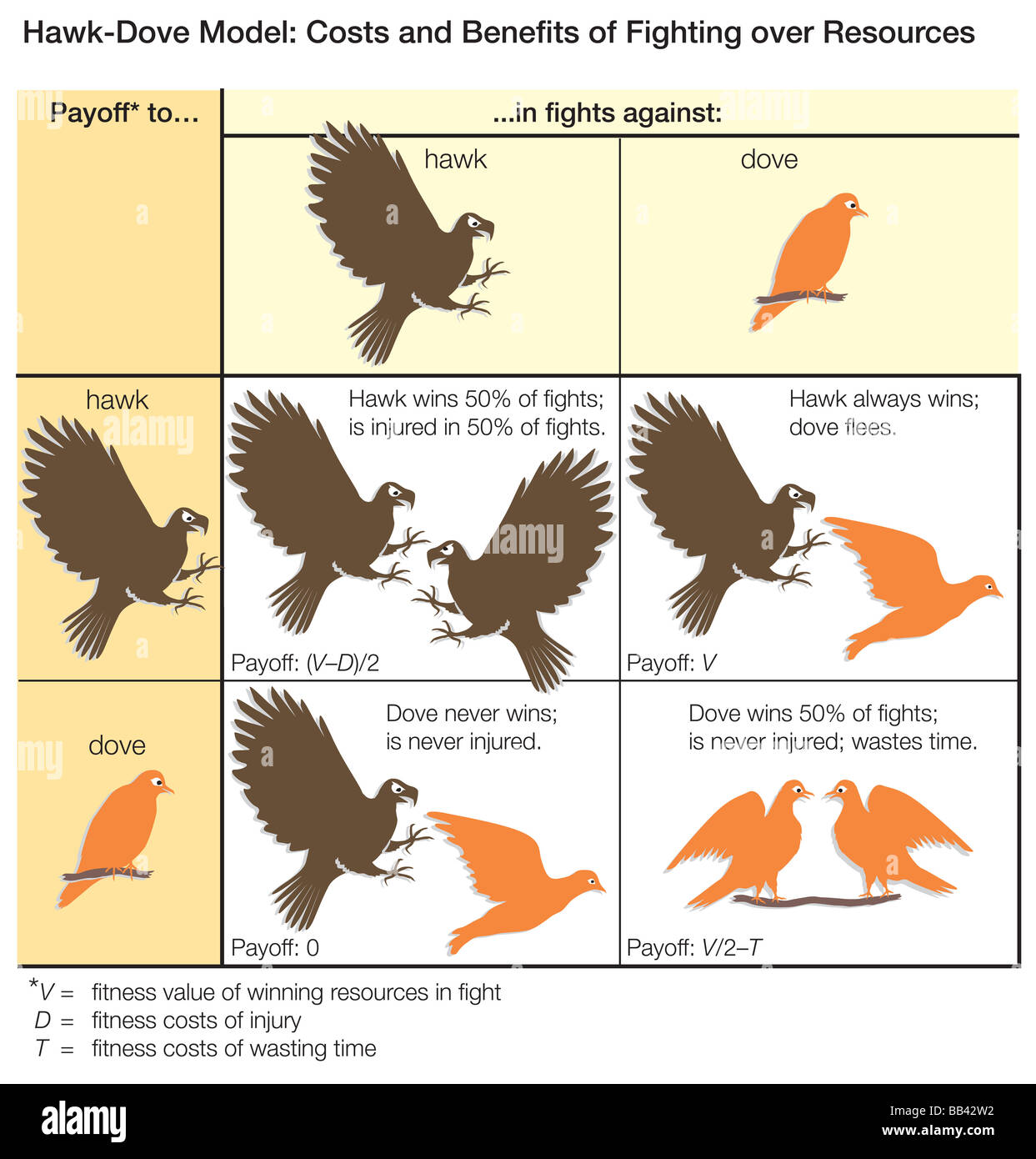
In our relationship scenario, we can define the variables as:
- V (Value): The value of winning the dispute (e.g., the satisfaction and security Alex gets from the "no overnight" rule being in place, or the freedom Beth gains from it not being there).
- C (Cost): The cost of a damaging fight. This represents the emotional harm, resentment, and potential long-term damage to the relationship that a major clash would cause. For simplicity, we'll use
Cinstead ofDfrom the image to represent this cost.
The payoffs for Player 1 (Alex) would look like this in a simple numerical example (V=10, C=20):
- H vs. H: Alex insists, Beth insists. A terrible fight ensues. Payoff: (V-C)/2 = (10-20)/2 = -5.
- H vs. D: Alex insists, Beth yields. Alex gets his rule. Payoff: V = 10.
- D vs. H: Alex yields, Beth insists. Beth gets her way. Payoff: 0.
- D vs. D: Both are conciliatory and compromise (e.g., agree to trial periods). Payoff: V/2 = 5.
This type of "mixed motive" game, where there is both a conflict of interest and a shared interest in avoiding the worst outcome, is an excellent model for many real-world disputes.
This paper, while focused on legal compliance, provides an excellent description of the Hawk-Dove game as a model for social conflict.
First, read the section "Background on Coordination Games and Focal Points" (to this paragraph). This introduces the idea of "mixed motive" games where players have conflicting preferences over outcomes but a shared interest in avoiding disaster. Next, read from the beginning of the subsection "The Focal Point Theory of Expressive Law" down to the description of the Hawk/Dove game payoffs (to this point). This section formally defines the game and provides relatable examples of how it models disputes.
Evolutionary Stability: When to Fight, When to Yield
Unlike the Prisoner's Dilemma, there is no single dominant strategy in the Hawk-Dove game. If you expect your partner to play Dove, your best move is Hawk. If you expect them to play Hawk, your best move is Dove. This leads to two pure-strategy Nash Equilibria: (Hawk, Dove) and (Dove, Hawk).
So, what should a rational player do? In evolutionary game theory, the answer is found by looking for an Evolutionarily Stable Strategy (ESS). An ESS is a strategy that, if adopted by most members of a population, cannot be bettered by any other strategy. It is a stable equilibrium.
In a symmetric Hawk-Dove game (where both players have the same V and C), the ESS is a mixed strategy. Players should play Hawk with a certain probability, p, and Dove with probability 1-p. The stable probability p is the point where the expected payoff of playing Hawk is equal to the expected payoff of playing Dove.
Given your background in statistics and probability, you'll recognize this is a simple expected value calculation. The expected payoff of playing Hawk against a mixed-strategy opponent is:
The expected payoff of playing Dove is:
Setting and solving for p, we find the equilibrium probability of playing Hawk is:
This result is profoundly intuitive. The rationality of escalating a conflict (playing Hawk) is directly proportional to the value of the prize (V) and inversely proportional to the cost of the fight (C).
- If an issue is incredibly important to you (high V) and you believe the fallout from a fight would be manageable (low C), it's rational to be more hawkish.
- If the issue is minor (low V) but a fight would be catastrophic for the relationship (high C), it's rational to be more dovish.
The graph below visualizes this concept. The fitness (payoff) of the Hawk strategy decreases as more Hawks are in the population (more costly fights). The fitness of the Dove strategy also decreases (more encounters with Hawks who take the whole resource). The stable point (the ESS) is where these two lines intersect.

Asymmetry and Dominance: When Partners Aren't Equal
The classic model assumes players are identical. In reality, relationships are full of asymmetries. One partner might be more stubborn, less conflict-averse, have stronger convictions on a particular topic, or perceive they have better outside options.
A sophisticated model of the iterated Hawk-Dove game incorporates this by introducing the concept of Resource Holding Potential (RHP). In an evolutionary context, this is an animal's physical strength. In a relationship context, we can think of RHP as a combination of:
- Resolve: How deeply a person cares about the issue.
- Emotional Resilience: The ability to withstand the stress of conflict.
- Perceived Power: Influence derived from factors like financial control, social status, or the desirability of one's alternatives.
When there's a significant asymmetry in RHP, the dynamics of the Hawk-Dove game change dramatically. Instead of a mixed strategy, the evolutionarily stable outcome is often a dominance hierarchy.
[PDF] Dominance, sharing, and assessment in an iterated Hawk-Dove game
This advanced paper models how asymmetries (differences in RHP) lead to stable dominance patterns in repeated Hawk-Dove games. Given your expertise, you can navigate the technical aspects to extract the core strategic insights.
First, read Section 2.1, "An iterated Hawk–Dove game with winners and losers" (up to the part about distributions). This explains how the standard model is modified to include a probability of winning, pA, based on differences in RHP. Next, read Section 3.1, "Stage-game classification and its implications" (to this point). This section is key. It shows how the nature of the game itself changes based on the expected payoffs, which are a function of pA. A conflict can shift from a "Snowdrift" game (where fighting is very costly) to a "Prisoner's Dilemma" depending on the power imbalance. Then, review Appendix C, "Pair behaviours associated with the PD TfT strategy" (read the entire appendix). Although it refers to a specific strategy (PD TfT), its analysis of the three resulting behaviors—dominance relationship, continual fights, and sharing—is a perfect summary of the possible outcomes based on the degree of asymmetry. Finally, read the "Conclusions and discussion" (Section 5) (up to the part about unknown RHPs). This powerfully summarizes the main finding: while sharing is stable under limited conditions, dominance hierarchies emerge readily in the face of asymmetries.
The core insight from this research is that when one partner has a sufficiently higher "Resolve and Power" (RHP) on an issue, the stable outcome is not a mix of Hawk and Dove plays. Instead, the partner with higher RHP consistently plays Hawk, and the partner with lower RHP learns to consistently play Dove. The initial conflicts serve as an assessment phase where partners test each other's resolve.
Let's revisit Alex and Beth with this new lens.
Scenario: Beth (Hotwife) wants to stop using a location-tracking app during her dates, a boundary Alex (Cuckold) feels is essential for his peace of mind.
- Beth's Position: She feels the app is a symbol of mistrust and undermines her autonomy. Her resolve on this issue is very high (High RHP). The emotional cost of feeling controlled is greater than the cost of a fight for her.
- Alex's Position: He values the security the app provides. However, he is highly conflict-averse and fears pushing Beth away (Low RHP on this issue compared to her).
Dialogue & Analysis:
Alex: "I know we talked about this, but I'm just not comfortable with you turning off the location sharing. It's a hard line for me." (Plays Hawk, testing the waters)
Beth: "And I'm not comfortable being tracked like a child. This isn't negotiable, Alex. It's about my autonomy. If we can't trust each other on this, it says something much bigger about our relationship." (Plays Hawk with extreme conviction, signaling very high RHP)
Alex: (Senses the intensity. He calculates the cost of this fight: days of tension, emotional distance, potentially jeopardizing the entire dynamic. The value of the app (V) seems small compared to this catastrophic cost (C). His RHP is lower.) "Okay... okay. I hear you. It makes me anxious, but... I understand. We won't use the app." (Switches to Dove)
In this exchange, the initial Hawk-Hawk confrontation served as an assessment. Alex learned that Beth's RHP on this specific issue was insurmountably high. The stable outcome becomes a dominance relationship on this boundary: Beth plays Hawk (gets her way), and Alex plays Dove (yields). This doesn't mean Alex is submissive on all issues, but on this one, an asymmetric equilibrium has been established.
Conclusion
Today we've moved from the cooperative world of Tit-for-Tat to the confrontational dynamics of the Hawk-Dove game. This has provided a formal structure for analyzing conflicts where compromise is difficult and the choice is between escalating and yielding.
Key Takeaways:
- The Hawk-Dove game models conflicts over a contested resource where players must choose between an aggressive "Hawk" strategy and a conciliatory "Dove" strategy.
- In symmetric games, the Evolutionarily Stable Strategy (ESS) is a mixed strategy, where the probability of playing Hawk is (the value of winning divided by the cost of fighting).
- In real-world relationships, asymmetries in resolve, emotional resilience, or power (Resource Holding Potential) are critical.
- Significant asymmetry often leads to a dominance hierarchy on a specific issue, where the partner with higher RHP consistently plays Hawk and the partner with lower RHP learns to play Dove to avoid costly, repeated fights. The initial conflicts function as an assessment period.
Preview of the Next Lesson:
We introduced the concept of an Evolutionarily Stable Strategy (ESS) today as it applies to a single conflict type. In our next lesson, we will broaden this perspective to explore how evolutionary stability can be used more generally to predict the long-term prevalence of various relationship strategies and norms, not just within a couple, but across an entire social community.