Welcome to the final lesson of our course. In our previous session, we constructed an in-depth case study, synthesizing a range of game-theoretic tools to analyze a relationship's entire lifecycle—from the initial signaling encounter to negotiating and enforcing new rules. That exercise represented the peak of what the rational choice framework can offer: a structured, logical way to dissect complex strategic interactions.
Today, we take a crucial step back. Our learning objective is to critically evaluate the limitations and assumptions of applying rational game theory models to complex human emotional dynamics. Throughout this course, we have equipped ourselves with a powerful analytical toolkit. Now, we must do what any good statistician or strategist does: rigorously examine the assumptions underlying our models. We will probe the core assumption of the "rational player" and explore sophisticated ways the field has evolved to account for the often messy, emotional, and seemingly irrational landscape of human relationships. This final lesson is not about discarding our tools, but about understanding their tolerances, refining their application, and appreciating the frontiers of what they can explain.
The Limits of Pure Reason in Relationships
The models we have studied—from simultaneous games to repeated bargaining—are largely built upon the foundation of a rational agent. This is an individual who has consistent preferences and acts to maximize their utility. But how well does this describe a person in the throes of jealousy, experiencing the warmth of compersion, or navigating the sting of betrayal?
Consider the intricate web of human relationships. The diagram below, which may resonate with the complexities you've encountered in your consulting work, illustrates a wide spectrum of non-monogamous arrangements.
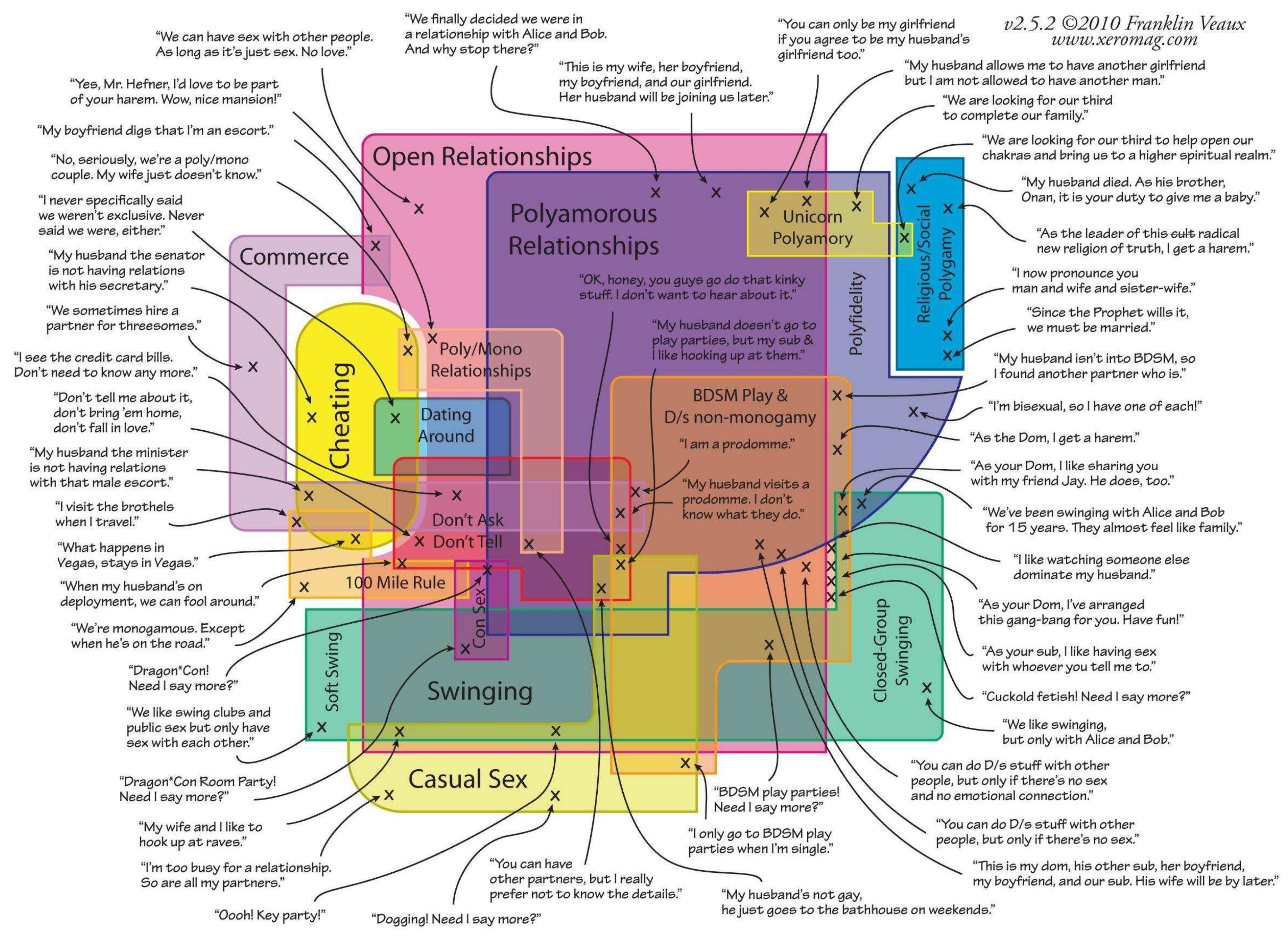
Each "x" on this chart could represent a couple or an individual navigating a unique emotional and strategic landscape. Classical game theory, with its assumption of rational utility-maximizers, might struggle to explain why someone stays in a "less optimal" box, or why they make choices that seem to decrease their material or social payoffs. The fundamental limitation is that human utility is not just about outcomes; it's profoundly influenced by emotions, which are, in turn, triggered by beliefs and expectations.
Psychological Game Theory: Putting Emotions in the Utility Function
Must we then abandon game theory when faced with emotion? Not at all. Instead, we can enrich our models. This is the domain of Psychological Game Theory (PGT), a framework designed to formally incorporate belief-dependent motivations into our analysis.
The core insight of PGT is that a person's utility from an outcome can depend on their beliefs. This includes their beliefs about what others will do, what others expect them to do, and what could have happened but didn't. This opens the door to formally modeling emotions like guilt, disappointment, anger, and even image concerns.
Belief-Dependent Motivations and Psychological Game ...
This paper by Pierpaolo Battigalli and Martin Dufwenberg provides a comprehensive overview of Psychological Game Theory. It's a foundational text for understanding how to move beyond the limitations of the purely rational player model.
To begin, please read the following sections: Introduction: Read Section 1, the introduction. It outlines the core purpose of PGT: to handle sentiments like emotions, reciprocity, and image concerns that traditional game theory cannot. Emotions: Read the introductory paragraphs of Section 3 on Emotions. This section frames the historical neglect of emotions in economics and psychology and sets the stage for their formal modeling. Modeling Specific Emotions: Now, focus on the subsections that are most relevant to relationship dynamics. Read the descriptions of how PGT models Guilt (3.1), Disappointment (3.2), and the frustration-aggression link in Frustration & Anger (3.3). As you read, consider these questions: How does defining utility in terms of a partner's expectations (as in the guilt model) change the strategic calculation in a negotiation? Think of a scenario from your consulting experience. Could the "frustration-aggression hypothesis" explain a conflict that seemed to escalate "irrationally"?
As you can see, PGT doesn't treat emotions as random noise. Instead, it provides a grammar for them. Guilt isn't just a feeling; it's a utility cost proportional to the gap between a partner's initial expectation and their actual outcome. This transforms a seemingly irrational emotion into a calculable factor in a strategic decision.
Quantifying The Irrational: The Concept of "Emotional Temperature"
While PGT provides a new language, can we quantify the degree to which emotions cause behavior to deviate from pure, cold rationality? A fascinating approach involves borrowing an analogy from physics and your own field of Operations Research: simulated annealing.
In optimization, simulated annealing allows a search algorithm to occasionally accept "worse" solutions (moving uphill) to escape local minima and find a better global optimum. The probability of accepting a worse solution is controlled by a "temperature" parameter, which is gradually cooled.
We can apply a similar idea to human decision-making.
The Influence of Emotion in Negotiations: A Game Theory ...
This paper by Chamoun and Hazlett proposes a framework for integrating emotional influence into game theory. Its concept of "emotional temperature" is particularly insightful.
Please read the following sections: First, read the section Emotions and Irrational Behavior. Pay close attention to the analogy with simulated annealing. This connects the idea of "hot" emotional states to a willingness to accept choices that seem objectively unfavorable. Next, read the section Taking Emotional Temperature. This is the core of the methodology. Focus on Equation (1) and the definition of the parameter q. This parameter represents the probability that a player will adopt the "energetically unfavorable" strategy, providing a direct measure of their deviation from pure utility maximization. The authors call this taking their "emotional temperature." Finally, skim the Examples section (Figure 4 and its accompanying text) to see how this emotional temperature is extracted from experimental data in a repeated Prisoner's Dilemma game. Notice how the temperature is higher and decays differently for "partners" versus "strangers," which is highly relevant for our study of relationships.
This concept gives us a mathematical tool to measure what we intuitively understand: when emotions run "hot," our decisions can seem random or counter-rational. By modeling this with a temperature parameter, we can analyze the probability of a partner making a "surprising" move that goes against their apparent self-interest, and we can model how this emotional state might evolve over the course of a repeated game (i.e., a long-term relationship).
Are We Playing the Wrong Game? The "Hidden Games" Perspective
So far, we've explored ways to fix our models of a given game. But what if the "irrational" behavior we observe is perfectly rational, but we're simply analyzing the wrong game?
This is the perspective of "Hidden Games," which argues that many of our puzzling behaviors—our sense of fairness, our altruism, our aesthetic tastes—are actually sophisticated, subconsciously-driven strategies in a game we're not even aware we're playing: the game of reputation, status, and social signaling.
"Hidden Games: The Surprising Power of Game Theory to Explain Irrational Human Behavior"
This talk, featuring the authors of the book "Hidden Games," offers a compelling perspective on how seemingly irrational human behavior can be explained as optimal strategies in subconscious, culturally evolved games.
Please watch these key segments: Human behavior is social and subconscious: The speakers argue that game theory doesn't require conscious strategizing. It can operate through cultural evolution and reinforcement learning, shaping our preferences and intuitions. Cultural vs. biological evolution: They distinguish their approach from classic evolutionary psychology. The "games" we play aren't just from the savannah; they are culturally specific and evolve quickly, explaining why different cultures have different norms and aesthetic values. The example of long fingernails is a perfect illustration of a costly signal in a specific cultural context. The hidden game of altruism: This is a fantastic case study. They argue that altruism is largely driven by reputation. This explains why we are often "ineffectively altruistic" – we prefer actions that are highly observable (like swinging a hammer for Habitat for Humanity) over actions that are more effective but less visible (like just donating the money). The key is that the act is a signal. Is it better that the game is hidden?: This Q&A segment touches on a crucial point. Not being consciously aware of the reputational game can make us more trustworthy. A calculated altruist is a Machiavellian; an intuitive altruist is a good partner.
The "Hidden Games" perspective offers a powerful re-framing for relationship dynamics. An act of jealousy that seems destructive might be a subconscious play in a hidden game of "commitment testing." A lavish gift that seems inefficient might be a costly signal of devotion. The preference for a certain "type" of bull might not be about maximizing physical pleasure but about signaling status or a particular identity within a social group. This moves the focus from "Is this person acting rationally?" to "What hidden game are they playing, and what are they signaling?"
Bounded Rationality and K-Level Thinking
There is one final, crucial limitation that applies even if players are emotionally calm and playing a well-defined game: cognitive capacity. Game theory often assumes players can perform infinitely deep chains of reasoning: "I think that you think that I think..." In reality, people's capacity for this is limited.
Game theory challenge: Can you predict human behavior? - Lucas Husted
This short, animated video provides a clear and concise explanation of a key concept in behavioral game theory: k-level reasoning.
Please watch the entire video (it's only about 4 minutes). Pay attention to three key ideas: The 2/3 Game: It shows the gap between the purely rational Nash Equilibrium (guessing 0) and how real people actually play. K-Level Reasoning: It explains the model where players have different "levels" of strategic depth. A k-level 0 player chooses randomly, a k-level 1 player best-responds to level 0 players, a k-level 2 player best-responds to level 1 players, and so on. Real-World Examples: It connects this abstract concept to practical situations like stock trading and penalty kicks.
In your work, you might model a negotiation between a couple. But is the husband reasoning at k-level 1 (what he thinks his wife wants), while the wife is at k-level 2 (what she thinks he thinks she wants)? This mismatch in strategic depth can lead to miscoordination and outcomes that are puzzling from a perfect rationality standpoint. Acknowledging bounded rationality means accepting that partners may not be irrational, just operating with different cognitive models of the game.
A Critical Look at the Critiques
We have now seen several ways to address the limitations of rational models. But these new, more complex models have limitations and critiques of their own. For a truly critical evaluation, we must turn the lens on our new tools.
Belief-Dependent Motivations and Psychological Game ...
Let's return to the Battigalli and Dufwenberg paper on PGT. The authors are well aware of the methodological challenges their framework introduces and they address them head-on.
Please read the sections under Further methodological considerations, specifically the parts addressing these questions: Is PGT too complex? The authors argue that while the framework is general, individual models can be simple and tractable. Identifiability and revealed preference: This is a deep methodological critique. If utility depends on unobservable beliefs, how can we ever identify the parameters of our model from observed choices? This will appeal directly to your statistical background. Game-form (in)dependence: Does a person have a "guilt parameter" they carry with them to every game, or is the motivation itself created by the specific strategic situation? Does PGT have predictive power? If PGT can explain more behaviors, does it risk explaining everything and predicting nothing? Reading these sections will provide you with the language and arguments used by experts at the frontier of the field to debate the validity and scope of their own models.
Conclusion: The Enlightened Strategist
This final lesson brings our journey full circle. We began by learning the crisp, clean rules of classical game theory. We built models of negotiation, signaling, and long-term cooperation. We then synthesized them into a comprehensive case study. And today, we have confronted the messy, emotional reality that those models often simplify.
Our key takeaways are:
- The rational player model is a powerful starting point, but its assumptions are its primary limitation when applied to the emotional domain of human relationships.
- We do not need to discard game theory. Psychological Game Theory (PGT) provides a formal language to incorporate belief-dependent emotions like guilt and anger directly into utility functions.
- Deviations from rationality can even be quantified, for example, using the concept of "emotional temperature" to model the likelihood of making a "hot-headed" decision.
- The "Hidden Games" perspective offers a paradigm shift: seemingly irrational behaviors may be perfectly rational solutions to subconscious games of reputation and signaling, shaped by cultural evolution.
- Finally, bounded rationality, illustrated by k-level thinking, reminds us that cognitive limits, not just emotions, constrain strategic play.
You embarked on this course to apply the rigor of game theory to the nuanced world of hotwife relationship negotiations. You are now equipped not just as a game theorist, but as an enlightened one. You have the tools to build the rational models, but you also have the critical framework to understand their limitations, to see the hidden games beneath the surface, and to appreciate that the most sophisticated model is the one that knows its own boundaries. This nuanced understanding is the true mark of an expert, both in game theory and in the complex art of human relationships.