Welcome to your penultimate lesson. Over the past several modules, we have assembled a powerful toolkit of game-theoretic models. We began with the foundational structures of games, moved through the complexities of information and bargaining, and explored the dynamics of repeated and evolutionary interactions. In our last lesson, we added Bayesian Networks, a formal method for modeling and updating beliefs under uncertainty. Now, we arrive at a crucial point in our journey: synthesis.
Today's learning outcome is to develop a case study analyzing a fictional relationship dynamic using the game-theoretic tools from the course. Rather than learning a new standalone concept, our goal is to weave together the threads of our previous discussions. We will construct a narrative and, at each stage, select and apply the most appropriate models from our toolkit to understand the strategic landscape. This exercise will demonstrate how different models can illuminate different facets of a single, evolving relationship, from the initial meeting to ongoing negotiation and conflict resolution.
Let's construct our case study around a fictional triad: Wendy (the hotwife) and Charles (her husband) are an established couple. They meet Mark, a potential recurring partner (or "bull"). We will follow their interactions and analyze the strategic challenges they face.
The Case Study: Wendy, Charles, and Mark
Stage 1: The Initial Encounter as a Signaling Game
When Wendy first meets Mark, both parties are operating under significant asymmetric information. Wendy knows her own boundaries, risk tolerance, and desires, but Mark does not. Mark knows his own intentions and character—whether he is genuinely respectful of the dynamic or simply a "user"—but Wendy does not. This is a classic setup for a signaling game, a topic we covered in Module 2.
The objective is for the "good" types to separate themselves from the "bad" types. A respectful Mark wants to send a credible signal of his character that a user cannot (or would not) want to mimic. Wendy, in turn, wants to signal the seriousness of her boundaries in a way that attracts the right partner while deterring the wrong one.

A costly signal, in the Spence tradition, might be the time and effort Mark invests in getting to know Wendy and Charles before any sexual activity. A "user," who is only interested in a quick hookup, would likely find this cost too high, making the signal credible. Conversely, Wendy might use a screening mechanism by asking pointed questions about consent, past experiences, and his understanding of the lifestyle. His answers—the content, tone, and thoughtfulness—serve as signals that help her update her beliefs about his type, much like the Bayesian network we built in the last lesson.
Stage 2: Conflict as a Hawk-Dove Game
Let's assume the initial signals are positive. Wendy and Mark have had a few successful dates, all within the rules established by Wendy and Charles. Now, a point of conflict arises. Mark, feeling more comfortable, suggests that he and Wendy start communicating directly via text for spontaneous meetups, bypassing the established rule that all scheduling goes through Charles.
This creates a classic conflict over a rule, which we can model as a Hawk-Dove game from Module 4.
- The Resource: The "prize" is control over the communication protocol.
- Hawk Strategy: To insist on one's preferred outcome. Mark plays Hawk by insisting on direct communication. Wendy/Charles play Hawk by rigidly refusing any change and threatening to end the arrangement.
- Dove Strategy: To yield to the other's preference. Mark plays Dove by immediately backing down. Wendy/Charles play Dove by immediately agreeing to his proposal.
The payoff structure, as you'll recall, looks something like this:
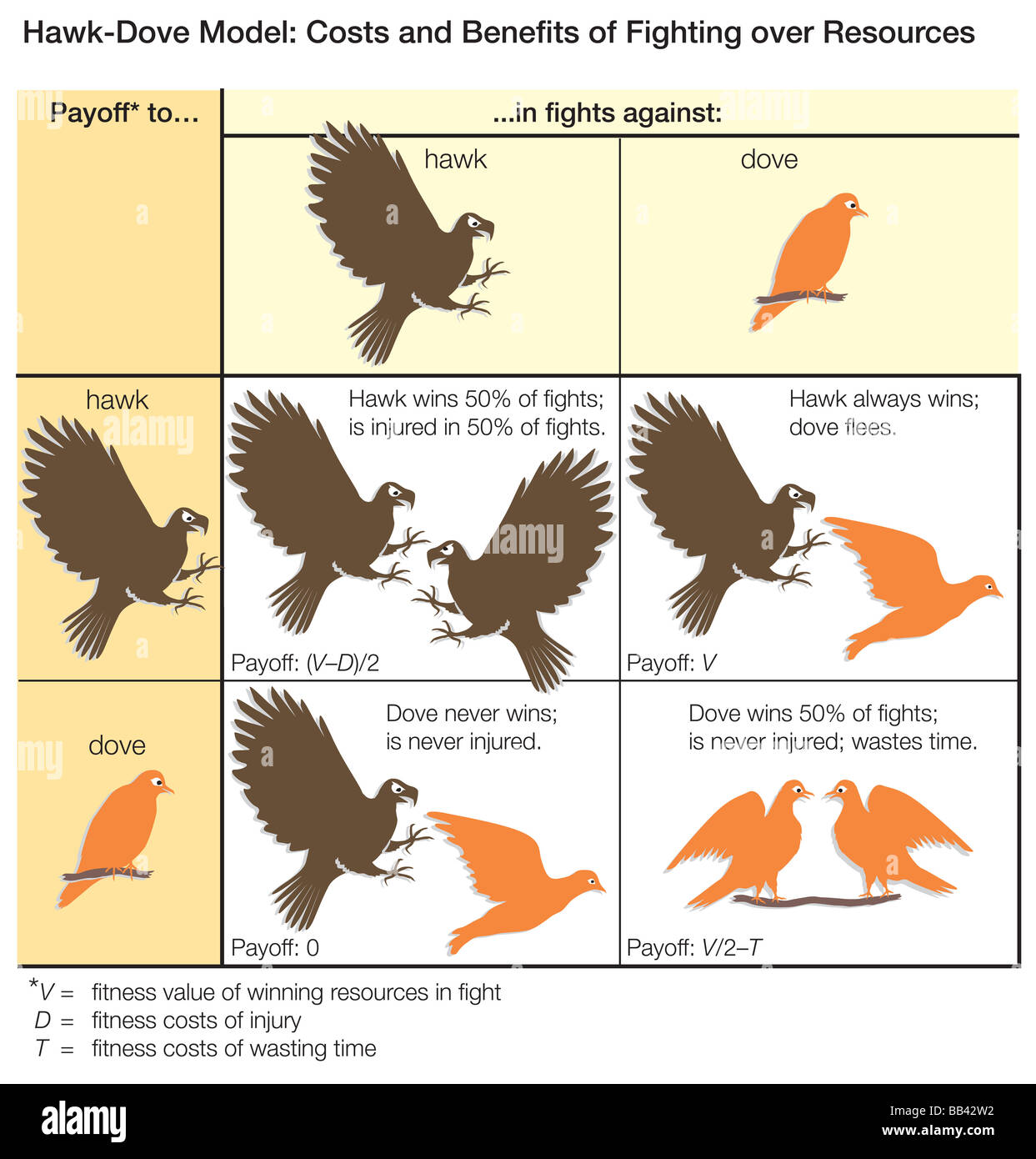
The key insight of the Hawk-Dove model is that while there is conflict (each player prefers to win), there is also a shared interest in avoiding mutual aggression (Hawk-Hawk), which is destructive for everyone. The question is, how do the players coordinate on one of the asymmetric equilibria (Hawk-Dove or Dove-Hawk) without escalating to a fight? The answer lies in their next move: negotiation.
Stage 3: The Negotiation - Analyzing Dialogue
The static Hawk-Dove game shows us the conflict, but the resolution happens in the dynamic process of communication. How can we model the evolution of preferences and commitments expressed in their conversation? For this, we will turn to a fascinating application of preference modeling from computational linguistics.
[PDF] Using Negotiation Dialogues to Predict Trades in a Win-Lose Game
This paper analyzes negotiation dialogues from the game The Settlers of Catan to predict which trades will be made. The authors model the dialogue using Conditional Preference Networks (CP-nets), a graphical model that represents evolving conditional preferences. This is a perfect tool for our case study, as it allows us to formally model a conversation. Given your background, you'll see the parallels between CP-nets for preferences and Bayesian Networks for beliefs.
Please read the following sections to understand their methodology: Introduction and The Game: Read the first two sections to understand the core idea. Notice the analogy: just as Catan players negotiate over resources like 'ore' and 'wheat', our trio negotiates over non-material resources like 'autonomy', 'security', and 'communication protocols'. CP-Nets: Read Section 5.1, which defines CP-nets. Pay close attention to the definition of a CP-net as a graphical model exploiting conditional preferential independence, similar to how a Bayesian Network exploits conditional probabilistic independence. Modeling and Updating: Read Sections 5.2 and the subsequent subsections on Offers, Counteroffers, Accepts, and Refusals. This is the core mechanism. It explains how different dialogue acts (e.g., "How about you text me, but copy Charles?") update the preference model. Prediction and Example: Finally, see how it all comes together. Read the first part of the next section on how to predict the final trade and then follow the detailed example walkthrough. This shows, step-by-step, how a dialogue is mapped to a series of evolving CP-nets that ultimately predict the negotiated outcome.
Let's apply this to our case. Imagine the following dialogue:
- Mark (Offer): "Things are going so well. I feel like it would be more spontaneous and fun if I could just text you directly when I'm thinking of you."
- Wendy (Counteroffer): "I appreciate that, but our rule about running things by Charles is really important for his comfort and our security. What if you texted both of us on a group chat?"
- Mark (Accept): "Okay, a group chat works. That's a great idea. I'm happy with that."
Using the logic from the paper, we can trace the preferences:
- Mark's Offer: Expresses a preference for
Direct TextoverStatus Quo. His CP-net now contains this. - Wendy's Counteroffer: She first
RefusestheDirect Textpreference, adding its negation to her CP-net. She thenOffersa new option,Group Chat. Crucially, this is conditional: she prefersGroup Chatgiven the context of changing the communication rule. Her CP-net now showsGroup Chat≻Direct Text. - Mark's Accept: Mark accepts the
Group Chatoption. His CP-net is updated. Now, both Wendy's and Mark's "best outcomes" align on theGroup Chatoption.
The CP-net model allows us to formalize the intuition of a negotiation, tracking how offers and counteroffers refine the space of possible agreements until an equilibrium—a mutually acceptable trade—is found.
Stage 4: The Resolution - Focal Points & Repeated Interactions
The negotiation is successful, and they agree on the "Group Chat Protocol." How does this new agreement stick? It works in two ways: as a focal point for coordination and as a rule to be enforced in a repeated game.
This paper provides the perfect theoretical bridge. It argues that laws and rules work not just through sanctions, but by creating focal points that help people coordinate, even in mixed-motive games like Hawk-Dove.
Please read the following sections: Read the Abstract and the Background on Coordination Games and Focal Points. This introduces Schelling's concept of a focal point and how third-party "cheap talk" can solve coordination problems. The new "Group Chat Protocol" is exactly this kind of cheap talk. Now, read how this applies to law and conflict in the section The Focal Point Theory of Expressive Law. The key idea is that our Hawk-Dove conflict can be resolved if a salient, shared rule guides expectations. Finally, look at the Experimental Design and Results. Skim the description of the four conditions (Control, Spinner, Random Leader, Merit-Based Leader). Then, look at Table 2 and the main finding: even a random, arbitrary signal (the spinner) significantly increased coordination and compliance compared to no signal at all.
The new "Group Chat Protocol" acts as that spinner. It's a clear, salient rule that both parties can coordinate around. It resolves the ambiguity of the Hawk-Dove game by providing a Schelling point. When Mark thinks about texting, the rule makes the "Group Chat" option psychologically prominent, and he expects Wendy to expect him to use it. This coordinates their behavior and avoids future conflict.
But what if he is tempted to violate the rule? This brings us to repeated games. The relationship is not a one-shot interaction. Its future value gives the players leverage to enforce the agreement.
This video provides a concise overview of strategies in repeated games, which are essential for long-term enforcement of agreements.
Watch the following segments: First, understand the core premise from the introduction. The key takeaway is that the prospect of future interaction can sustain cooperation where it would fail in a single-shot game. Next, learn about two classic enforcement strategies in the segment on Grim Trigger and Tit-for-Tat. Pay attention to the difference between the highly punitive Grim Trigger and the more forgiving Tit-for-Tat. Finally, see the mathematical logic from the breakdown of payoffs. The core idea is that a player will cooperate as long as the present value of future cooperation is greater than the one-time windfall from defecting.
Wendy and Charles can implicitly or explicitly adopt a trigger strategy to enforce the Group Chat Protocol:
- Grim Trigger: "If you text Wendy directly even once, this entire arrangement is over." This is a powerful deterrent but is brittle and leaves no room for error or forgiveness.
- Tit-for-Tat: "If you text Wendy directly, we will revert to the old 'all communication through Charles' rule for the next two weeks. If you follow the group chat rule, we'll continue with it." This is less punitive and allows for recovery from a mistake.
The choice of strategy depends on the discount factor—how much they value the future of the relationship. A high discount factor (they care a lot about the future) makes cooperation more likely and allows for enforcement.
Conclusion
In this case study, we have moved through a complete relationship arc and analyzed it with a sequence of integrated models:
- Signaling/Screening Games helped us model the initial challenge of learning about a new partner under asymmetric information.
- The Hawk-Dove Game allowed us to formally describe the structure of a conflict over a boundary.
- Conditional Preference Networks (CP-Nets) provided a novel method for analyzing the actual dialogue of a negotiation, showing how preferences evolve toward a compromise.
- Focal Point Theory explained why the resulting agreement is effective at guiding behavior and preventing future conflict.
- Repeated Game Theory gave us the enforcement mechanisms (like Grim Trigger and Tit-for-Tat) that ensure the agreement remains stable over time.
The most important takeaway is that no single model tells the whole story. The power of a game-theoretic analysis of relationships lies in its ability to deploy different tools to understand the strategic logic of each distinct phase of an interaction, from first impressions to long-term cooperation.
In our final lesson, we will take a step back from these rational models and conduct a critical evaluation, considering the limitations, assumptions, and ethical implications of applying this type of analysis to the deeply personal and emotional domain of human relationships.