In our last lesson, we examined the distinct roles of the lawyers, court staff, and journalists who operate within the justice system. Now, we will see how these professionals interact as we follow the path of a criminal case. Understanding this journey is essential for your work, whether you are providing legal support and need to anticipate the next procedural step, or reporting on a case and need to describe its status accurately.
This lesson directly addresses the learning outcome: to trace a criminal matter from arrest or charge through the magistrates’ courts and, where applicable, the Crown Court. We will map out the key stages, decision points, and the different routes a case can take depending on the seriousness of the offence.
From Report to Charge
The process begins long before a case reaches a courtroom. It starts when a crime is reported and the police conduct an investigation, gathering evidence. Once a suspect is identified and the investigation is complete, a crucial decision must be made: whether to charge the suspect.
For less serious offences, the police can make this decision. For more serious matters, the police pass the evidence to the Crown Prosecution Service (CPS), who act as the state's prosecutors. The CPS applies a two-stage test, known as the Full Code Test, before deciding to prosecute.
How Criminal Cases Work in the UK: From Report to Verdict | Woolfe & Co Solicitors
This guide from Woolfe & Co Solicitors provides a clear, stage-by-stage overview of the criminal justice process. Please read the section on the charging decision.
In the article, find "Stage Three: The Charging Decision". Read from the heading The Two-Stage Legal Test down to the end of that section. Pay close attention to the evidential and public interest tests, as these principles govern every prosecution in England and Wales.
If the case fails either test, no further action is taken. If it passes both, the suspect is charged and the court process begins.
The Three Paths: Classifying the Offence
The route a case takes through the courts is determined by the classification of the offence. There are three categories, and understanding them is fundamental to navigating the criminal justice system.
Criminal Courts # 1 - A General Outline
The YouTube channel The Law Bank offers concise explainers on core legal topics. This video provides a clear breakdown of the different classifications of criminal offences.
Watch the first part of the video, which outlines the three types of offences. The presenter explains summary, indictable, and either-way offences, giving examples of each and identifying which court typically hears them.
To summarise the key distinctions:
- Summary Only Offences: These are the least serious crimes, such as most motoring offences and common assault. They can only be tried in a magistrates' court.
- Indictable Only Offences: These are the most serious crimes, such as murder, rape, and robbery. They must be tried in the Crown Court before a judge and jury.
- Either-Way Offences: These fall in the middle and can be tried in either court. Examples include theft and assault occasioning actual bodily harm (ABH). The decision on where the trial takes place involves several steps, which we will explore next.
The Court Process: From First Hearing to Trial
All criminal cases, regardless of their classification, start in the magistrates' court. The following flowchart illustrates the possible routes a case can take.
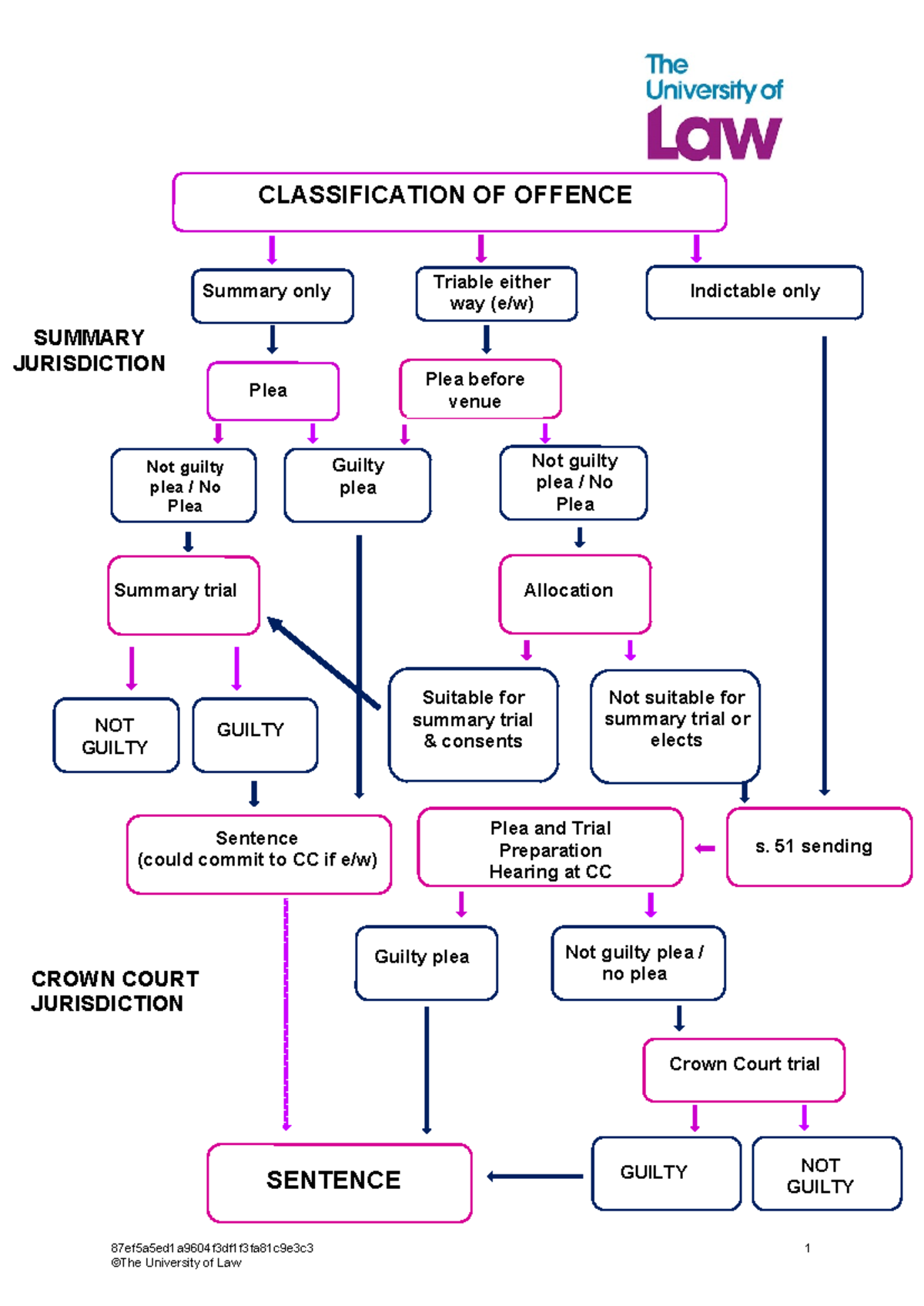
Let's break down this journey.
The Magistrates' Court Stage
The first hearing in the magistrates' court deals with preliminary matters. For all cases, this will involve confirming the defendant's identity, dealing with legal aid, and managing bail. What happens next depends on the offence type and the defendant's plea.
Criminal Courts # 2 - Procedure to Trial
This second video from The Law Bank details the specific procedures for each type of offence.
Please watch the following three segments: First, watch the section on summary offences, which outlines the straightforward process for minor crimes. Next, watch the more detailed explanation of the procedure for either-way offences. Focus on the "mode of trial" hearing and the factors influencing the decision to send a case to the Crown Court. Finally, watch the procedure for indictable offences, noting how quickly these cases are passed from the magistrates' to the Crown Court.
As you saw in the video:
- Summary cases: If the defendant pleads guilty, the magistrates will proceed to sentence. If they plead not guilty, a date is set for a trial in the magistrates' court.
- Indictable cases: These are purely administrative hearings in the magistrates' court. The case is formally "sent" to the Crown Court for the next stage.
- Either-way cases: This is the most complex path.
- Plea before venue: The defendant is asked to indicate their plea. If they plead guilty, they will be sentenced by the magistrates, unless the magistrates feel their sentencing powers are insufficient, in which case they will "commit" the defendant to the Crown Court for sentence.
- Mode of trial: If the defendant indicates a not guilty plea, the magistrates decide if the case is suitable for them to hear. They will consider the seriousness of the case and their sentencing powers (currently a maximum of 12 months' custody for a single either-way offence).
- Defendant's election: If the magistrates accept jurisdiction, the defendant is then given the choice: be tried by the magistrates or elect to be tried by a judge and jury in the Crown Court. If they elect Crown Court trial, the case is sent there.
The Crown Court Stage
When a case arrives at the Crown Court, either because it is an indictable-only offence or has been sent/committed from the magistrates' court, the process is managed through the "Better Case Management" (BCM) framework. The first key hearing is the Plea and Trial Preparation Hearing (PTPH).
The PTPH is central to the modern criminal process. It aims to ensure that everyone knows what the case is about at an early stage.
[PDF] The Better Case Management (BCM) Handbook
This handbook is a guide for legal practitioners on the BCM system. It provides authoritative detail on the Crown Court process. Your legal background will be helpful in navigating this practitioner-focused document.
Please read the following sections: First, read "3. The Plea and Trial Preparation Hearing (PTPH)". Pay attention to the subsections on Timing (3.3) and what happens in the event of Not Guilty Pleas (3.9). This establishes the purpose and structure of the hearing. Next, read the section on The four stages (3.12). This timetable is the roadmap for how a case is prepared for trial after the PTPH.
At the PTPH, the defendant is formally arraigned (the indictment is read out and they enter a plea).
- If the plea is guilty, the judge may sentence them immediately or adjourn for reports.
- If the plea is not guilty, the judge and the parties' advocates (barristers) will identify the key issues in the case and set a timetable for the trial preparation, using the four stages outlined in the BCM Handbook. This includes deadlines for the prosecution to serve its evidence and for the defence to respond with a Defence Statement.
Trial, Verdict, and Appeal
The culmination of this process is the trial.
- In the magistrates' court, this is a "summary trial" heard by two or three lay magistrates or a single District Judge, who decide both the facts and the law.
- In the Crown Court, this is a "trial on indictment" heard by a jury of 12 citizens, who decide the facts (i.e., whether the defendant is guilty or not guilty), and a judge, who directs them on the law.
In both courts, the prosecution must prove the defendant's guilt beyond reasonable doubt. If the jury or magistrates are not sure of the defendant's guilt, they must acquit (find them not guilty).
If found guilty, the defendant is convicted and will be sentenced. Following conviction or sentence, there may be a further step: an appeal to a higher court.
Conclusion
Today, we have traced the procedural map of a criminal case in England and Wales. We've seen that the journey is determined primarily by the seriousness of the offence, which dictates whether the case is resolved in the magistrates' court or proceeds to the Crown Court.
Key Takeaways:
- All criminal cases begin in the magistrates' court.
- The classification of an offence as summary, either-way, or indictable determines its path.
- For either-way offences, a "mode of trial" hearing determines whether the case is heard by magistrates or sent to the Crown Court, with the defendant having the final say if magistrates accept jurisdiction.
- In the Crown Court, the Plea and Trial Preparation Hearing (PTPH) is the crucial first hearing for managing the case and setting a trial timetable.
- The trial itself involves the prosecution proving its case beyond reasonable doubt, culminating in a guilty or not guilty verdict.
In our next lesson, we will zoom out from the court process itself. When things go wrong—not in a criminal sense, but in terms of service or administration—who provides oversight? We will learn how to map allegations of failure or misconduct to the correct regulatory, oversight, or ombudsman body.