Welcome to the third lesson in our module on the justice system and reporting. In our previous lesson, we traced the path of a criminal case through the courts. Today, we step back and look at the broader accountability landscape. What happens when the system, or the professionals within it, fall short? Answering this is vital for your future work, whether in a legal support role guiding a client or as a legal journalist investigating a systemic failure.
This lesson is designed to help you master the learning outcome: to map an allegation of systemic administrative failure, professional misconduct, or poor legal service to the appropriate regulator, ombudsman, inspectorate, or judicial oversight body in England and Wales. We will create a conceptual map of this complex world, ensuring you can confidently identify the correct port of call for any given issue.
The Accountability Framework: A Map of Oversight
When faced with a potential injustice, the first step is to correctly categorise the problem. Is it a one-off instance of poor service? Is it a serious breach of professional ethics? Or is it a systemic failure within a public institution? The answer determines where to turn. The landscape can be broadly divided into:
- Regulators: Bodies that set standards for and police the conduct of professionals.
- Ombudsmen: Independent services that resolve complaints about service quality.
- Inspectorates: Bodies that assess the performance and effectiveness of entire organisations (like the police or prisons).
- Judicial Oversight: Mechanisms to challenge court decisions or the conduct of judges.
Let's begin by looking at the legal professions themselves.
Part 1: Complaints Against Legal Professionals
A common source of confusion is the difference between a complaint about poor service and one about professional misconduct. This distinction is critical because it directs the complaint to two different types of bodies.
A great way to understand this is to watch this interview with Mark Neal, the Director General of the Bar Standards Board (BSB).
What does the Bar Standards Board do (and not do)?
This video from the BlackBeltBarrister channel features an interview with the head of the BSB. It clearly explains the different remits of professional regulators and the Legal Ombudsman.
Please watch the section from the beginning of the discussion on the distinction between the BSB and the Legal Ombudsman. Pay close attention to how he separates complaints about the service you receive from breaches of the professional code of conduct.
As you heard, the two main avenues are:
-
Poor Service (The Legal Ombudsman): If a client's lawyer is slow, fails to communicate, or provides an unclear bill, this is a service-level issue. The primary body for resolving these is the Legal Ombudsman, which acts as an impartial adjudicator for consumers.
-
Professional Misconduct (Regulators): If a lawyer is dishonest, misleads the court, misuses client money, or breaches confidentiality, this is a conduct issue. This is the territory of the professional regulators.
The image below, from the Legal Services Board, provides a clear visual map of the main regulators for legal professionals in England and Wales.

The two most significant regulators for court work are:
- Solicitors Regulation Authority (SRA): Regulates solicitors.
- Bar Standards Board (BSB): Regulates barristers.
These bodies investigate misconduct and can impose sanctions, from fines to striking a professional off the register, thereby preventing them from practising. They are overseen by the Legal Services Board (LSB), which ensures the entire regulatory framework is working in the public interest.
Your legal background and experience in the law clinic likely gave you some exposure to professional standards. The key takeaway here is this two-track system: the Legal Ombudsman for consumer service complaints, and the SRA/BSB for ethical and conduct breaches.
Part 2: Oversight of the Wider Justice System
Beyond lawyers, the major institutions of the justice system—police, prosecutors, and prisons—each have their own bespoke accountability structures. The comprehensive report Criminal justice systems in the UK from the Centre for Crime and Justice Studies is an excellent guide to this.
[PDF] Criminal justice systems in the UK
This report provides a detailed breakdown of the governance, inspection, and complaints mechanisms for each part of the criminal justice system. As a future journalist analysing policy, this level of detail is invaluable.
For this lesson, focus on the sections covering England and Wales. Read the 'Complaints' section for the Police (pages 16-17), which introduces the IOPC. Read the 'Inspection' and 'Complaints' sections for the Prosecution service (pages 26-27), detailing HMCPSI and the IAC. Read the 'Inspection' and 'Complaints' sections for Prisons (pages 47-49), covering HMCIP and the PPO.
Let's synthesise the key bodies from that reading:
-
Police:
- Independent Office for Police Conduct (IOPC): Investigates the most serious complaints against the police, such as deaths in custody or allegations of serious corruption.
- HM Inspectorate of Constabulary and Fire & Rescue Services (HMICFRS): Doesn't handle individual complaints, but inspects the efficiency and effectiveness of police forces, often producing thematic reports that are goldmines for journalistic investigation.
-
Crown Prosecution Service (CPS):
- Independent Assessor of Complaints (IAC): For complaints about service standards, not the legal decision to prosecute.
- HM Crown Prosecution Service Inspectorate (HMCPSI): Inspects the performance of the CPS.
- Victims' Right to Review (VRR): A specific scheme allowing a victim to request a review of a decision not to charge or to stop a case.
-
Prisons and Probation:
- Prisons and Probation Ombudsman (PPO): Investigates individual complaints from prisoners, people on probation, and those held in immigration detention. It also investigates all deaths that occur in custody.
- HM Inspectorate of Prisons (HMCIP): Inspects conditions and treatment in prisons, young offender institutions, and immigration detention facilities. Its reports provide critical, independent evidence of systemic issues.
Part 3: Challenging the State and the Judiciary
What if the failure lies not with a specific professional but with a government body, or even a judge?
Public Body Failures: The Role of the Ombudsman
Ombudsmen are a crucial tool for holding public administration to account. They are independent, free to use, and can investigate complaints of "maladministration"—where a public body has acted wrongly or unfairly.
A Guide to Ombudsman Offices in the UK
This guide is a practical directory of the ombudsman landscape. It's a useful resource to bookmark for future reference.
First, read the introductory section, "Role of an Ombudsman", to understand their function. Then, skim the entries for the Legal Ombudsman, the Local Government & Social Care Ombudsman, and the Parliamentary and Health Service Ombudsman to see their specific jurisdictions. Finally, glance at the table of "Other Complaint Handling Bodies" at the end to appreciate the diversity of schemes, such as the Information Commissioner's Office (ICO) for data protection and freedom of information issues.
The key bodies for general public services are:
- Parliamentary and Health Service Ombudsman (PHSO): For complaints about UK government departments (like the Home Office or MoJ) and the NHS in England.
- Local Government and Social Care Ombudsman (LGSCO): For complaints about local councils, adult social care providers, and some other local bodies in England.
Judicial Oversight
Judges themselves are also subject to oversight, but it's crucial to separate complaints about their personal conduct from challenges to their legal decisions.
- Judicial Conduct: If a judge is, for example, rude, falls asleep, or displays bias, a complaint can be made to the Judicial Conduct Investigations Office (JCIO). The JCIO investigates the personal conduct of judicial office holders.
- Judicial Decisions: Disagreeing with a judge's ruling is not a matter for the JCIO. The correct path is through the appeals process, which we touched on in the last lesson.
- Miscarriages of Justice: In the rare and serious instance where the entire appeals process has been exhausted but a person is believed to have been wrongly convicted, the case can be referred to the Criminal Cases Review Commission (CCRC). The CCRC has the power to refer a case back to the Court of Appeal.
Part 4: Avenues for Systemic Change
Sometimes, the issue isn't just one bad decision, but a failing system. For a journalist or policy-focused professional, identifying routes to challenge these systemic problems is essential.
'Super-Complaints'
A powerful but specific tool is the 'super-complaint'. Designated organisations (like charities and consumer groups) can raise a complaint about a systemic issue in policing that is harming the public.
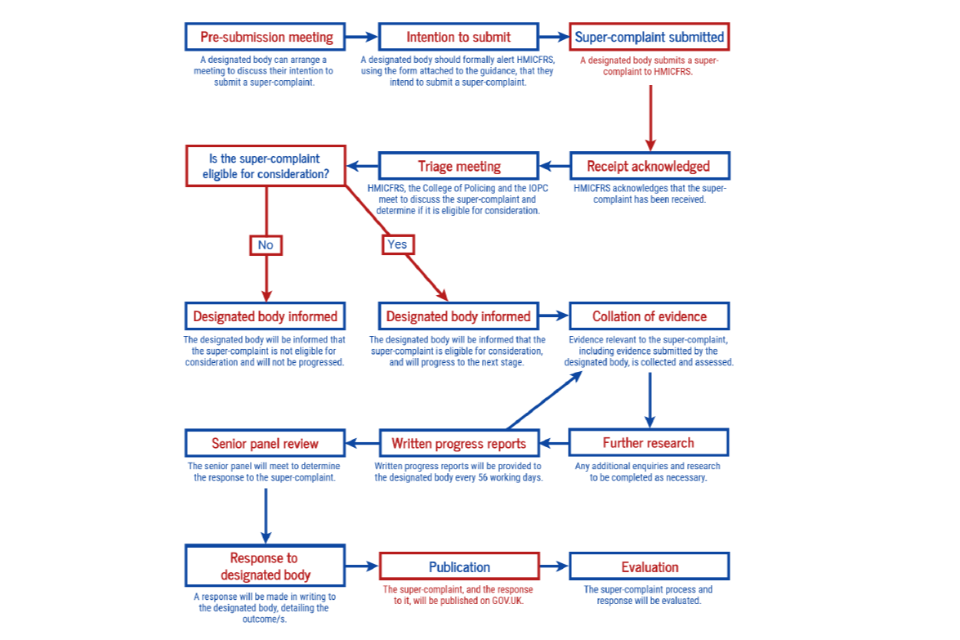
As the flowchart shows, a super-complaint triggers a formal investigation by the police inspectorate (HMICFRS), the police conduct office (IOPC), and the College of Policing, leading to a published report with recommendations. This is a mechanism designed specifically for tackling widespread problems.
Judicial Review: The Ultimate Backstop
The final and most powerful tool for challenging the actions of any public body is Judicial Review (JR). This is not an appeal. It's a High Court process that examines the lawfulness of the decision-making process itself, not the merits of the decision reached.
Explainer: What is judicial review?
This explainer from Cambridge Law Faculty provides a concise and clear introduction to the principles of judicial review.
Watch the first few minutes covering two key points: The definition of judicial review: a challenge to the way a decision was made, from the start of the explanation. The concept of JR as a "remedy of last resort," meaning other avenues like ombudsmen must usually be tried first, from this important point.
As the video explains, a court in a judicial review can get involved if a public body has acted:
- Illegally: Acting beyond its given powers.
- Irrationally: Making a decision so unreasonable that no reasonable authority could have made it.
- With Procedural Impropriety: Failing to follow the correct procedure or acting unfairly.
For a legal journalist, understanding that judicial review exists as the ultimate check on the power of the state is fundamental. It is often the vehicle for major legal challenges that have wide-ranging public interest implications.
Conclusion
Today we've constructed a comprehensive map of the accountability landscape in England and Wales. You can now trace a grievance from a simple service complaint to a full-blown High Court challenge.
Key Takeaways:
- Legal Professionals: Distinguish between poor service (Legal Ombudsman) and professional misconduct (SRA for solicitors, BSB for barristers).
- Justice Institutions: Each has a dedicated complaints and inspection body (IOPC/HMICFRS for police, IAC/HMCPSI for prosecutors, PPO/HMCIP for prisons).
- Public Services: General failures in government are handled by Ombudsmen (PHSO for central government/NHS, LGSCO for local government).
- The Judiciary: Personal misconduct is for the JCIO; incorrect legal decisions are for the appeal courts; wrongful convictions are for the CCRC.
- Hierarchy of Redress: The system has a clear hierarchy, from internal complaints, to ombudsmen or regulators, with Judicial Review as the ultimate legal backstop.
To help you navigate this, here is a simplified decision tree:
In our next lesson, we will build directly on this foundation. Now that you know who holds the system to account, we'll focus on how to convert a broad concern about injustice into a specific, evidence-testable public-interest question—the first and most critical step in any piece of legal journalism or policy analysis.