Welcome to the next lesson in our journey through the mathematical foundations of computer science and engineering. In our previous session, we populated our "visual library" with the shapes of polynomial, exponential, and logarithmic functions. Today, we add a new and profoundly important family to this collection: trigonometric functions.
While you may have encountered these functions in high school, likely in the context of right-angled triangles, today we will explore them from a more powerful and general perspective: the unit circle. This approach is the key to understanding how these functions describe anything that involves rotation, oscillation, or waves. From the angle of a robot's joint to the alternating current in an electrical circuit, or the signals processed in AI, trigonometric functions provide the mathematical language.
Our goal is to define all six trigonometric functions using the unit circle and to understand and apply their most fundamental relationships, known as the Pythagorean identities.
1. The Unit Circle: A New Perspective
You likely remember the mnemonic "SOHCAHTOA" for finding sine, cosine, and tangent from the sides of a right triangle. This is a useful starting point, but it's limited to angles between 0 and 90 degrees. To generalize these functions to all possible angles, we use the unit circle.
The unit circle is simply a circle with a radius of 1, centered at the origin (0,0) of the Cartesian plane. The beauty of this construction is that it allows us to define the trigonometric functions for any angle.
An angle is measured counterclockwise from the positive x-axis. The point (x, y) where the terminal side of the angle intersects the circle becomes the basis for our definitions.
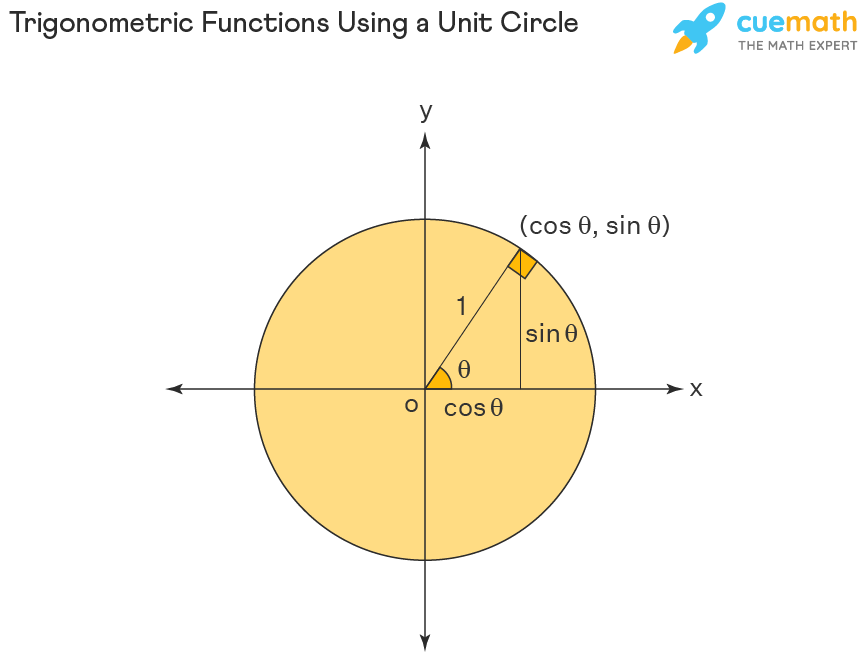
The core idea is this:
- The cosine of the angle is the x-coordinate of this point.
- The sine of the angle is the y-coordinate of this point.
So, for any point (x, y) on the unit circle corresponding to an angle :
This is the foundational definition from which everything else in trigonometry flows. It elegantly extends the concepts of "adjacent" and "opposite" sides to a full 360-degree rotation and beyond.
To formalize this, please review the following text, which clearly lays out this unit circle approach.
Section 4.2: Trigonometric Functions: Unit Circle Approach
This resource from Lumen Learning introduces the unit circle and provides the formal definitions for the sine and cosine functions based on it.
Please read the first two parts of the webpage: Read the introductory section, "Section 4.2: Trigonometric Functions: Unit Circle Approach," which explains what the unit circle is and how an angle t relates to a point (x, y). This is found from the beginning. Continue to the next section, "Defining Sine and Cosine Functions," which explicitly states that cos(t) = x and sin(t) = y.
2. The Full Family: Six Trigonometric Functions
Sine and cosine are the two parent functions of trigonometry. The other four functions—tangent, cosecant, secant, and cotangent—are defined directly from them.
- Tangent (): The ratio of sine to cosine.
- Cosecant (): The reciprocal of sine.
- Secant (): The reciprocal of cosine.
- Cotangent (): The reciprocal of tangent (and the ratio of cosine to sine).
Notice that some of these functions will be undefined when their denominator is zero. For example, is undefined when , which occurs at 90° and 270°.
The following resource formally defines these four functions.
Section 4.2: Trigonometric Functions: Unit Circle Approach
Continuing with the Lumen Learning article, this section introduces the remaining four trigonometric functions.
Please read the section titled "Find exact values...". Focus on the definitions of tangent, secant, cotangent, and cosecant as ratios of x and y (and thus of cosine and sine).
While these ratio definitions are essential, there's a beautiful geometric way to visualize all six functions simultaneously. The following short video shows how each function corresponds to the length of a specific line segment in a diagram built around the unit circle. This provides a deep, visual intuition for how they all relate.
Trig Visualized: One Diagram to Rule them All (six trig functions in one diagram)
This video from Mathematical Visual Proofs offers a powerful diagram that visualizes all six trigonometric functions as lengths.
Watch from the beginning to see the construction. Observe how: sin(θ) and cos(θ) are sides of a triangle inside the circle. tan(θ) and sec(θ) are sides of a larger, similar triangle built on the x-axis. cot(θ) and csc(θ) are sides of another similar triangle built on the y-axis.
3. The Pythagorean Identities: The Rules of the Game
The most fundamental relationship in trigonometry comes directly from the equation of the unit circle itself. As you know, any point (x, y) on a circle of radius r centered at the origin satisfies the equation . For the unit circle, the radius r is 1, so the equation is:
Now, by simply substituting our definitions and , we arrive at the fundamental Pythagorean Identity:
This identity is a cornerstone of mathematics. It holds true for any angle and establishes a non-negotiable link between the sine and cosine of that angle.
From this single identity, we can derive two others:
- Deriving the tangent-secant identity: Divide every term of the main identity by . This simplifies to:
- Deriving the cotangent-cosecant identity: Divide every term of the main identity by . This simplifies to:
The following resource walks through the derivation of these identities and, more importantly, shows how to apply them to solve a common type of problem: finding one trigonometric value when you know another.
Section 4.2: Trigonometric Functions: Unit Circle Approach
This section of the Lumen Learning text focuses on the Pythagorean Identity.
Please read the part titled "The Pythagorean Identity." Pay close attention to the derivation of the identity from the unit circle equation. Then, study Example 3 carefully. It demonstrates how to use the identity to find \cos(t) when you are given \sin(t) and the quadrant. Knowing the quadrant is crucial for determining the correct positive or negative sign.
4. Special Angles and Their Values
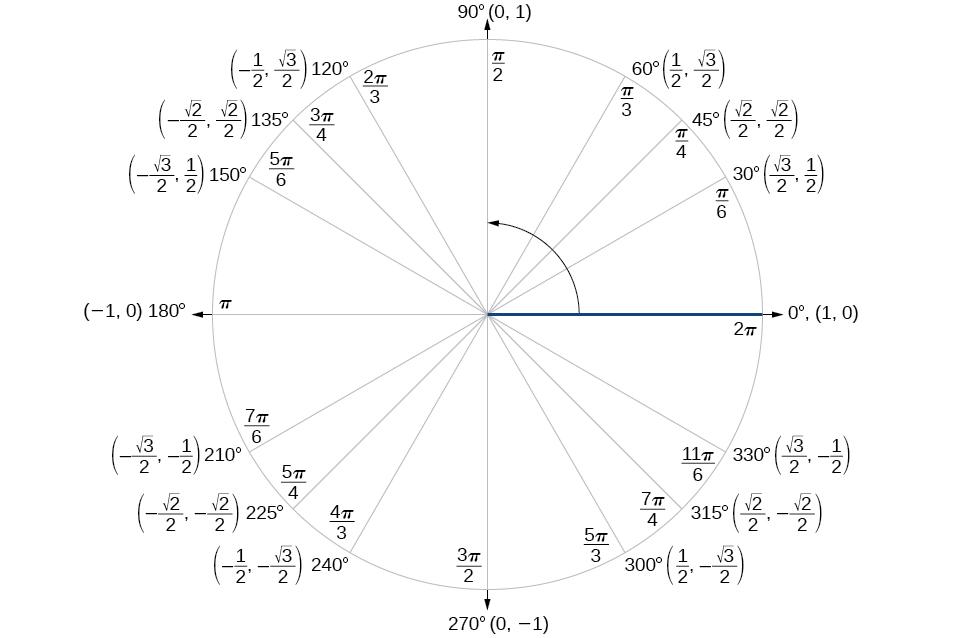
You don't need a calculator to find the trigonometric values for certain "special" angles—multiples of 30° ( radians) and 45° ( radians). We can find their exact (x, y) coordinates using simple geometry.
Instead of memorizing a table of values, it's far more effective to understand the pattern. The following video provides an intuitive method that requires you to know only three numbers, which correspond to the "small," "medium," and "large" coordinate values you'll encounter in the first quadrant.
Trigonometry Concepts - Don't Memorize! Visualize!
This video from Dennis Davis provides an excellent, memory-free way to understand the values of sine and cosine for all the common angles around the unit circle.
Please watch the segment from The Unit Circle. The key takeaways are: The re-framing of sin(θ) as the y coordinate and cos(θ) as the x coordinate on the unit circle. The geometric proofs for the values at 30°, 45°, and 60°. Since you prefer understanding the theory, these proofs show exactly why the values are what they are. The "large, medium, small" mnemonic: \frac{\sqrt{3}}{2}, \frac{\sqrt{2}}{2}, and \frac{1}{2}. The video explains how to assign these values to the x and y coordinates just by looking at the angle on the circle, which is a very powerful technique for building intuition.
By understanding the symmetry of the circle and the signs of x and y in each of the four quadrants, you can use these three values to find the sine and cosine of any special angle.
Conclusion
Today we've redefined trigonometric functions through the lens of the unit circle, a perspective that is essential for their application in advanced topics. This view transforms them from simple triangle ratios into a powerful system for describing periodic phenomena.
Here are the key takeaways:
- For any angle , the point
(x, y)on the unit circle gives its two fundamental trigonometric values: and . - The other four trig functions () are all defined as simple ratios or reciprocals of sine and cosine.
- The equation of the unit circle gives rise to the fundamental Pythagorean Identity, , which is the most important trigonometric relationship. Two other Pythagorean identities can be derived from it.
- The values for special angles can be determined through geometry and patterns, not just memorization.
This lesson concludes the first module on mathematical foundations. You now have a basic toolkit of functions (algebraic, exponential, logarithmic, and trigonometric) and concepts (coordinate systems, notation) that will serve you well. In our next lesson, we will make a significant shift and begin our journey into programming by setting up your Python environment and writing your very first code.