Hello. This module turns from the tools jurists use to the communities of scholarship that preserve and apply those tools. Earlier in the course, you encountered the distinction between religious sources and juristic interpretation, along with reasons jurists may reach different conclusions. Here, you will see why disagreement does not necessarily split a legal school: a madhhab can preserve a shared method and body of scholarship without requiring every jurist to give the same answer.
This lesson takes about 35–40 minutes. A disagreement within the Mālikī school will provide the main example; a diagram of Ḥanafī legal reasoning will show how another school can organize disagreement.
What belongs to a school?
A madhhab is a tradition of interpreting and applying Islamic law. It has inherited methods, texts, arguments, and recognized authorities—not simply a list of rulings attributed to its founder. That distinction matters because a founder’s students and later jurists can reason within the tradition while disagreeing with the founder or with one another.
Imam Omar Suleiman The Four Imams Why & How to choose a Madhab
In “The Four Imams: Why & How to Choose a Madhab,” Imam Omar Suleiman describes a school as a framework for deriving rulings rather than a fixed catalogue of answers. Watch for that distinction.
Watch the framework. The key claim begins when the speaker contrasts methodological principles with a static list of verdicts; the examples that follow illustrate why one school can contain multiple opinions.
The following reading adds a historical dimension. A school lasts because scholars teach its methods, preserve earlier arguments, and evaluate proposed rulings against what others in the tradition have established. Continuity does not mean repetition: a later jurist’s view may become influential precisely because other scholars examine and adopt it.
What is a Madhhab? Exploring the Role of Islamic Schools of Law
Read the opening portions of “What is a Madhhab?” from the Yaqeen Institute for the distinction between a shared methodology and loyalty to one person. Then read the relevant paragraph of “The growth of the madhhabs” for a picture of scholarly debate within a school.
In “What is a Madhhab?”, read from the opening paragraph beginning “Since Islam does not have an ecclesiastic body” through the paragraph’s explanation of shared methodology. Later in that same section, begin at “A common misconception” and read founders and successors through the end of the section. Notice the Ḥanafī examples of positions associated with the founder’s associates, and the distinction between an opinion within a school and its relied-on position. In “The growth of the madhhabs,” go below the historical chart to the paragraph beginning “It is important to highlight.” Read the collective process through the paragraph’s end. Focus on debate, revision, and preservation rather than the names in the chart.
The Ḥanafī examples make an important point: “the Ḥanafī view” need not mean “whatever Abū Ḥanīfa personally said.” An opinion associated with a student or later scholar can carry substantial weight within the Ḥanafī tradition. Nor does the existence of several recorded opinions mean that all of them are equally likely to be given as the school’s usual guidance. Jurists also consider which position the tradition has come to rely upon.
A concrete disagreement inside the Mālikī school
Consider a traveler who has stopped at a place during a journey and wants to combine two prescribed prayers. The issue is not whether prayer matters, but whether the permission to combine prayers during travel applies while the traveler is staying temporarily in one place, rather than actively moving. According to the account in the next video, some Mālikī jurists allowed combining in that situation, while another view became the predominant one used when advising people within the school.
Danger of not Following a Madhab - Origin of Madhabs Explained - Shaykh Hamza Yusuf
In “Danger of not Following a Madhab – Origin of Madhabs Explained,” Shaykh Hamza Yusuf uses Mālikī opinions on combining prayers during travel to show the difference between a recorded internal view and the position ordinarily given in a fatwa.
In the section on branches of the Mālikī school, start at the travel example. Listen for the contrast between jurists who allowed combining while a traveler was staying in one place and the predominant position described for advising an inquirer. The discussion of mashhūr near the end concerns a predominant school position, not the disappearance of dissenting views.
This example shows two kinds of continuity at once. The jurists remain participants in a recognizable Mālikī tradition, even though they reach different answers to a particular question. At the same time, a mufti—someone giving a juristic opinion—may ordinarily present the position that has gained authority within that tradition, rather than select any recorded view at will.
Predominant does not mean unanimous. A minority position can remain part of the school’s scholarship and still not be its default answer. The exact criteria for preferring opinions vary among schools and across their histories; a short description of a “Mālikī position” should therefore not be mistaken for an account of everything Mālikī jurists have said. The travel example explains how disagreement is accommodated, not which ruling someone should personally follow.
Preserving disagreement without treating every opinion alike
Legal schools developed ways to record competing opinions and to indicate which ones carry greater authority for ordinary guidance. The Islamic Law Lexicon describes this distinction using the term mashhūr for a predominant opinion. Its central point for this lesson is practical: a jurist arguing for a different view must engage with established school scholarship, not pretend it does not exist.
Islamic Law Lexicon :: Madhhab – Islamic Law Blog
Read the Islamic Law Blog’s account of how a school handles multiple opinions. It will help distinguish an internally argued disagreement from an isolated personal preference.
In the section beginning “It is worth noting,” read weighted opinions to the end of that paragraph. Then read the next paragraph, beginning “In general, scholars of Islamic law issue advisory opinions,” through its sentence ending “their own schools.” Focus on why an advisory opinion draws on earlier scholarship. Treat the terminology as an introduction, not as a single ranking formula that works identically in every school.
The supplied Ḥanafī diagram makes that process visible in another tradition. Read its rows as illustrations of questions a mufti might face: Is there established doctrine for this case? If early authorities disagree, which views have standing within the school? If the case is new, have later jurists reached an accepted resolution? If not, how should the school’s methods guide further reasoning?
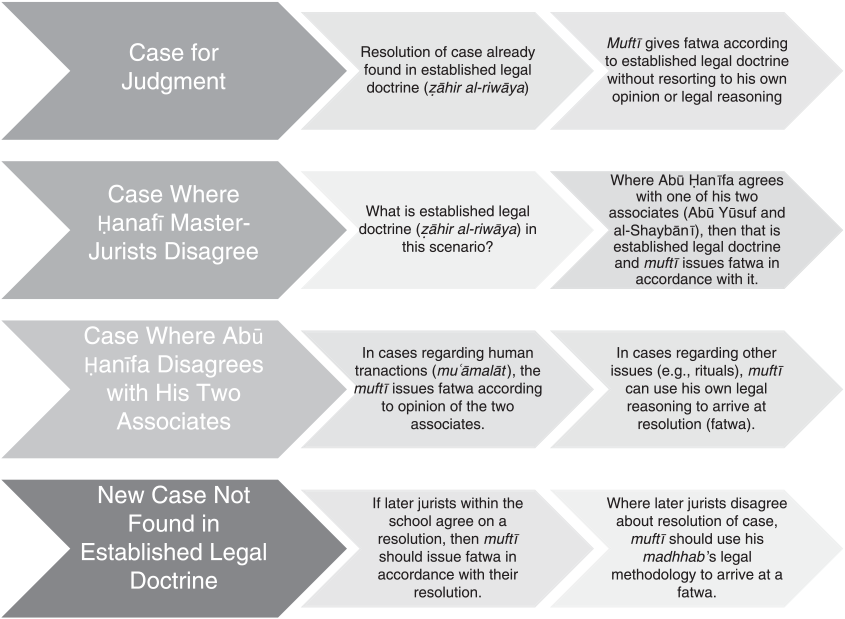
The diagram’s most revealing feature is that it does not stop when authorities disagree. It depicts routes for considering disagreement between Abū Ḥanīfa and his associates, as well as disagreement among later jurists. Those routes depend on a shared body of prior opinions and legal methods. The diagram is a simplified account of one school’s reasoning, not a universal algorithm for Islamic law. Its reference to a mufti issuing a fatwa also should not be confused with a court issuing a binding judgment—a distinction a later lesson will address.
Together, the Mālikī travel example and the Ḥanafī diagram show why “a school permits disagreement” is more precise than either “a school has one answer to everything” or “anything goes within a school.” Scholars can dispute a ruling while still sharing an interpretive tradition; the tradition, in turn, supplies ways to preserve those disputes and assess their authority.
Conclusion
A madhhab sustains continuity through shared methods, inherited scholarship, and practices for weighing opinions—not through complete agreement on every ruling. In the Mālikī travel example, differing opinions remained within one school even as one became predominant for ordinary guidance. The Ḥanafī diagram shows the same broader principle: internal disagreement is something jurists work with, not necessarily a reason to abandon the tradition.
Next, the course compares sources of religious authority in Sunni and Twelver Shia jurisprudence, while keeping this lesson’s caution in view: neither tradition should be treated as internally uniform.