Introduction
Welcome back. In our previous lesson, we analyzed what new value a transformation to a microservices and AI-based architecture creates for B2B customers. We established that microservices offer structural value like flexibility and speed, while AI delivers substantive value through prediction and intelligence.
Now, we shift from defining the value to communicating it. A brilliant product with a muddled story will get lost in today's crowded market. This is especially true in an era where, as the article "The New SaaS Battleground" notes, AI is accelerating product commoditization, making your narrative the most critical differentiator. This lesson directly addresses your goal of translating complex technical shifts into clear, value-based stories for your entire organization and, ultimately, your customers.
The learning outcome for this lesson is to redesign product positioning and messaging for a modular, AI-enhanced product portfolio. We will cover:
- The foundational concepts of positioning and why it's the strategic bedrock of your Go-to-Market efforts.
- A step-by-step framework for systematically developing a strong product position.
- A narrative structure to translate your positioning into a compelling and memorable message.
By the end of this lesson, you will have the tools to move from a list of features to a powerful story that defines your product's place in the market.
Part 1: Positioning as Strategic Context-Setting
Before we can craft a message, we must define our position. Many people confuse positioning with messaging, taglines, or branding, but it's much more fundamental. Positioning is the act of deliberately setting the context for your product in the customer's mind.
To grasp this crucial concept, we'll turn to April Dunford, one of the foremost experts on B2B product positioning.
The Marketing Expert: Sell Anything with this Trick | April Dunford
Let's start with a foundational understanding of what positioning is. In this clip, April Dunford explains her definition and distinguishes it from the activities that are often confused with it.
Watch from 00:31 to 02:23. Pay close attention to her definition of positioning as 'the foundation upon which the house is built' and how it sets the context for a product.
As Dunford states, positioning defines how your product is the best in the world at delivering a specific value to a well-defined set of customers. To make this tangible, she uses a simple but powerful analogy.
The Marketing Expert: Sell Anything with this Trick | April Dunford
To see how changing context alters market perception, let's explore Dunford's classic 'muffin vs. cake' analogy.
Watch from 02:23 to 04:36. As you watch, consider your company's transformation. You are essentially turning a monolithic 'cake' into a modular, AI-powered 'box of assorted muffins.' Without clear positioning, customers won't understand what they're buying or how to value it.
This analogy perfectly captures the challenge and opportunity of your transformation. Your old monolithic product was a "cake"—customers understood what it was, but it was singular and inflexible. Your new modular, AI-enhanced portfolio is like a collection of "muffins"—each with its own purpose, value, and potential customer. Your job is to create the "menu" that helps customers understand what each offering is, why it's valuable, and how it compares to the alternatives.
Part 2: A Structured Framework for Redesigning Positioning
Good positioning doesn't happen by accident. It requires a deliberate, structured process. Filling in a "positioning statement" template without doing the underlying work is, as you'll see, a common path to failure.
Fortunately, there is a robust methodology for this. We'll again draw on April Dunford's work to outline a five-step process that starts from the most important point of reference: the customer's alternatives.
Why Your Positioning Sucks And How to Fix it (w/ April Dunford)
A structured process is key to getting positioning right. This video breaks down the five core components of positioning and, most importantly, reveals the correct order in which to approach them.
Please watch from 05:27 to 10:48. This is a critical segment. Focus on the five components and especially the starting point: Competitive Alternatives. Note her crucial point that 'no decision' or using a spreadsheet often represents your biggest competitor, something highly relevant in enterprise software sales.
Let's formalize that five-step flow. This is the core methodology for this lesson:
-
Competitive Alternatives: Start here. If your product didn't exist, what would the customer do? This isn't just about direct competitors. In B2B, it often includes:
- The status quo (using an old, legacy system).
- Manual processes (using spreadsheets, email, and human effort).
- Building an in-house solution.
- "No decision" due to fear or confusion.
This anchors your positioning in reality.
-
Unique Attributes: Now, list what your product has that the alternatives don't. This is where you connect back to our previous lesson. Your unique attributes are the modularity enabled by microservices, the API-first integration, the predictive analytics from your AI layer, and the natural language interfaces.
-
Differentiated Value: For each unique attribute, ask "So what?" How does this feature translate into a tangible benefit for the customer? This is where you formulate the "value equations" we discussed—turning capabilities into cost savings, revenue increases, or risk reduction.
-
Best-fit Customer Characteristics: Who cares the most about this value? A modular pricing model might be highly valued by mid-market companies that can't afford the full enterprise suite. Predictive AI features might be most critical for large enterprises operating at a scale where small efficiencies yield huge returns. Defining this sets the stage for customer segmentation, which we'll cover in our next lesson.
-
Market Category: Finally, determine the market "box" you want to put your product in. This context triggers a set of assumptions in the buyer's mind. Are you an "AI-Enhanced CRM" (an evolution of an existing category) or an "Intelligent Revenue Platform" (a new category)? Your choice here should make your differentiated value obvious to your target customers.
By following these steps in order, you ensure your positioning is not just a creative exercise but a strategic tool grounded in market realities and your unique strengths.
Part 3: From Positioning to Messaging: Crafting the Narrative
With your strategic position defined, the next step is to translate it into messaging—the actual story you tell the market. In a world of feature parity, a clear and compelling narrative is your most defensible asset.
The New SaaS Battleground: Positioning and Differentiation
This article provides an excellent framework for moving from strategic positioning to a compelling narrative. It argues that clarity, not creativity, is what converts customers.
Please read the introduction ('The Great SaaS Collapse of Differentiation'), the section 'The Power of Clarity Over Creativity', and especially the section 'How to Tell a Differentiation Story That Wins'. Focus on the 'Shift → Gap → Payoff' framework. This is a powerful recipe for structuring your new message.
The Shift → Gap → Payoff framework is an elegant and effective way to structure your story:
- Shift: Start by describing an undeniable change in the world that affects your customer. This establishes urgency and relevance.
- Example: "In today's economy, every business decision must be backed by data, but executive teams are drowning in dashboards they don't have time to analyze."
- Gap: Explain why existing solutions (including, perhaps, your own previous product) are inadequate to handle this shift. This highlights the pain and makes your competitors look outdated.
- Example: "Traditional BI tools were built to show you what happened, but they can't tell you why it happened or what to do next, leaving your team to guess."
- Payoff: Introduce your product as the inevitable solution that closes the gap and delivers a new, desirable outcome. This is where you articulate your differentiated value.
- Example: "Our platform moves beyond static reports, using AI to automatically surface the critical insights and recommend the next best action, turning your data into decisive strategy."
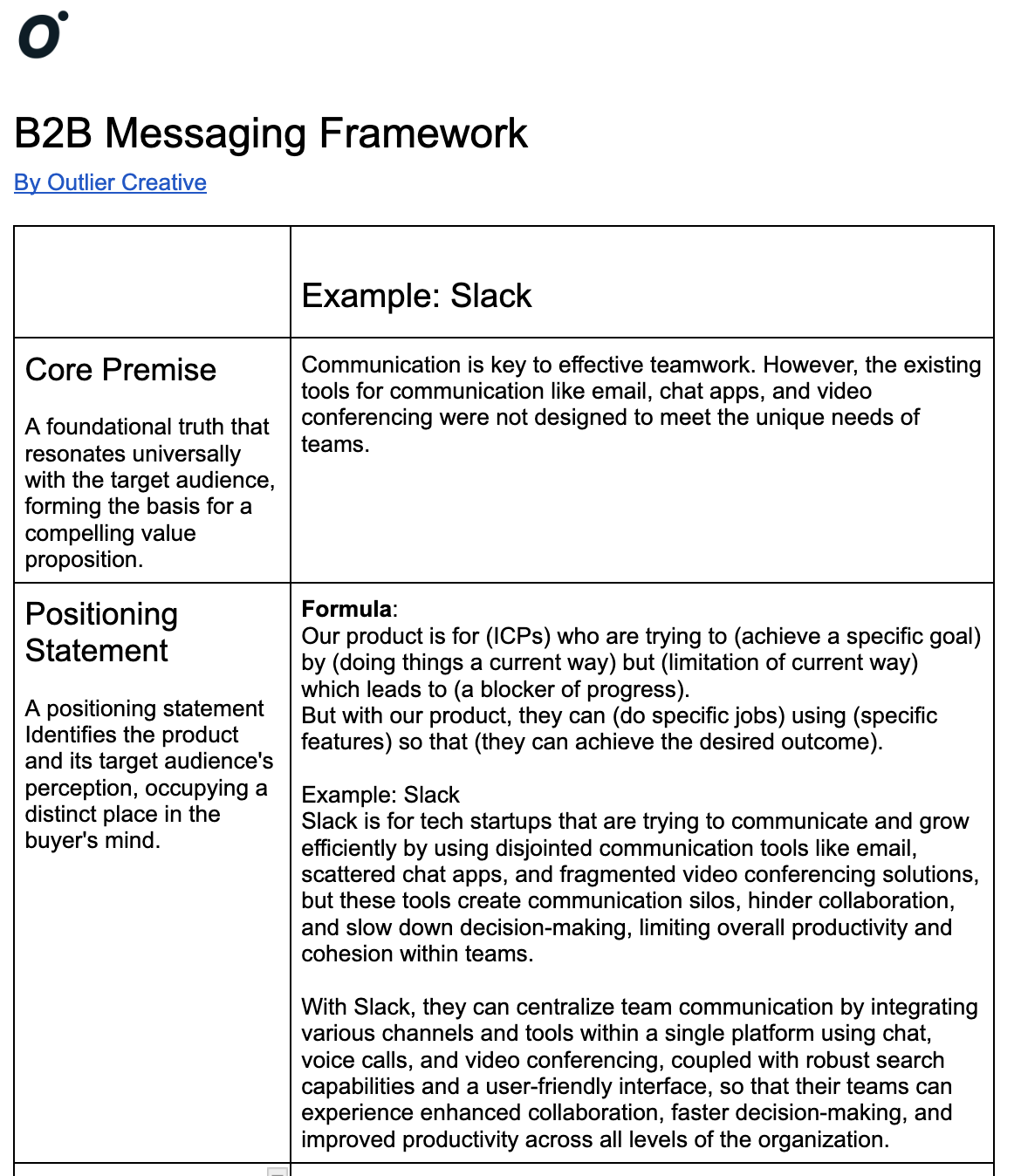
This narrative structure elevates your product from a simple tool to a strategic solution for an evolving business landscape. To help document this, you can use a simple messaging template.
Practical Application Exercise
Let's apply these frameworks to your company's transformation. This exercise will help you create the first draft of your new positioning and messaging.
Your Task (10 minutes):
Imagine your company's flagship product is a loan origination system, and it's being transformed from a monolith into a modular, AI-enhanced platform.
-
Draft Your Positioning Components (following Dunford's 5 steps):
- Competitive Alternative: Identify one key alternative (e.g., a direct competitor's product, or a bank's large, inflexible in-house legacy system).
- Unique Attribute: Name one new capability from your transformation (e.g., "AI-powered credit risk assessment" or "Modular compliance service").
- Value: State the value of that attribute in one sentence (e.g., "Reduces loan approval time from days to hours while lowering default rates").
- Target Customer: Describe the ideal customer who values this most (e.g., "Mid-sized credit unions looking to compete with large banks on speed and efficiency").
- Market Category: Propose a new market category that highlights your uniqueness (e.g., "Intelligent Lending Platform" instead of just "Loan Origination System").
-
Draft Your Messaging Narrative (using Shift → Gap → Payoff):
- Write one sentence for the Shift.
- Write one sentence for the Gap.
- Write one sentence for the Payoff.
Example Answer
1. Positioning Components Draft:
- Competitive Alternative: A bank's decades-old, internally-built mainframe loan processing system.
- Unique Attribute: AI-powered predictive default risk scoring that analyzes non-traditional data points.
- Value: This allows the bank to safely approve a wider range of applicants faster, increasing market share without increasing risk.
- Target Customer: Regional banks that are losing market share to fintech lenders who use more sophisticated decisioning.
- Market Category: "Predictive Lending Platform."
2. Messaging Narrative Draft:
- Shift: Borrower expectations have fundamentally changed; they now demand instant decisions and personalized offers, a standard set by digital-native fintechs.
- Gap: Traditional, rule-based loan origination systems are too slow and rigid, causing you to lose credit-worthy customers to faster competitors.
- Payoff: Our Intelligent Lending Platform uses AI to provide instant, data-driven credit decisions, enabling you to grow your loan portfolio safely while delivering the modern experience your customers expect.
Conclusion
In this lesson, we have built a bridge from the technical reality of your transformed product to the market's perception of it. You now have a repeatable process for defining not just what your product does, but what it means to your customers.
Key Takeaways:
- Positioning is Strategic Context: It's the foundation that defines your competitors, value, and customers before you write a single line of marketing copy.
- Start with Alternatives: The most effective positioning process begins by understanding what customers would do without you. This grounds your strategy in market reality.
- Translate Attributes to Value: A feature is a "what"; value is the "so what?" for the customer. Your positioning must be built on this translation.
- Narrative Sells: The Shift → Gap → Payoff framework is a powerful tool for turning your strategic position into a story that creates urgency and positions your product as the inevitable solution.
Preview of the Next Lesson
We have now crafted our core positioning and the overarching narrative for the transformed product. However, a single message rarely fits all customers, especially when managing a complex migration. In our next lesson, "Segment the existing customer base for a phased migration approach," we will explore how to take this core message and tailor it to different customer groups to build momentum, manage expectations, and drive adoption across your entire client base.