Introduction
Welcome to the next lesson in our module on Delivery Process Transformation. In the previous lesson, we established how to measure the performance of your new delivery model using the four key DORA metrics. You now have the tools to answer the question, "How are we performing?"
Today, we transition from measuring the system to changing it. A large-scale transformation doesn't happen all at once. It begins with a single step, carefully chosen and executed, that builds the momentum for the entire journey. This lesson directly addresses the learning outcome: Define criteria for selecting pilot teams and plan a phased rollout of the new operating model.
We will cover two critical aspects of execution:
- How to strategically select the first team and project—the pilot—to test your new operating model.
- How to design a phased rollout plan that scales the change from that initial pilot to the wider organization in a structured and manageable way.
Getting this right is crucial. A successful pilot serves as a beacon, creating evidence and belief that the new way of working is superior. A poorly chosen pilot can stall a transformation before it even begins.
Part 1: The Strategic Role of a Pilot
Before rolling out a new operating model across an entire organization, you need to prove it works in your specific context. This is the purpose of a pilot. A pilot is not just a trial; it's a strategic tool designed to:
- Validate the new model: Test your new team topologies, roles, and processes on a real project to see what works and what needs adjustment.
- Create a reference implementation: The pilot team becomes a "beacon" for the rest of the organization—a tangible example of what "good" looks like.
- Build momentum and buy-in: A successful pilot generates positive stories and provides concrete data (using the DORA metrics we just learned) to convince skeptics and secure leadership support for a wider rollout.
- Surface hidden impediments: No amount of planning can uncover all the organizational friction. The pilot team will inevitably run into real-world blockers, giving you a chance to solve them for a small group before they impact the entire organization.
The LeadingAgile whitepaper describes this well, framing the pilot as the first "Expedition" that establishes a "Basecamp" for others to follow. It's the first step in creating a playbook for the rest of the transformation.
To understand the pilot's role in the broader transformation, let's look at how the 'AGILE TRANSFORMATION' whitepaper by LeadingAgile introduces the concept.
Please read two short sections in this document. First, find the section titled 'Pilot' (on page 32). Focus on its purpose as a 'reference implementation' and 'beacon'. Then, read the section 'Transformation Hypothesis' (on page 29). This explains the strategic process of getting leaders aligned to identify where a pilot would deliver the most value.
Part 2: Criteria for Selecting the Right Pilot
Choosing the right pilot is arguably one of the most critical decisions you'll make in the early stages of a transformation. A common mistake is to pick a project that is either too insignificant ("If it fails, no one will care") or too complex ("Let's solve the hardest problem first"). The ideal pilot lies somewhere in between.
Let's explore the key attributes of a strong pilot candidate.
Four Attributes of the Ideal Pilot Project
The article 'Four Attributes of the Ideal Pilot Project' from Mountain Goat Software provides an excellent, concise framework for this decision.
Please read the entire article. It's short and to the point. Pay close attention to the four attributes and the reasoning behind each one.
Based on this, we can establish four key criteria for your selection process:
- Importance: The pilot must be on a project that matters to the business. A success on an important project is compelling. A success on a trivial project is easily dismissed. This also ensures the team and stakeholders are motivated to overcome the initial difficulties.
- Duration: Aim for a "Goldilocks" duration of around 3-4 months. This is long enough for the team to go through several cycles, learn the new process, and show meaningful results, but short enough to maintain focus and declare victory in a reasonable timeframe.
- Size: The pilot should start with a single, dedicated, and ideally co-located team. The project's scope should be manageable for one team to minimize the complexity of multi-team coordination, which is a challenge to tackle after you've stabilized the single-team model.
- Business Sponsor Engagement: This is non-negotiable. You need an influential business sponsor who is genuinely committed to the new way of working, is willing to engage with the team regularly, and can act as a champion for the pilot's success across the organization. Given your background in customer-facing roles, you understand the power of a strong internal champion.
When evaluating potential pilots, you'll need to weigh these factors. You may not find a "perfect" candidate, but this framework helps you make a conscious, strategic trade-off rather than an accidental one.
Part 3: Planning a Phased Rollout with "Basecamps"
Once your pilot is underway and showing signs of success, the question becomes: "How do we scale this?" The answer is not a "big bang" where everyone changes at once. A much safer and more effective approach is a phased rollout, where you incrementally move the organization toward the new operating model.
A powerful metaphor for this is the concept of Basecamps, which you saw mentioned in the LeadingAgile whitepaper. Think of your transformation as an expedition up a mountain. You don't go from the bottom to the summit in one go. You establish a series of basecamps, each representing a stable, higher level of maturity.
Agile Transformation Explained
This video, 'Agile Transformation Explained', provides a clear overview of the Basecamp model for a phased transformation.
Please watch from 34:15 to 37:41. Focus on how the speaker describes the progression through different phases or 'base camps', each with a different organizational goal.
The video and the AGILE TRANSFORMATION whitepaper outline a typical progression:
- Basecamp 1: Stabilize the System. The primary goal is predictability. Teams learn to form stable backlogs, work as dedicated units, and reliably make and meet commitments. This is the goal for your pilot and the first wave of your rollout. The DORA metrics you learned about are crucial for measuring this.
- Basecamp 2: Reduce Batch Size. Once predictable, the focus shifts to speed and feedback. You work on breaking down work into smaller increments to deliver value to market faster and get feedback sooner.
- Basecamp 3+: Decouple Dependencies. This is where you tackle the deeper, systemic issues you identified in earlier lessons, such as refactoring your architecture (e.g., monolith to microservices) to allow teams to work more autonomously.
Your rollout plan involves moving the organization from one basecamp to the next in waves. These waves are often called "Expeditions"—groups of teams (perhaps a whole department or value stream) that make the journey together.
Part 4: Creating the Rollout Roadmap
To make this plan tangible, you need to create a transformation roadmap. This is a visual plan that communicates the what, when, and who of the rollout. It is an essential artifact for aligning leadership and managing expectations.
Here are two examples of what such a roadmap might look like.
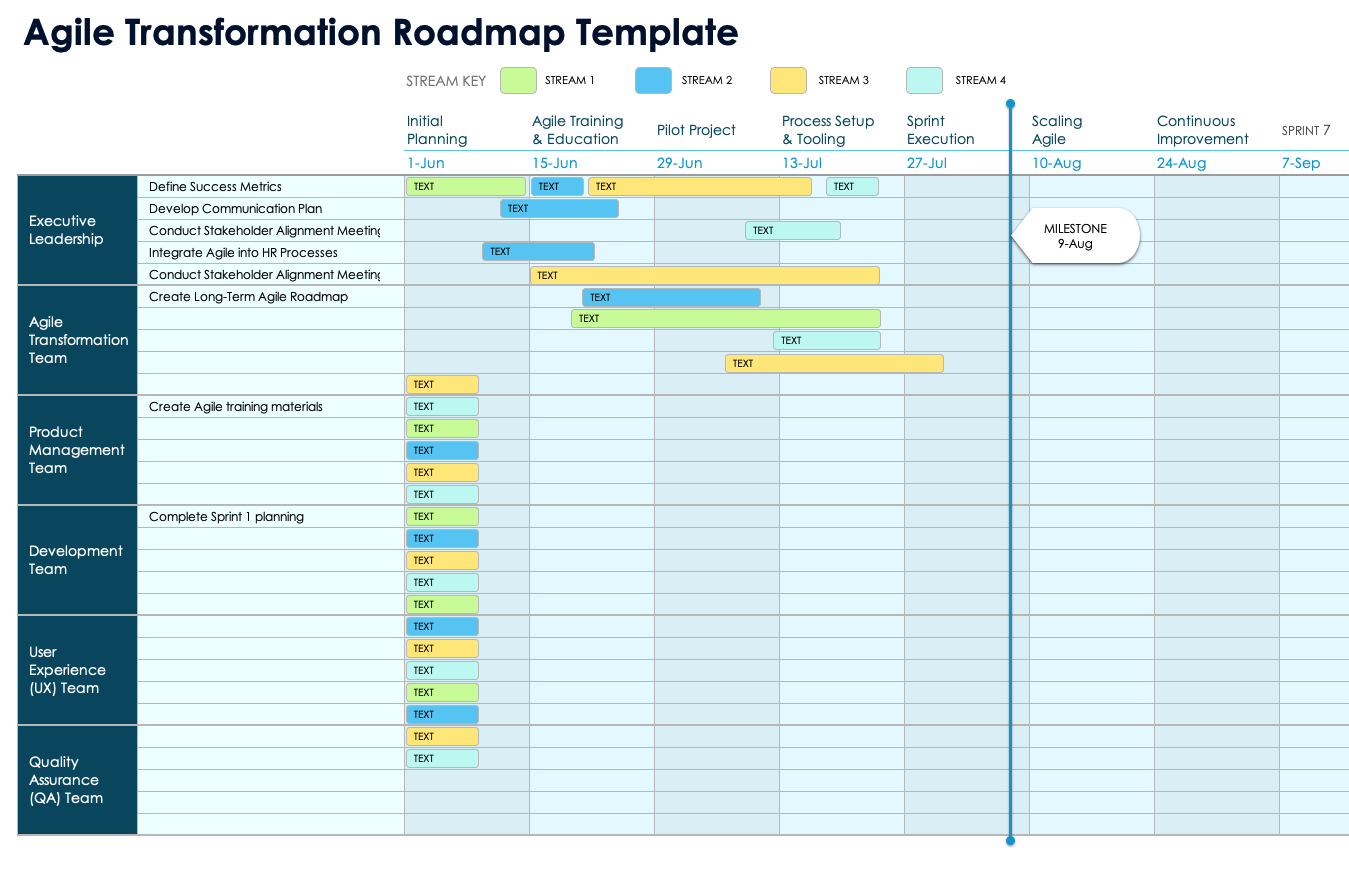

Notice the common elements:
- Phases/Waves: The work is broken down into sequential stages (e.g., Pilot, Wave 1, Wave 2).
- Workstreams: The plan covers multiple types of activities, such as process setup, tooling implementation, training, and coaching.
- Timeline & Milestones: It provides clear dates and defines what success looks like at each stage.
- Responsibilities: It clarifies which teams or departments are involved in each activity.
Practical Application Exercise
Your first pilot team (the "Phoenix" team) has just completed a successful 3-month pilot. They are now operating predictably at "Basecamp 1." You have been asked by leadership to create a plan to roll out the new operating model to the rest of the "Core Banking" department, which has four other teams.
Your Task (10 minutes):
Sketch a high-level, 6-month roadmap for rolling out the new operating model to the remaining four teams. You don't need to create a detailed Gantt chart; a simple, structured list or table is fine.
Consider the following questions:
- How would you sequence the teams? (e.g., all at once, in smaller waves?)
- What are the major phases or milestones of your 6-month plan?
- What key activities or workstreams (beyond just the teams' project work) need to be included? (Hint: Think about training, coaching, tooling.)
Suggested Approach
Here is one possible way to structure the 6-month rollout plan:
Objective: Move all four remaining teams in the Core Banking department to Basecamp 1 (Predictable Delivery) within 6 months.
Rollout Strategy: A two-wave approach to manage risk and focus coaching efforts.
Roadmap:
Phase 1: Rollout Wave 1 (Months 1-3)
- Teams: "Eagle" and "Falcon" teams.
- Key Activities:
- Month 1 (Setup):
- Official kickoff for both teams.
- Intensive training workshops on the new operating model (Team Topologies, roles, ceremonies).
- Tooling setup and configuration (JIRA boards, CI/CD pipeline access).
- Dedicated coaching support begins.
- Establish baseline DORA metrics.
- Months 2-3 (Stabilization):
- Teams execute their first few sprints/iterations under the new model.
- Weekly coaching sessions and 'health checks'.
- The original "Phoenix" pilot team acts as peer mentors.
- Month 1 (Setup):
- Milestone (End of Month 3): Wave 1 teams demonstrate stable velocity and improved lead time for changes.
Phase 2: Rollout Wave 2 (Months 4-6)
- Teams: "Hawk" and "Kestrel" teams.
- Key Activities:
- Month 4 (Setup):
- Kickoff, training, and tooling setup (replicating the Wave 1 process).
- Lessons learned from Wave 1 are incorporated into the training.
- Coaching support begins.
- Months 5-6 (Stabilization):
- Teams execute their first few sprints/iterations.
- Coaching continues.
- Teams from Wave 1 now join the "Phoenix" team as mentors.
- Month 4 (Setup):
- Milestone (End of Month 6): All teams in the department are operating at Basecamp 1. The transformation program is ready to plan the journey to Basecamp 2 (Reduce Batch Size).
Conclusion
In this lesson, we have moved from the abstract design of a new operating model to the concrete steps of implementing it. You now have a framework for making one of the most vital early decisions in a transformation and a plan for scaling that initial success.
Key Takeaways:
- Pilot selection is a strategic decision. The ideal pilot is important, appropriately sized, runs for 3-4 months, and has a highly engaged business sponsor.
- Rollouts should be phased, not "big bang." The "Basecamps" model provides a powerful way to structure the transformation journey into manageable stages of maturity (e.g., Stabilize -> Reduce Batch Size -> Decouple).
- Plan the rollout in waves ("Expeditions"). This allows you to focus resources, manage risk, and apply learnings from one wave to the next.
- A transformation roadmap is an essential artifact. It visualizes the plan, aligns stakeholders, and tracks progress across different workstreams like training, tooling, and team readiness.
Preview of the Next Lesson
We've planned the rollout of the new process. However, as your experience in L&D and organizational design has surely taught you, processes are only followed if people's mindsets and behaviors change. In our next lesson, we will focus on the human element: "Identify critical mindset and behavioral shifts required and design interventions to foster Agile culture." We will explore what it truly means to have an "Agile culture" and how you, as a transformation leader, can actively cultivate it.