Introduction
Welcome to the twelfth and final lesson of your course. In our previous lesson, we established the critical importance of defining ownership and accountability structures to ensure your transformation's gains are not lost after the program ends. You learned how to transition responsibilities from the temporary project team to permanent owners in "business as usual" (BAU) operations, using tools like the RACI matrix to provide clarity.
Now that we know who is accountable, we must equip them with the tools and mindset to ensure the change not only sticks but also continues to evolve. This lesson addresses the final learning outcome of the course: to design continuous improvement cycles to sustain the transformation mindset post-program. We will explore how to make change a part of your organization's DNA, moving from a one-time transformation event to a state of perpetual improvement. This is the ultimate defense against the "snap-back" effect and the key to creating a truly agile and resilient organization.
1. The Core Engine of Sustainability: Continuous Improvement Cycles
The concept of "sustaining change" can feel abstract. At its core, it is a disciplined, cyclical process. The most fundamental model for this is the Plan-Do-Check-Act (PDCA) cycle, a cornerstone of quality management.

This model provides a powerful visual for preventing "snap-back." The act of standardizing an improvement—embedding it into your formal processes, tools, and training—is what locks in progress. The BAU owners you identified in the last lesson are responsible for running these PDCA cycles for their respective areas.
2. An Agile Approach: From Insights to Experiments
While PDCA is a powerful mental model, in a dynamic software company, a more adaptive, feedback-driven approach is often more effective. This is where Lean Change Management comes in. It reframes the PDCA cycle into a rapid loop of learning and experimentation.
Lean Change Management: A Feedback-Driven Approach to Change
To understand this iterative approach, let's watch a short video from Jason Little, a key figure in this field, titled 'Lean Change Management: A Feedback-Driven Approach to Change'. It introduces the core cycle that powers this methodology.
Please watch from 01:42 to 02:30 and from 03:55 to 04:23. Focus on the three key steps: starting with Insights, turning them into Options, and creating Minimum Viable Changes (MVCs) to test those options.
This cycle of Insights -> Options -> MVCs is essentially a fast, agile version of PDCA. Instead of a large, formal plan, you generate hypotheses based on insights and run small, safe-to-fail experiments (MVCs) to see what works.
To put this into practice, teams use a tool called the Lean Change Management Canvas.
Top 7 Change Management Process Templates for 2025
The article 'Top 7 Change Management Process Templates for 2025' provides an excellent description of the Lean Change Management Canvas. It will show you how to structure this iterative process.
Please read section 4, 'Lean Change Management Canvas'. Pay close attention to the description of the canvas components (like 'Change Hypotheses' and 'Experiments') and the cyclical process: Understand & Options, Hypothesis Formulation, Experimentation, Feedback & Learning, and Adapt & Iterate.
The Lean Change Canvas gives the BAU owners a practical tool to facilitate continuous improvement. Instead of just "maintaining" a process, their job becomes to constantly gather insights and run experiments to make it better.
3. Sustaining the Mindset: Beyond Process to People
A perfect process will fail if the underlying mindset doesn't shift. Forcing everyone to adopt a new mindset at once often creates resistance. A more effective strategy is to focus on winning over the right people first, letting the change spread organically.
Simon Sinek: How to start a cultural change?
Simon Sinek, in this clip 'How to start a cultural change?', explains this brilliantly using the Law of Diffusion of Innovations. This is a crucial concept for making change sustainable.
Please watch from 00:53 to 07:45. Focus on three key ideas: The difference between early adopters and the majority. The strategy of ignoring the majority at first and focusing exclusively on the 'early adopters'. His practical example of making the millennial program voluntary and challenging to create demand.
Sinek's message is powerful: to sustain a transformation mindset, you don't need to convince everyone at once. You need to identify and empower your early adopters—the 15-18% of the population who are naturally inclined to embrace the new way of working.
By making participation in new initiatives voluntary, selective, and maybe even a little challenging, you create a grassroots movement. The early adopters become your evangelists, creating social proof and pulling the "early majority" across the chasm. This is how you sustain a mindset, not just a process.
4. A Holistic Framework for Improvement
Now, let's pull these ideas together. The BAU owners in your organization need a map of where to apply these continuous improvement cycles. This framework helps structure those efforts.
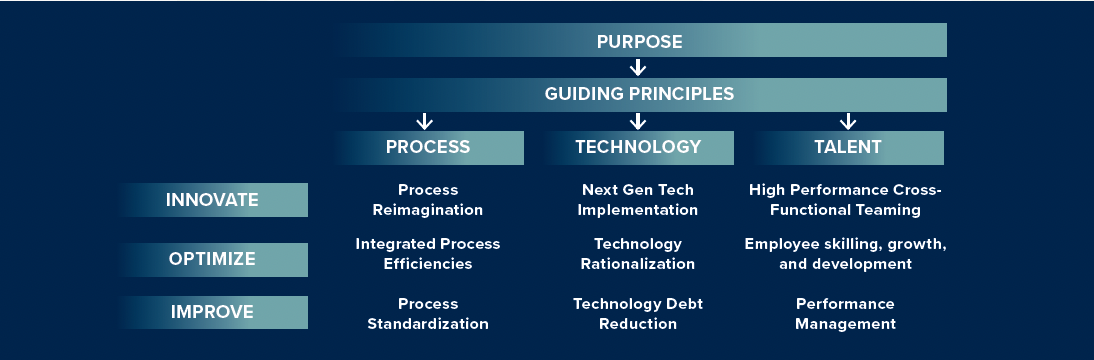
This framework provides a menu of opportunities. For example:
- The owner of your new GTM process might run an MVC to "Improve" process standardization.
- The head of engineering might launch a pilot to "Innovate" with next-gen tech.
- An L&D leader might design a program to "Optimize" employee skilling for the new microservices architecture.
Each of these initiatives can be managed as a Lean Change cycle, starting with early adopters to build momentum.
5. Application Exercise: Design Your First Improvement Cycle
Let's make this practical. Refer back to the ownership structure you designed in the previous lesson's exercise.
Your Task:
- Select an Activity: Choose one of the ongoing BAU activities for which you assigned ownership (e.g., "Continuously update sales training materials" or "Quarterly Review of Feature Adoption Metrics").
- Design an MVC: Using the Lean Change Canvas structure, outline a small experiment (an MVC) to improve this activity. Your outline should include:
- Insight: What problem or opportunity have you observed? (e.g., "Sales teams still seem confused about the pricing of new modules.")
- Hypothesis: Frame your belief as a testable statement. (e.g., "We believe that by creating a one-page interactive pricing calculator [Experiment], the sales team [Stakeholder] will be able to generate quotes 50% faster [Success Criteria].")
- Experiment (MVC): What is the smallest possible thing you can build or do to test this hypothesis? (e.g., "Build the calculator for just one product module in a simple spreadsheet and pilot it with two 'early adopter' sales reps.")
- Engage Early Adopters: Briefly describe how you would apply Sinek's strategy. How would you identify and recruit your two pilot sales reps? What would you ask of them?
This exercise will help you practice thinking in terms of small, iterative improvements driven by feedback from the right people. Take about 15 minutes to complete it.
6. The Digital Ecosystem for Continuous Improvement
Finally, remember that you don't have to do this manually. Your interest in a "Transformation Tech Stack" is highly relevant here. Modern tools can help automate the monitoring and feedback loops essential for continuous improvement.
Digital Change Management Ecosystem
The article 'Digital Change Management Ecosystem' explores how technology can support the final phase of change management: sustainment.
Please read the section titled 'Sustainment and Continuous Improvement'. Note the examples of how AI-enhanced tools like Salesforce Einstein or Tableau can be used to automatically identify trends, analyze feedback, and pinpoint gaps in user adoption, providing a steady stream of 'insights' to fuel your improvement cycles.
By integrating such tools, you create a data-driven engine for continuous improvement. This allows your BAU owners to move from reactive problem-solving to proactively identifying opportunities, ensuring the transformation mindset is not just sustained, but strengthened over time.
Conclusion
This lesson completes your course by bridging the gap between a successful transformation project and a perpetually improving organization. You have learned that sustainability is an active, not a passive, process.
Key Takeaways:
- Improvement is a Cycle: Use structured cycles like PDCA or the more agile Insights -> Options -> MVCs loop to drive continuous improvement.
- Standardize to Prevent Snap-Back: Lock in your gains by making improvements the new standard operating procedure.
- Win the Mindset, Not Just the Argument: Focus on inspiring your early adopters to create a grassroots movement that pulls the rest of the organization along.
- Structure Your Efforts: Use a holistic framework (Process, Technology, Talent) to guide where you apply your improvement efforts.
- Leverage Technology: Employ modern tools to automate the feedback and insight-gathering process, creating a data-driven engine for sustainment.
You have now journeyed from the foundational theories of change to the practical realities of crafting a vision, structuring a program, driving transformation across your organization, and, finally, ensuring it lasts. You are equipped with the frameworks, strategies, and practical tools to lead your B2B software company through the complex but rewarding process of large-scale transformation.
Congratulations on completing this course. The true test of this knowledge lies in its application, and you are now well-prepared to begin that journey.