Introduction
Welcome back. In our last lesson, we established a framework for making the critical "pivot, persevere, or pause" decisions that are central to leading an adaptive transformation. You learned how to use a mix of quantitative and qualitative data to diagnose a struggling workstream and determine the right path forward.
That framework helps you react when a plan is off course. But what if you could de-risk your plans before you commit a full team for an entire 8-12 week wave? This is where the practice of experimentation comes in.
Today's lesson addresses the learning outcome: Design rapid experimentation cycles to test transformation hypotheses before scaling. We will move from the high-level concept of agility to the practical, on-the-ground discipline of running small, fast, and low-cost experiments. This skill is the engine of an adaptive strategy, allowing you to validate your strategic bets and course corrections with evidence rather than intuition. For your goal of leading a complex tech and business transformation, mastering this will enable you to navigate uncertainty, reduce waste, and build momentum.
1. From Linear Plans to an Experimental Mindset
Traditional change management often treats transformation like a predictable project with a start, middle, and end. However, as you know from your experience, reality is far more complex.
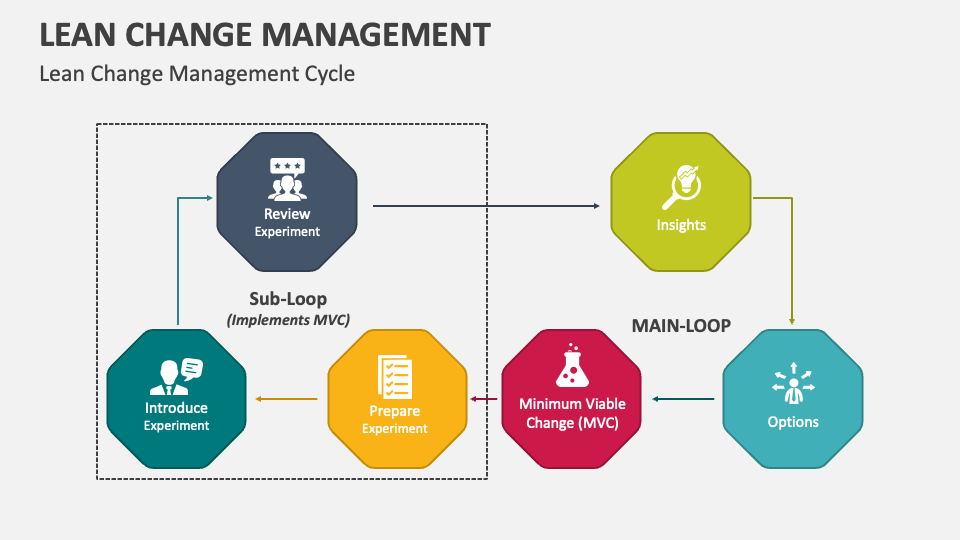
This short video from Lean Change Management effectively illustrates the challenge with linear thinking and introduces the core alternative: a cycle of insights, options, and experiments.
What is Lean Change Management?
This video, 'What is Lean Change Management?', explains why rigid plans often fail and introduces an adaptive, experiment-driven approach to change.
Please watch from the beginning until 02:40. Pay attention to: The description of the 'messy middle' of change. The core cycle: generating insights, creating options, and running experiments. How an experiment is framed with a hypothesis and measurements.
The video introduces the idea that instead of executing a fixed plan, we can test our ideas as small, controlled experiments. This approach is rooted in a discipline known as Hypothesis-Driven Development (HDD), which adapts the scientific method for business and product development.
How to Implement Hypothesis-Driven Development
This article from Thoughtworks, 'How to Implement Hypothesis-Driven Development,' provides a great introduction to the core principles. It explains how to shift your thinking from delivering features to running experiments.
Read the first part of the article, from the introduction down to the list summarizing the steps of the scientific method. Focus on the core idea of viewing a proposed solution as a hypothesis to be tested.
As the article states, "the key outcome of an experimental approach is measurable evidence and learning." An experiment cannot truly "fail" unless it fails to produce learning. This reframes setbacks as valuable data, which is a crucial mindset shift for leading a long-term transformation.
Visually, this process looks like a continuous loop.
2. Crafting a Testable Transformation Hypothesis
A well-designed experiment starts with a well-formed hypothesis. A vague goal like "improve the GTM process" is not testable. We need to be specific about what we're changing, who it's for, and what outcome we expect.
The Thoughtworks article provides an excellent, practical template for this.
How to Implement Hypothesis-Driven Development
Let's return to the Thoughtworks article to get a concrete structure for our hypotheses.
Please read the section 'Using an experimentation approach to software development,' focusing on the user story structure for Hypothesis-Driven Development. This provides the template we will use.
The format is simple but powerful:
We believe
<this capability>
Will result in<this outcome>
We will know we have succeeded when<we see a measurable signal>
This structure forces clarity:
- The Capability: The specific change, new tool, or process you're introducing.
- The Outcome: The benefit you expect to see. This should connect to a strategic objective.
- The Measurable Signal: The metric that will prove the outcome occurred. It must be quantifiable and have a target value.
Let's look at an example in your transformation context:
- We believe that equipping the sales team with an AI-powered proposal generator (the capability)...
- Will result in them creating more customized, higher-quality proposals for our new modular products (the outcome)...
- We will know we have succeeded when we see a 20% reduction in the time to create a proposal and a 10% increase in the proposal-to-demo conversion rate within 6 weeks (the measurable signals).
To create strong hypotheses, it's helpful to break down your underlying assumptions. The following video explores this deeper level of thinking.
Hypothesis Driven Product Development | Featured Product Makers, Pavel Samsonov
This video, 'Hypothesis Driven Product Development,' breaks down the thinking behind a good hypothesis, connecting user behavior, problems, and business objectives.
Please watch the two segments from 06:08-09:18 and 10:03-13:46. Focus on how the speaker deconstructs a hypothesis into assumptions about user behavior, their problems, and the desired benefits. This will help you formulate more robust hypotheses for your own experiments.
3. Designing and Running the Experiment
With a clear hypothesis, you can design the experiment itself. This involves defining the scope, methodology, and success criteria.
A great way to structure this is by using a visual tool like the Lean Experiment Canvas.
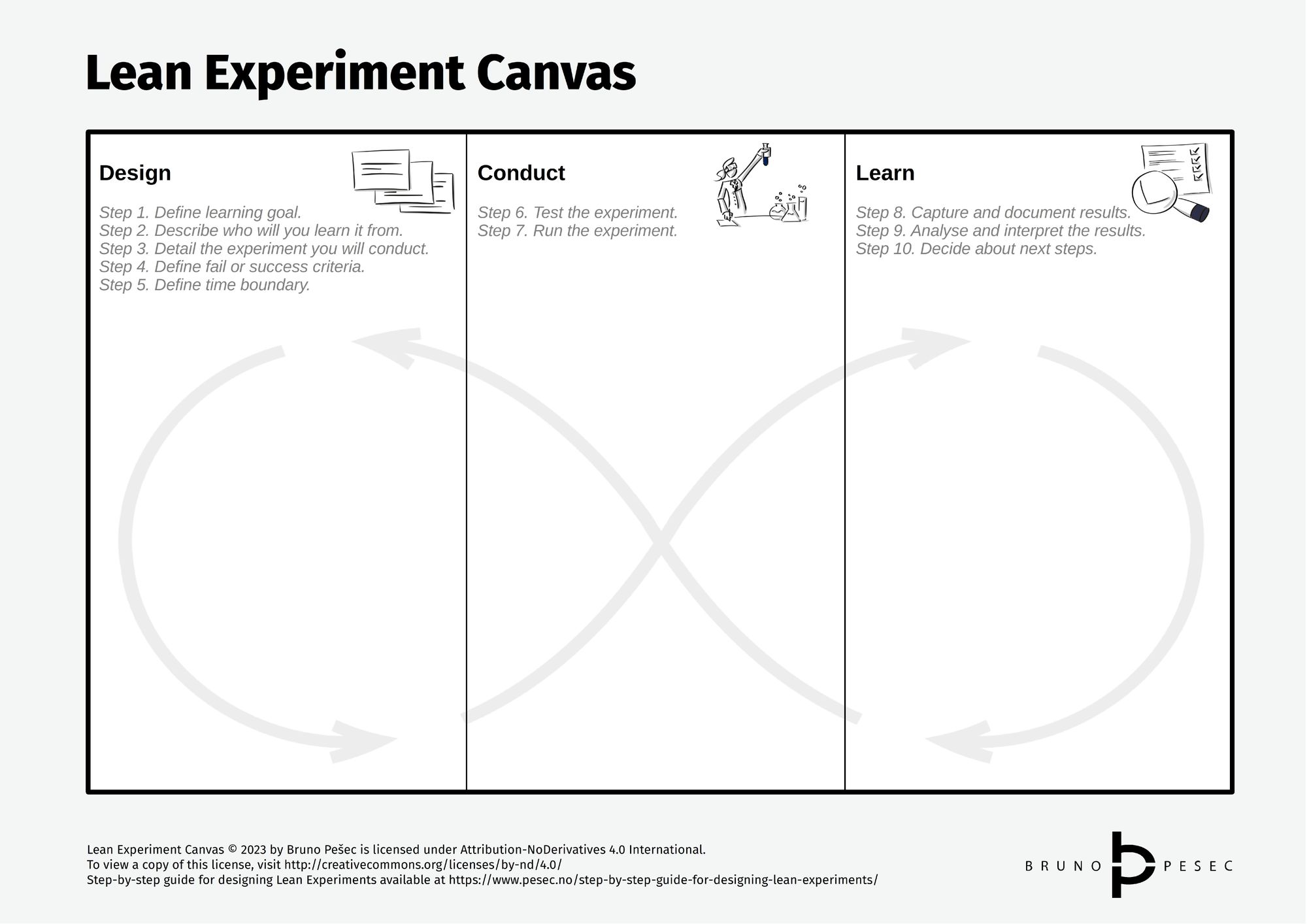
Let's walk through the key fields of the canvas:
- Learning Goal: What is the single most important thing you need to learn? (e.g., "Can our sales team adopt an AI tool effectively?")
- Experiment: A brief description of the test. (e.g., "Pilot an AI proposal tool with 5 reps for 4 weeks.")
- Success Criteria: What metric values will prove the hypothesis? (e.g., "Time-to-proposal drops by >15%.") This comes directly from your hypothesis.
- Failure Criteria: What result will disprove the hypothesis? (e.g., "No change in time-to-proposal, and reps report spending more time fixing AI outputs.")
- Time Boundary: How long will you run the test? Short feedback loops are key. (e.g., "4 weeks.")
A crucial aspect of experiment design is keeping it as cheap and fast as possible, especially in the early stages. You don't always need to build working software.
Hypothesis Driven Product Development | Featured Product Makers, Pavel Samsonov
Returning to the 'Hypothesis Driven Product Development' video, let's look at how to use low-fidelity artifacts to test ideas quickly and cheaply.
Watch from 31:23 to 42:32. Notice the emphasis on using storyboards, wireframes, and even simple drawings to get feedback before writing a single line of code. The generic experimentation cycle discussed at the end (Hypothesis -> Objectives -> Plan -> Synthesis) is a universal process.
For your transformation, a "low-fidelity" experiment might be:
- Testing a new process: Manually walking a small team through a new workflow on a whiteboard for a day.
- Testing a new role definition: Having someone "act" in the new role for a week with a temporary list of responsibilities.
- Testing a new GTM message: Trying out new talking points in five friendly customer conversations.
4. A Practical Guide to Running a Pilot Experiment
The Fullcast article on launching an AI-powered GTM pilot provides an excellent, real-world walkthrough of how to run a more formal experiment once you have some initial validation. Its principles are directly applicable to any transformation pilot.
How to Launch Your First AI-Powered GTM Pilot Program
This article, 'How to Launch Your First AI-Powered GTM Pilot Program,' is a step-by-step guide to running a structured business experiment. It translates the theory we've discussed into concrete actions.
Please read these four key sections: 'Pick one high-impact use case and define success': Reinforces how to frame the hypothesis. 'Tighten scope and staff a cross-functional squad': Emphasizes limiting variables. 'Run a real experiment, not a demo': Highlights the importance of a control group and a balanced scorecard. 'Decide with data, then wire the learnings into GTM': Explains the 'scale, iterate, or stop' decision and the retrospective process.
Key disciplines highlighted in the article include:
- Start narrow: Don't try to boil the ocean. Pick one team, one process, one metric.
- Establish a baseline: You can't measure improvement if you don't know where you started.
- Use a control group: The only way to know if your change caused the result is to compare it against a group that didn't get the change.
- Make a clear decision: At the end of the timebox, formally decide to scale, iterate, or stop the initiative based on the data.
5. Application Exercise
Let's put this into practice. Your transformation involves shifting from a monolithic product to a modular, microservices-based one. A major challenge is that the sales team is struggling to articulate the value of this new modularity to customers.
Your Hypothesis: If you create a "Solution Architect" role within the sales team, they can help reps build custom solution packages for clients, better demonstrating the value of the new architecture and accelerating the sales cycle.
Your Task (15 minutes):
You decide to run a rapid experiment to test this before committing to hiring and training a full team of Solution Architects.
-
Formulate the Hypothesis: Write out the full hypothesis for this experiment using the "We believe... Will result in... We will know..." format. Be specific in your measurable signal.
-
Design the Experiment: Using the Lean Experiment Canvas as a guide, outline the following for a low-cost, 4-week experiment:
- Experiment Description: What is a low-fidelity way to test this without hiring anyone yet? (Hint: Think about temporarily assigning an existing, knowledgeable person).
- Success Criteria: What specific, measurable result will validate your hypothesis?
- Failure Criteria: What result would convince you this is the wrong approach?
-
Ensure Rigor: Drawing from the Fullcast article, identify two critical elements you must have in place to ensure the results of your 4-week experiment are trustworthy.
Click here to see a sample answer after you've completed the exercise.
Sample Answer:
1. Formulate the Hypothesis:
- We believe that embedding a senior product specialist to act as a temporary "Solution Architect" in the sales process for 5 key deals...
- Will result in the sales team being able to more effectively propose and close complex, multi-module solutions...
- We will know we have succeeded when for those 5 deals, the time from initial proposal to technical validation with the customer is reduced by 30% compared to the historical baseline, AND we see a 2-point increase in customer-reported confidence (on a 1-5 scale survey) in our solution's fit.
2. Design the Experiment (Lean Canvas Elements):
- Experiment Description: We will "borrow" one senior engineer from the core product team to act as a dedicated "Solution Architect" for one experienced sales rep for 4 weeks. They will be involved in all discovery and proposal stages for that rep's top 3-5 opportunities. They will not write code, only model solutions and answer deep technical questions.
- Success Criteria: The target metrics in the hypothesis are met (30% reduction in validation time, +2 confidence score). The sales rep reports being able to focus more on commercial aspects.
- Failure Criteria: The validation timeline does not change or increases due to more complexity being introduced. The sales rep feels the "SA" slows down their process. Customers are more confused.
3. Ensure Rigor:
- Control Group: We must simultaneously track 3-5 similar deals being worked by another sales rep without the support of the temporary Solution Architect. This helps isolate the impact of the new role from other market factors.
- Clean Data / Baseline: Before the experiment starts, we must analyze the last 10-15 closed-won deals of similar complexity to establish a credible baseline for the "proposal to technical validation" timeline. Without a reliable baseline, we cannot measure the 30% reduction.
Conclusion
Today you've learned the practical mechanics of designing and running rapid experiments. This is the core engine of an adaptive transformation strategy, allowing you to turn uncertainty into a source of learning and strength.
Key Takeaways:
- Frame your transformation initiatives not as projects to be executed, but as hypotheses to be tested.
- Use the "We believe... Will result in... We will know..." structure to bring clarity and measurability to your ideas.
- Start with low-cost, low-fidelity experiments to learn quickly before committing significant resources.
- For more formal pilots, enforce discipline through baselines, control groups, and clear decision criteria to ensure your results are trustworthy.
Preview of the Next Lesson
Running experiments and making evidence-based pivots is a powerful capability. However, these course corrections can create confusion or anxiety if not communicated well. How do you share that a plan is changing without undermining stakeholder confidence?
In our next lesson, we will focus on how to "Develop a communication approach for transparently sharing course corrections with stakeholders," ensuring your adaptive strategy builds trust rather than chaos.