Welcome to the fifth lesson in your Networking Basics course. In our previous session, we examined the physical hardware that makes up a network, such as routers, switches, and access points. When we traced how you access a website, we implicitly followed a specific communication pattern: your computer (a client) requested information from a web server.
Today, we will formalize this concept by exploring the two fundamental architectural models that govern how devices on a network communicate: client-server and peer-to-peer. Understanding the design principles, strengths, and weaknesses of each is essential. For your goal of working in cloud engineering, mastering the client-server model is non-negotiable, as it's the foundation of nearly all cloud services. However, peer-to-peer concepts are increasingly relevant in modern technologies like blockchain and certain content delivery systems.
The Client-Server Architecture: A Centralized Approach
The client-server model is the most common architecture on the internet today. It operates on a simple principle: specialized, powerful computers called servers hold resources and provide services to other computers, known as clients.
- Clients are devices like your laptop or smartphone. They request services or data (e.g., loading a webpage, fetching emails, accessing a file from cloud storage).
- Servers are computers optimized to respond to these requests, serving up the data or running the application logic. A single server typically handles requests from many clients simultaneously.
In this model, communication is centralized. Clients talk to the server, but they don't talk directly to each other. Think of a traditional library: you (the client) go to the librarian (the server) to request a book (the data). You don't take books directly from other patrons.

To get a clear overview of this model, let's watch a short video.
Client Server and Peer-to-Peer Networking - CompTIA Network+ N10-005: 3.5
Professor Messer's video, "Client Server and Peer-to-Peer Networking," offers a concise explanation of these architectures.
Please watch the first part covering the client-server model. Pay close attention to the advantages he mentions, like centralized administration, and the disadvantages, such as cost and the server being a single point of failure.
As the video highlights, centralization is both a strength and a weakness. It simplifies administration and security, but it also creates a single point of failure and a potential performance bottleneck. From a cybersecurity perspective—an area you're interested in—a central server is a very attractive target for attackers. If you can compromise the server, you can compromise the entire service and potentially all its user data.
The following video discusses this vulnerability in the context of why alternative models were developed.
What is a Peer to Peer Network? Blockchain P2P Networks Explained
The video "What is a Peer to Peer Network?" from the Lisk channel provides an excellent summary of the problems inherent in the centralized client-server model.
Watch the segment from the introduction to client-server. Note the specific issues raised regarding data security and user control.
The Peer-to-Peer (P2P) Architecture: A Decentralized Alternative
In contrast to the client-server model, a peer-to-peer (P2P) architecture is completely decentralized. There are no dedicated servers or clients. Instead, all devices on the network, called peers, are equal. Each peer can act as both a client (requesting data) and a server (providing data).
Returning to our library analogy, a P2P network is like a book club where every member owns some books and can borrow directly from any other member. There's no central building or single librarian.
This model is famous for its use in file-sharing applications like BitTorrent, but its principles are also the foundation for cryptocurrencies like Bitcoin.
Let's return to Professor Messer's video to see how this model works.
Client Server and Peer-to-Peer Networking - CompTIA Network+ N10-005: 3.5
Continue with Professor Messer's video.
Now, watch the sections covering the peer-to-peer model and the final summary comparison. Notice how the advantages of P2P (low cost, easy deployment) are the flip side of its disadvantages (security challenges, difficult administration).
A Head-to-Head Comparison
Choosing between client-server and P2P involves a series of trade-offs. The right choice depends entirely on the application's goals, whether it's prioritizing security, scalability, cost, or resilience.
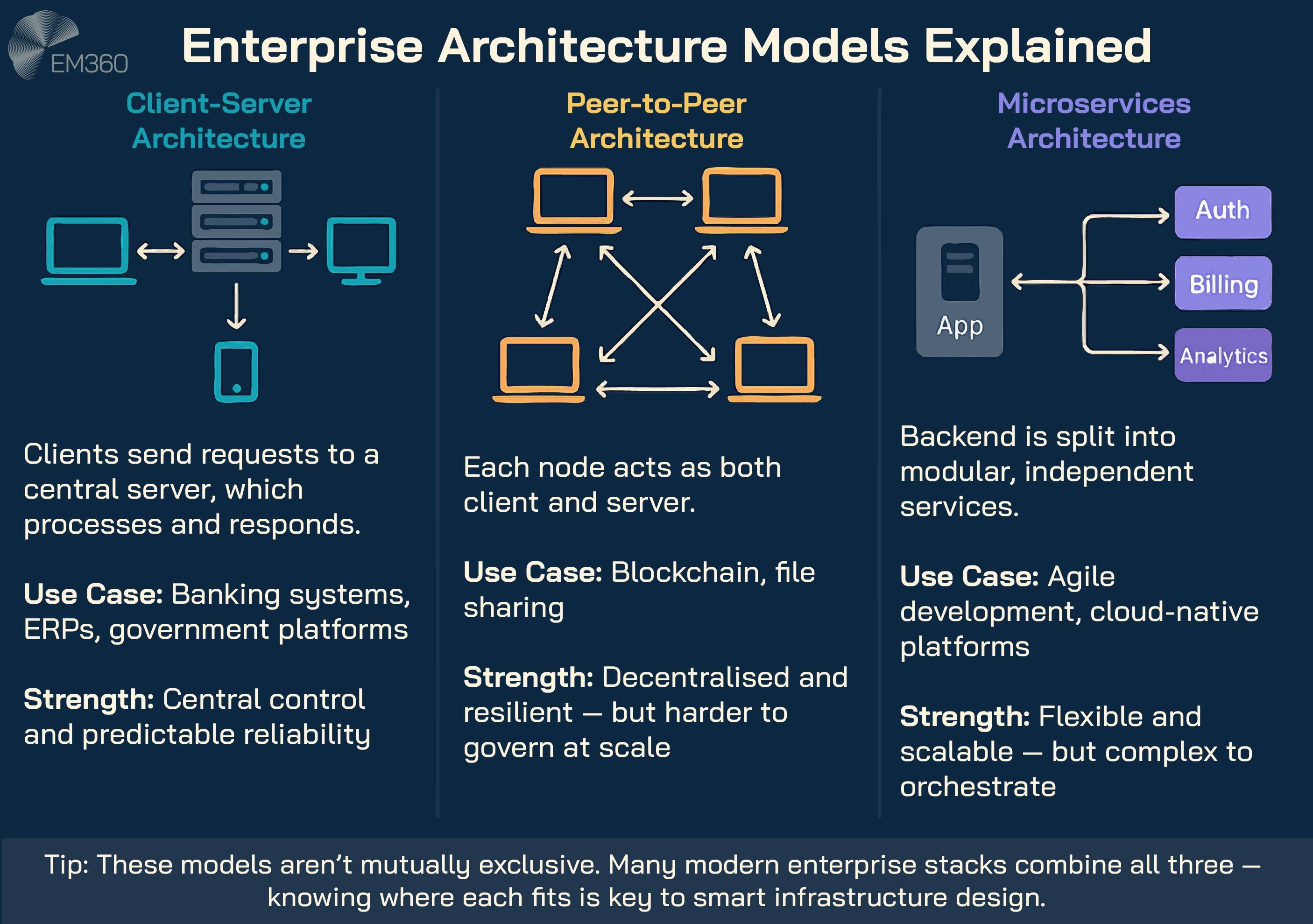
Let's break down the key differences:
| Feature | Client-Server | Peer-to-Peer |
|---|---|---|
| Control | Centralized. A single authority manages resources, data, and user access. | Decentralized. Each peer manages its own resources. No central authority. |
| Security | Easier to secure. Security policies can be enforced at the server. The server is a single, hardened target. | Harder to secure. Data is distributed, and every peer is a potential entry point for malware. |
| Availability | Vulnerable. A server failure (or DoS attack) brings down the entire service (single point of failure). | Highly resilient. The network remains functional even if many peers go offline. No single point of failure. |
| Scalability | Limited by the server. Performance degrades under high load. Scaling requires expensive server upgrades. | Highly scalable. The network's capacity increases as more peers join, since each peer adds new resources. |
| Cost | High. Requires purchasing, maintaining, and administering dedicated server hardware. | Low. Leverages the existing hardware and bandwidth of the users. |
| Administration | Simple. Software updates, backups, and user management are all handled centrally. | Complex. Updates must be deployed to every peer. Backups are difficult to manage. |
Given your interests in hacking and cybersecurity, the security differences are particularly important. In a P2P network for online gaming, for example, there is no central "referee" to validate game states. This makes it much easier for a malicious client to cheat by sending false information to other peers. In a client-server game, the server acts as the source of truth, validating all actions.
For a deeper analysis of these trade-offs, especially regarding security and scalability, the following article provides excellent context from the world of game development.
Peer-to-peer vs client-server architecture for multiplayer ...
This blog post from Hathora Dev explores the practical implications of choosing an architecture.
Please read the sections on Denial of Service, Cheating, Stability, Scale, and Cost. Notice how the "best" choice is not always obvious and depends heavily on the priorities of the application.
While P2P networks are often associated with illegal file sharing and security risks, it's crucial to understand that the architecture itself is not inherently insecure. When implemented correctly within a trusted enterprise environment, P2P can be a powerful tool for efficient data distribution. The following resource dispels some common myths.
What's the difference between peer-to-peer (P2P) networks ...
This article from Resilio provides an enterprise perspective on the advantages of P2P, particularly for solving problems of availability and high load that plague client-server systems.
Focus on the sections covering Availability, High Load, and Scalability. Then, read the section Busting common P2P myths to understand how P2P security can be managed in a corporate context.
Conclusion
You now understand the fundamental differences between the client-server and peer-to-peer network architectures. Each model presents a distinct approach to network communication with its own unique set of advantages and disadvantages.
Here are the key takeaways:
- Client-Server is a centralized model where clients request services from a powerful, centrally-managed server. It is the backbone of the modern web and cloud computing, offering strong control and security at the cost of being a single point of failure and more expensive to scale.
- Peer-to-Peer (P2P) is a decentralized model where all participants are equal and share resources directly with each other. It is highly resilient and scales organically but presents significant challenges for security and administration.
- The choice between them involves a critical trade-off between centralized control and security (Client-Server) versus decentralized resilience and scalability (P2P).
This lesson concludes our first module on Network Fundamentals. You have defined what a network is, compared network types and topologies, identified key hardware, and now, distinguished between the two primary architectural models.
In our next lesson, we will begin a new module by diving into the logical rules that govern network communication. We'll introduce the TCP/IP model, the four-layer framework that serves as the blueprint for how data actually moves across the internet, whether in a client-server or a P2P architecture.