Hello! Welcome back.
In our last lesson, you took a major step forward by learning to construct "A 是 B" identification sentences, allowing you to state facts like "我 是 人" (Wǒ shì rén). Now that you can affirm what something is, it's time to learn how to express the opposite.
Today's lesson focuses on negation. You will learn to recognize and write the essential character 不 (bù), which means "not." We will then combine it with 是 (shì) to form sentences like "A is not B." We'll also cover a crucial pronunciation rule that is fundamental to speaking correctly.
1. The Character for 'Not': 不 (bù)
The character 不 (bù) is your primary tool for negation in Mandarin. It's incredibly common and versatile.
- Pinyin:
bù - Tone: 4th tone (a sharp, falling tone)
- Meaning: not; no
Character Analysis
As an ideograph, the character's form hints at its meaning. An ancient interpretation suggests it depicts a bird flying up towards the sky (represented by the top horizontal line 一) but being unable to pass it, thus representing the concept of "not." It's composed of four simple strokes.
Writing Practice
Mastering characters starts with the correct stroke order. Given your analytical preference, paying close attention to this foundational step will serve you well.

Please take about 5 minutes to practice writing the character 不 on paper.
2. Forming Negative Sentences: 不是 (bùshì)
Negating the 'to be' verb in Chinese is straightforward. You simply place 不 (bù) directly before 是 (shì).
The structure is as follows:
This creates the phrase 不是 (bùshì), which means "am not," "is not," or "are not." Let's examine this in an article.
10 Ways to Say "No" in Chinese
The article '10 Ways to Say "No" in Chinese' from The Chinese Language Institute provides an excellent explanation of using 不是 (bùshì).
Please read the first section, titled '1. 不是 | bùshì | no; is not; not be'. Focus on how 不是 is used to disagree with a statement and the example sentences provided.
As you've just read, we can now turn the sentences from our last lesson into their negative forms:
- 我 不是 人。 (Wǒ bùshì rén.) — I am not a person.
- 她 不是 女人。 (Tā bùshì nǚrén.) — She is not a woman.
- 他们 不是 大人。 (Tāmen bùshì dàrén.) — They are not adults.
The core logic remains simple: 不是 functions as a single unit meaning "is not."
3. A Crucial Pronunciation Rule: Tone Sandhi
There is a critical pronunciation detail you must learn. While the pinyin is written as bùshì, it is not pronounced that way.
- 不 (bù) is a 4th tone.
- 是 (shì) is also a 4th tone.
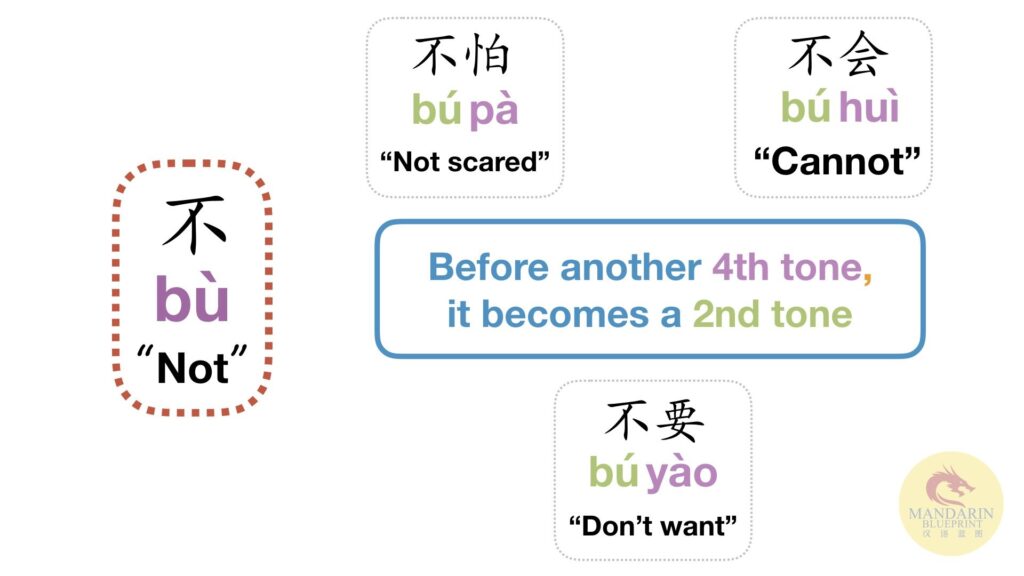
The Rule: When 不 (bù) is followed by another 4th tone syllable, its own tone changes from the 4th tone (falling) to the 2nd tone (rising).
Therefore, the combination is pronounced búshì, not bùshì.
This rule, called tone sandhi, is not optional; it's a fundamental part of spoken Mandarin. Let's see it in action.
Mandarin Chinese Lessons with Yangyang - Grammar 004 (negation word bú)
The video 'Mandarin Chinese Lessons with Yangyang' explains this tone change rule very clearly.
Please watch two short segments. First, watch from 00:43 to 01:33 for an explanation of the general rule. Then, watch from 03:06 to 03:33, where this rule is applied specifically to our phrase, '不是'. Listen carefully to the pronunciation 'búshì'.
To reinforce this concept, here is a visual summary of the rule. Although the examples are different, the principle is the same.
4. Why '不' and Not Another Word?
In Chinese, there are two main words for negation: 不 (bù) and 没 (méi). A common point of confusion for learners is when to use which.
The rule regarding 是 (shì) is absolute and simple: 是 is always negated by 不. This applies whether you are talking about the present or the past.
The Difference Between 不 and 没
To solidify this rule and prevent future confusion, let's read a brief explanation from Flexi Classes.
Find the heading '不, 没 AND 是, 有, 在' and read the first point, 'Only 不 (bù) negates 是 (shì)'. Notice how it applies to both present and past examples. You don't need to worry about '有' or '在' for now; we'll cover them in upcoming lessons.
This strict rule—that only 不 negates 是—is an important one to internalize.
5. Practice Time
Let's integrate what you've learned.
1. Writing & Pronunciation:
- Continue practicing the four strokes of 不 until you can write it from memory.
- Say the phrase 不是 out loud several times, focusing on the
bú(rising)shì(falling) tone combination.
2. Sentence Translation:
Translate the following sentences. Write them using Chinese characters and include pinyin with the correct tone marks (remembering the change for búshì).
- I am not an adult.
- You are not a woman.
- He is not a person.
Answers:
- 我不是大人。(Wǒ búshì dàrén.)
- 你不是女人。(Nǐ búshì nǚrén.)
- 他不是人。(Tā búshì rén.)
Conclusion
Excellent work today. You have now mastered a fundamental pair of concepts: affirming with 是 and negating with 不是. This dramatically expands the range of ideas you can express.
Key Takeaways:
- The character 不 (bù) means "not" and is used to form negative statements.
- To negate 是 (shì), you place 不 before it to form 不是 (bùshì).
- Crucial Tone Rule: When 不 (bù) precedes a 4th-tone character like 是 (shì), its pronunciation changes to the 2nd tone: búshì.
- Grammar Rule: The verb 是 (shì) is always negated with 不 (bù), never with other negation words.
Preview of the Next Lesson:
The tone change rule for 不 (bù) that you learned today is the most common one, but it's not the only one. In the next lesson, we will focus exclusively on this rule, examining how the tone of 不 behaves when placed before other tones. This will complete your understanding of this key character's pronunciation.