Hello! Welcome back to your Chinese course.
In our last lesson, we made a significant leap by learning how to combine individual characters like 大 and 山 to form two-character words like 大山 (dàshān). You learned that this compositional logic is a cornerstone of the Chinese language, allowing you to build a large vocabulary from a smaller set of core components.
Today, we take the next and most exciting step: building complete sentences. We will learn one of the most fundamental verbs in any language, 是 (shì), which means "to be." By the end of this lesson, you will be able to recognize and write 是, and more importantly, use it to construct "A 是 B" identification sentences. This will allow you to state simple facts and identities, forming the bedrock of your conversational ability.
1. Meet the Character: 是 (shì)
The character 是 (shì) is one of the most frequently used characters in Mandarin. It carries the meaning of "to be" (am, is, are).
- Pinyin:
shì - Tone: 4th tone (a sharp, falling tone)
Character Analysis
As you prefer an analytical approach, let's look at the structure of 是. It is a top-bottom compound character:
- Top component: 日 (rì), which you know means "sun."
- Bottom component: 正 (zhèng), which means "correct" or "straight."
While the historical etymology is complex, a helpful way to remember it is to think of it as stating something that is as clear and direct as the sun (日) and is correct (正). It establishes a fact.
Writing the Character
Writing characters correctly requires following a specific stroke order. This ensures the character is balanced and legible.
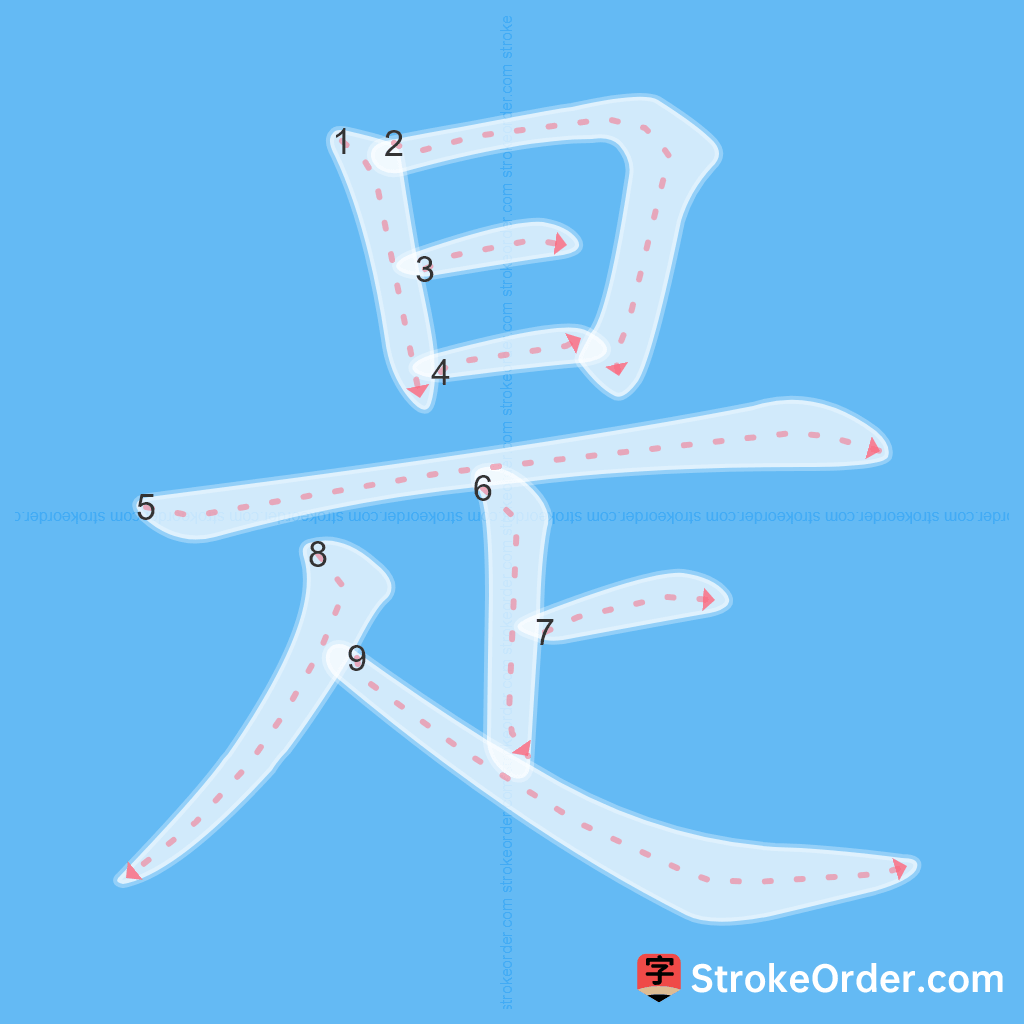
Take a few minutes now to practice writing 是 on paper. Focus on the order and direction of each of the nine strokes. This physical practice is crucial for memory.
2. The Core Grammar: 'A 是 B' for Identification
In English, the verb "to be" is very versatile. In Chinese, the use of 是 (shì) is much more specific. Its primary function is to link two nouns, essentially stating that 'A equals B'. This is often called an "identification sentence."
The structure is simple and consistent:
Let's dive into an article that explains this structure with clear examples.
How to Use 是(shì) for “To Be” in Chinese
The article 'How to Use 是(shì) for “To Be” in Chinese' provides a clear and simple explanation of this fundamental sentence pattern.
Please read the sections 'What Is 是 (shì)?', 'Examples', and 'Easy Tip to Remember'. The examples use some new words for professions (like teacher, student), which you don't need to memorize yet. Your focus should be entirely on the 'Subject + 是 + Noun' structure and the excellent analogy that likens 是 to an 'equals' sign.
As you saw in the reading, the structure is very logical. Unlike English ("I am," "he is," "we are"), the verb 是 (shì) never changes.
Let's form some sentences using the vocabulary you already know:
- 我 是 人。 (Wǒ shì rén.) — I am a person.
- 她 是 女人。 (Tā shì nǚrén.) — She is a woman.
- 他们 是 大人。 (Tāmen shì dàrén.) — They are adults.
Notice how 是 simply connects the subject (e.g., 我) with an identifying noun (e.g., 人).
3. Knowing the Limits: Identification vs. Description
A common point of confusion for learners is trying to use 是 (shì) where it doesn't belong. In English, we say "He is a doctor" (Noun) and "He is tall" (Adjective). In Chinese, these two sentences use different structures.
是 (shì) is used to link a subject to a noun, but NOT to an adjective.
To understand this crucial distinction, let's watch a video that explains it perfectly.
TO BE in Mandarin Chinese 是vs很 Shi vs Hen Chinese Sentence Structure Chinese grammar lesson
The video 'TO BE in Mandarin Chinese' from Andy and Sarah Mandarin clearly explains the difference between using 是 (shì) for definitions and another word, 很 (hěn), for descriptions.
Watch from 01:03 to 02:00, and then from 04:00 to 06:53. The speaker does an excellent job explaining that 是 (shì) is used for 'definitions' where you end with an object (a noun). Pay attention to the contrast she makes with sentences that end with an adjective. You will learn more about 很 (hěn) in a later lesson; for now, just absorb the concept that 是 has a specific job.
The key idea is that 是 (shì) defines what something is (A = B), while a different structure is needed to describe its qualities. Getting this right from the beginning will prevent many future mistakes.
4. Practice Time
Let's put your new knowledge into practice.
1. Writing:
Take another 5 minutes to practice writing 是 (shì). Try to write it from memory, then check your work against the stroke order guide. Repetition is key to mastering character writing.
2. Sentence Construction:
Using the characters and words you know, translate the following sentences into Chinese. Write them down in characters and include the pinyin.
- You are a person.
- He is an adult.
- We are women.
(Check your answers below)
Answers:
- 你是人。 (Nǐ shì rén.)
- 他是大人。 (Tā shì dàrén.)
- 我们是女人。 (Wǒmen shì nǚrén.)
3. Sentence Scramble:
In the article "How to Use 是(shì) for “To Be” in Chinese" that you read earlier, there is a section called "🎯 Practice Time!". Complete the three word-rearrangement exercises there to test your comprehension of the A 是 B sentence order.
Conclusion
Congratulations on completing this foundational lesson! You have moved from individual words to constructing complete, meaningful sentences. This is a major step in your language learning journey.
Key Takeaways:
- The character 是 (shì) means "to be" and is pronounced with a fourth tone.
- Its primary grammatical function is in the
A 是 Bstructure, where it connects two nouns or pronouns to state an identity. - Crucially, 是 (shì) is not used to link a subject with an adjective. It is for identification, not description.
Preview of the Next Lesson:
Now that you can make statements of fact (A is B), the next logical step is to learn how to negate them. In our next lesson, we will learn the character 不 (bù), meaning "not," and see how to use it to form sentences like "A is not B."