Welcome back. In the previous lesson, an extra principal payment lowered future interest and brought the payoff date forward because the scheduled payment stayed unchanged. That is one possible result, but it is not the only way a lender can handle a large principal reduction.
This lesson is about reading the terms behind a calculation. You will distinguish an ordinary extra payment from a recast, which can lower the required payment, and a refinance, which replaces the loan. You will also see why instructions for applying a payment, eligibility rules, and fees matter before relying on any projected savings.
One principal reduction, two payment schedules
Suppose a mortgage has a $200,000 balance, a fixed 6.70% rate, and 25 years remaining. Its scheduled monthly principal-and-interest payment is $1,375.51. A $25,000 payment applied directly to principal immediately reduces the balance to $175,000. What happens to the next required payment depends on the loan arrangement.
With an ordinary principal prepayment, there is no new payment schedule. The required principal-and-interest payment remains $1,375.51. Keeping up that payment reduces the smaller balance faster, so the mortgage is ordinarily paid off before its original maturity date.
With a recast, the servicer uses the $175,000 balance, the existing 6.70% rate, and the 25 years still remaining to calculate a new required principal-and-interest payment. The following infographic illustrates the result: $1,203.58 per month, while the rate and scheduled remaining term stay the same.
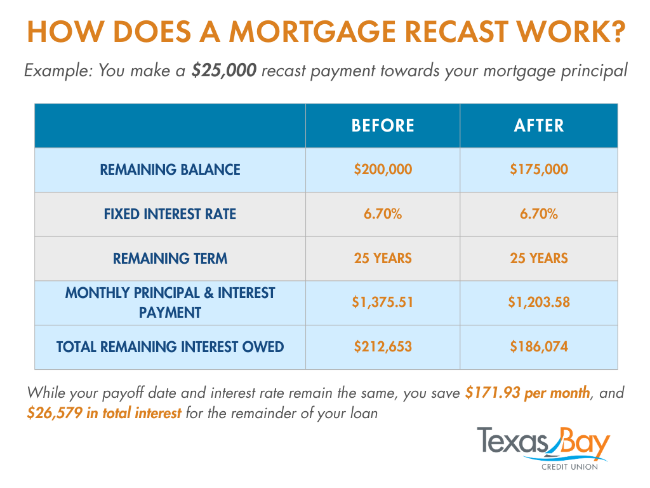
The graphic compares recasting with making no $25,000 payment. Its $26,579 of remaining interest saved is not the difference between recasting and making the same $25,000 prepayment without a recast. If the borrower prepays without recasting and continues paying $1,375.51, interest will generally be lower still, because principal is repaid more quickly.
The first month after either type of principal reduction makes the distinction tangible. Assuming the same payment date and monthly interest calculation, interest on $175,000 at 6.70% is approximately $977.08. Of the unchanged $1,375.51 payment, about $398.43 would reduce principal. Of the recast $1,203.58 payment, about $226.50 would reduce principal. The balance and first month’s interest are the same; the scheduled payment determines how fast the balance falls afterward.
For a concise overview before examining the terms, watch the indicated portions of Recasting vs. Refinancing: Which Mortgage Option is Better? from Marriage Kids and Money.
Recasting vs. Refinancing: Which Mortgage Option is Better?
Watch for the distinction between changing a payment schedule on an existing loan and replacing that loan. The final segment contrasts recasting with simply continuing to pay extra principal.
Watch recasting for the reduced-balance payment calculation, then refinancing for the new-loan distinction. At ordinary prepayment, focus on which payment is optional and which one the loan requires.
Read the payment instructions before projecting savings
For the next worked example, assume a hypothetical term sheet says the following:
- The account is current. Its $200,000 balance carries a fixed 6.70% rate, with 300 scheduled monthly payments of $1,375.51 in principal and interest remaining.
- The borrower may send additional money designated “principal only” after satisfying the amount currently due. This illustrative loan has no prepayment penalty.
- A recast is available after a principal reduction of at least $25,000, subject to a separate request and a $250 processing fee. Until the servicer confirms the new payment and effective date, the existing required payment remains due.
These are sample terms, not universal mortgage rules. They let us interpret the same $25,000 transaction without silently assuming how every servicer operates.
First, the $25,000 must actually reach principal. Sending money earlier than the due date, or paying more than the usual amount without clear instructions, does not by itself establish how the excess will be credited. A statement or transaction history should show both the principal reduction and the balance afterward. If the account is past due, or has a payment deferral or modification, payment application may follow different rules; the simple current-loan example does not cover those cases.
Fannie Mae’s Processing Additional Principal Payments gives a useful example of a servicing rule, rather than a promise that every mortgage has identical terms. Read its current-loan provision with that distinction in mind.
Processing Additional Principal Payments | Fannie Mae
Fannie Mae’s servicing guide shows why explicitly identifying additional money as principal matters for a current loan.
Under “Processing Additional Principal Payments for Current Mortgage Loans,” read the opening paragraph on principal payments and the following paragraph pointing to detailed processing procedures. Stop before the table about loans subject to a payment deferral or modification. Focus on the words “identified by the borrower as such” and on the fact that this provision addresses current loans.
The sample term sheet also says there is no prepayment penalty. That makes the ordinary $25,000 principal payment free of a prepayment penalty in this example; it does not make a later recast free. On another loan, a penalty clause could depend on when, how much, or under what circumstances principal is prepaid. The charge must be checked against that loan’s documents rather than inferred from its interest rate or an online calculator.
Finally, distinguish principal and interest from the total amount collected each month. If this sample loan also collects $320 for taxes and insurance through escrow, the initial amount remitted would be $1,695.51. An ordinary prepayment does not change its required $1,375.51 principal-and-interest component. After the illustrated recast, that component would be $1,203.58; if escrow remained $320, the total would be $1,523.58. Escrow can change independently, so a lower principal-and-interest payment need not produce an identical reduction in the total bill.
What a recast changes—and what it does not
A recast, also called a re-amortization of the remaining balance, ordinarily needs more than a qualifying lump-sum payment. Under our sample terms, the borrower must also request it, pay the $250 fee, and continue making the existing required payment until the new amount takes effect. The principal reduction and the payment change are separate events.
Rocket Mortgage’s Mortgage recasting: How it works and when to recast sets out that operational distinction. Its stated fee and eligibility requirements describe its own process; use the concepts, not those particular rules, when reading another servicer’s offer.
Mortgage recasting: How it works and when to recast | Rocket Mortgage
Read Rocket Mortgage’s explanation for the mechanics of recasting, the separate request, and the difference between a reduced balance and a reduced required payment.
In “What is a mortgage recast?”, read the explanation and the next sentence about the total monthly payment. In “How does recasting a mortgage work?”, follow the listed steps. Then, under “How to start the recasting process,” read from the paragraph beginning “When you speak with your servicer” through the distinction. Finish with “Mortgage recast vs. principal payment,” from the comparison. Focus on what requires a new request, rather than assuming a large payment triggers one automatically.
On the illustrative numbers, the recast reduces required principal and interest by $171.93 per month. Across 300 months, the graphic’s rounded payments imply $26,579 less remaining interest than the no-prepayment path. Under our additional hypothetical $250 recast fee, that would be $26,329 less in nominal interest-plus-fee costs. The $250 is not interest, and this subtraction does not account for the timing of cash flows; it is not an investment return on the $25,000.
A recast creates a useful option: the borrower can pay the new, lower required amount, or generally continue voluntarily paying more toward principal if the loan permits it. If the borrower keeps paying the old $1,375.51 as intended principal-and-interest payments after recasting, the balance would follow approximately the same accelerated path as a $25,000 prepayment without recasting, apart from the fee and any processing differences. The recast’s distinctive benefit is a lower required obligation, not a special reduction in the interest rate.
Refinancing starts a different loan
A refinance does not merely recalculate payments on the existing mortgage. It uses a new loan to pay off the old one. The new loan may carry a different rate, repayment term, or loan type, and its required payment follows its new terms. It also requires approval and may have application or closing costs.
Rocket Mortgage’s comparison is worth reading separately because it keeps “lower monthly payment” from obscuring why the payment changed.
Mortgage recasting: How it works and when to recast | Rocket Mortgage
Return to Rocket Mortgage for its direct recast-versus-refinance comparison, particularly the existing-loan/new-loan and fee distinctions.
Under “Mortgage recasting vs. refinancing,” read from the opening comparison. Stop after the bullets on costs. Focus on which route preserves the existing rate and remaining term, and which route requires qualification for new borrowing.
Imagine a separate hypothetical refinance offer: a new fixed-rate loan at 5.50% with a 25-year term and $3,000 in closing costs paid upfront. Its lower rate might produce a lower required payment, but that outcome comes from replacing the loan, not from recasting the 6.70% mortgage. The refinance offer must specify the new loan amount, term, fees, and payment before its costs can be compared fairly with either $25,000 principal-reduction path. A lower payment alone does not establish lower total cost: a newly extended term can mean paying interest for longer.
| Action under the sample terms | Principal balance after $25,000 is applied | Required principal-and-interest payment | Rate and remaining term | Charges to check |
|---|---|---|---|---|
| Ordinary prepayment | $175,000 | Still $1,375.51 | Existing 6.70%; usually paid off earlier if payments continue | Prepayment penalty, if the actual loan has one |
| Prepayment and recast | $175,000 | Illustrated $1,203.58 after approval | Existing 6.70% and 25-year remaining schedule | Sample $250 recast fee; eligibility and timing |
| Refinance | Set by the new loan | Set by the new loan | Set by the new agreement | Qualification and closing costs |
The table describes the sample arrangements, not a ranking of them. It also shows why a mortgage statement, recast estimate, and refinance quote answer different questions. The statement verifies how money was applied; the recast estimate specifies the revised required payment and effective date; the refinance quote specifies the terms and costs of a replacement loan.
What to retain
An ordinary prepayment reduces principal while generally leaving the required payment alone; continuing that payment tends to shorten payoff time. A recast follows a principal reduction but separately recalculates the required payment over the time remaining on the existing loan, without changing its existing fixed rate. A refinance replaces the loan and can change its rate, term, payment, and costs.
Before using any calculator result, establish how extra money will be credited, whether a prepayment penalty applies, whether a recast is available and must be requested, and which part of the monthly bill is actually changing. In the next module, the focus shifts from what the loan allows to how much cash a household can prudently commit while keeping reserves and near-term needs covered.