Welcome. This course begins with the mechanics of a mortgage payment before moving to extra payments, cash reserves, investing, and personal priorities. In this lesson, you will build a short amortization schedule: a month-by-month record of interest charged, principal repaid, and the balance still owed. That schedule is the starting point for calculating what changes when you pay extra later in the course.
Why a fixed payment has changing parts
A mortgage balance is the principal still owed. Each regular payment first covers the interest accrued on that balance during the period; the rest reduces principal. For a fixed-rate loan, the scheduled principal-and-interest payment can remain constant even though its two parts change. Once a payment reduces the balance, the next period’s interest is calculated on a smaller amount.
Read the short explanation and two-payment example in Fidelity’s What Is Amortization and How Does It Work? The example supplies the numbers behind the illustration below.
What is amortization and how does it work? | Fidelity
Fidelity explains why the interest share falls as a loan balance falls, then calculates the first two payments of a sample mortgage.
In “How does amortization work for a loan?”, read the payment explanation, from its opening sentence through the explanation of the changing principal share. In “Amortization example,” read the chart explanation. Then, in “How is an amortization schedule calculated?”, read the calculations, starting with the interest formula and ending after the second-payment calculation. Focus on which balance is used for each month.
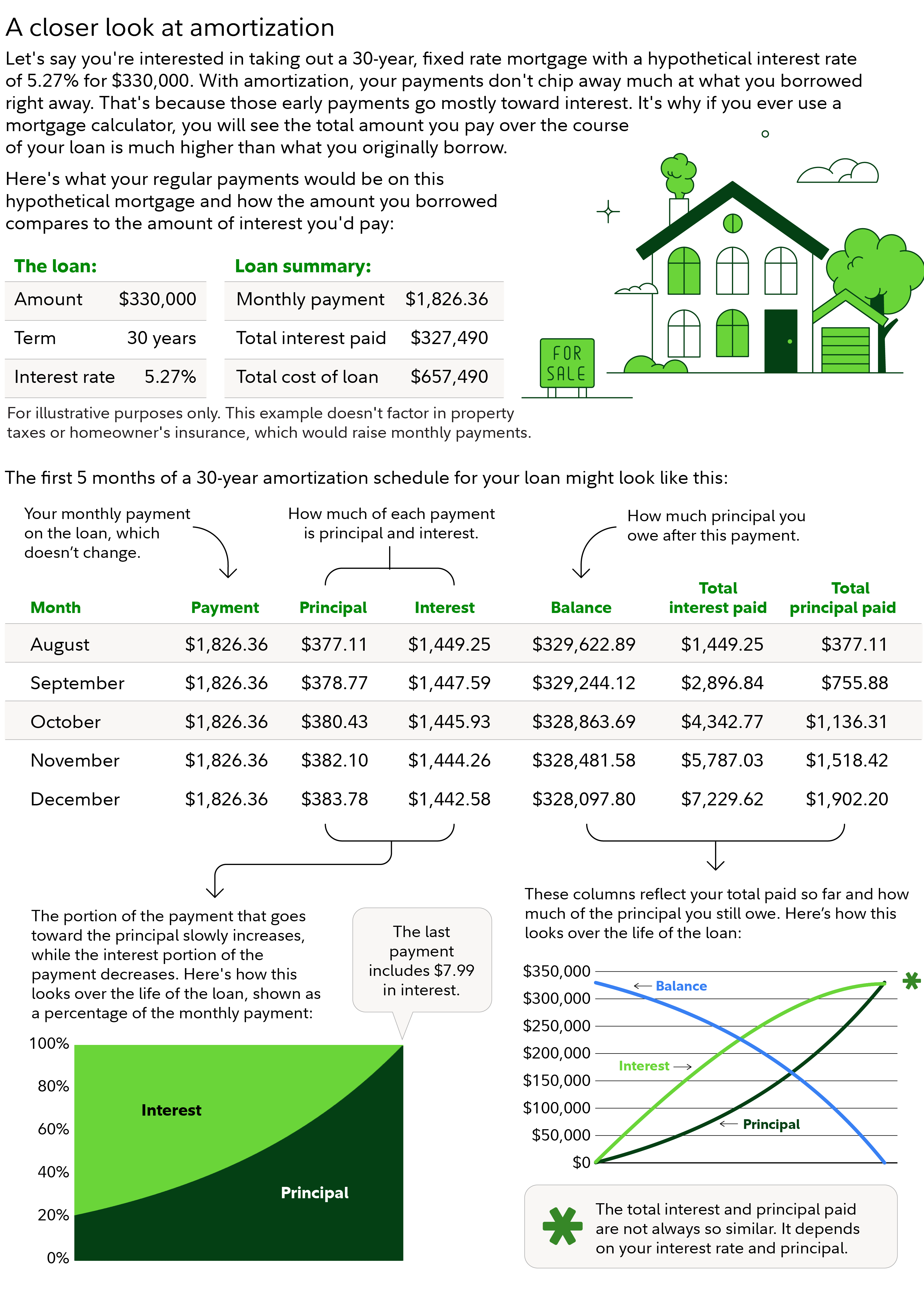
In the illustration, the first payment includes $1,449.25 of interest and $377.11 of principal repayment. Only the $377.11 reduces what is owed, leaving $329,622.89. The second month’s interest is calculated on that new balance—not on the original $330,000. “Early payments are mostly interest” describes this example, but the proportions depend on the rate, balance, and payment amount; it is not an extra charge imposed only at the start.
The calculation that generates every row
Suppose you are given a beginning balance, a stated annual interest rate, and a monthly principal-and-interest payment. For a simple schedule with monthly interest calculated at one-twelfth of the annual rate, convert the annual percentage to a decimal and divide by 12. At 6%, the monthly rate is , or 0.5%.
Let be the balance just before payment , the regular monthly payment, and the monthly interest rate. Calculate each row in this order:
The ending balance becomes the next row’s beginning balance. That one carry-forward step is what makes this a schedule rather than a collection of separate interest calculations.
Watch the worked demonstration before applying the same method to a new set of figures. The video’s example starts with a $400,000 balance at a 5% fixed annual rate and a supplied monthly payment of $2,147.29; you can skip the earlier portion that derives that payment.
How To Calculate The Monthly Interest and Principal on a Mortgage Loan Payment
In “How To Calculate The Monthly Interest and Principal on a Mortgage Loan Payment,” The Organic Chemistry Tutor calculates a first payment and then carries its ending balance into the following rows.
Watch the first split for the initial interest and principal amounts. Continue with the schedule to see the balance carried into months two and three. Keep track of the balance used to calculate each month’s interest; the payment amount itself stays fixed.
Build a four-month schedule
Consider a loan with a $120,000.00 beginning balance, a 6% fixed annual interest rate, and a $900.00 monthly principal-and-interest payment. Assume each month’s interest equals the beginning balance multiplied by , rounded to the nearest cent.
For month 1, interest is . Subtract that from the $900.00 payment: $300.00 repays principal. The balance after payment is therefore $119,700.00.
Month 2 begins at $119,700.00, not $120,000.00. Its interest is ; the remaining $301.50 of the payment reduces principal. Repeating those operations gives:
| Month | Beginning balance | Payment | Interest | Principal repaid | Ending balance |
|---|---|---|---|---|---|
| 1 | $120,000.00 | $900.00 | $600.00 | $300.00 | $119,700.00 |
| 2 | $119,700.00 | $900.00 | $598.50 | $301.50 | $119,398.50 |
| 3 | $119,398.50 | $900.00 | $596.99 | $303.01 | $119,095.49 |
| 4 | $119,095.49 | $900.00 | $595.48 | $304.52 | $118,790.97 |
Month 3 illustrates why cent-rounding matters: , recorded here as $596.99 of interest. Subtract that rounded amount from $900.00 to obtain $303.01 of principal repayment, then carry the new balance forward.
Two checks help catch mistakes. In every row, interest plus principal repaid equals the payment, and beginning balance minus principal repaid equals ending balance. Across these four rows, payments total $3,600.00: $2,390.97 in interest and $1,209.03 in principal repayment. The original balance less that $1,209.03 is the final $118,790.97 shown in the table.
This is a simplified monthly model. An actual lender may use daily interest, different payment timing, or a different rounding convention, so a statement can differ by a small amount. Property taxes, insurance, and similar amounts collected with a mortgage payment are also not principal-and-interest; do not include them in when splitting the loan payment. Finally, this ordinary repayment pattern assumes the payment exceeds the month’s interest. If it does not, the balance will not fall as shown here.
What to retain
To construct a schedule, start each row with the balance currently owed, calculate that period’s interest, subtract interest from the regular principal-and-interest payment, and subtract the resulting principal repayment from the balance. Repeat using the new balance. A fixed payment can therefore pay less interest and more principal over time without changing its total.
The next lesson uses this baseline schedule to measure how an extra principal payment changes remaining interest and the payoff date while the regular payment stays unchanged.