News reports often use “Ebola” as though it names one virus. It can instead mean a group of related diseases, and that distinction matters when you interpret an outbreak report. This first module follows the path from exposure to illness; today’s lesson establishes the naming you will need before examining incubation, symptoms, and transmission. Later modules will cover diagnosis, care, outbreak control, and vaccines.
By the end of this lesson, you should be able to tell whether a report identifies Ebola virus (often called Zaire), Sudan virus, or Bundibugyo virus—and recognize when a report does not identify the virus at all.
One disease family, three names to recognize
Ebola disease is caused by viruses in the Orthoebolavirus genus. The three viruses responsible for most large outbreaks are related, but they are not interchangeable. In particular, Ebola virus is the formal name of one virus; “Ebola” is also used informally as an umbrella term. That overlap is the main source of confusion.
Start with the World Health Organization’s overview. It establishes the broader disease category and introduces a practical reason to distinguish its causes.
Read the World Health Organization’s “Ebola disease” overview to establish what the shared disease name does—and does not—tell you.
In “Overview,” begin at the paragraph starting “Ebola disease is caused by viruses that belong to the” and read the overview through its final sentence about candidate products. Focus on the distinction between Ebola disease generally and the specifically named Ebola virus disease.
For reading reports, this compact guide is more useful than memorizing the full scientific taxonomy:
| If a report names… | Identify the cause as… | Disease wording you may encounter |
|---|---|---|
| Ebola virus, EBOV, or Zaire | Ebola virus | Ebola virus disease |
| Sudan virus or SUDV | Sudan virus | Sudan virus disease |
| Bundibugyo virus or BDBV | Bundibugyo virus | Bundibugyo virus disease |
“Zaire” is an older name that remains common in coverage of Ebola virus. It is a naming clue, not an instruction to infer the virus from the outbreak’s location. Likewise, a report about cases in Sudan does not, on location alone, establish that Sudan virus caused them.
The distinction between virus and disease also helps. A virus is the infectious agent; disease describes the illness it causes. “Ebola disease” can describe the broader category. WHO uses “Ebola virus disease” specifically for disease caused by Ebola virus, alongside “Sudan virus disease” and “Bundibugyo virus disease.” News articles may be less consistent, so look for an explicit virus name rather than relying on the word “Ebola” by itself.
How the names appear in outbreak accounts
The CDC’s outbreak history puts the three names beside concrete examples. Read its short comparison first, then two reports from the same year. Notice how a report can say “Ebola” near the beginning but become more informative when it states what laboratory testing confirmed.
History of Ebola Outbreaks | Ebola | CDC
Read the CDC’s comparison of the three viruses and its 2025 outbreak entries to see how virus identity is stated in real reporting.
In “About the outbreaks,” read from “The Ebola virus, Sudan virus, and Bundibugyo virus are the three viruses responsible for most large outbreaks in Africa” through the Bundibugyo account. Then, under “Cases and outbreaks by year,” find “2025.” Read the “Democratic Republic of the Congo (DRC)” entry beginning with the September 4 declaration and the following “Uganda” entry ending with its April 26 declaration: the two entries. Pay particular attention to “confirmed Ebola virus” in one entry and “Ebola (Sudan virus)” in the other.
Those two entries demonstrate a reliable reading habit: separate the announcement of suspected Ebola disease from the identification of its cause. The DRC entry specifies that laboratory samples confirmed Ebola virus. The Uganda entry names Sudan virus. The country name alone would not have established either result.
Now consider Bundibugyo virus in a short piece of outbreak coverage. The speaker contrasts it with the virus called Zaire; listen for the name that changes how the report must be read.
Ebola: Everything you need to know about the outbreak | The Global Story
Watch the opening of BBC News’s “Ebola: Everything you need to know about the outbreak” for a spoken example of distinguishing Bundibugyo from Zaire.
Watch the species contrast, from the question about which virus is involved through the comparison with the better-known Zaire outbreak. The speakers use “strain” and “variant” informally; for this lesson, retain the more precise point that Bundibugyo virus and Ebola virus are distinct viruses.
The supplied travel-health map offers another form of evidence, but also a limitation.
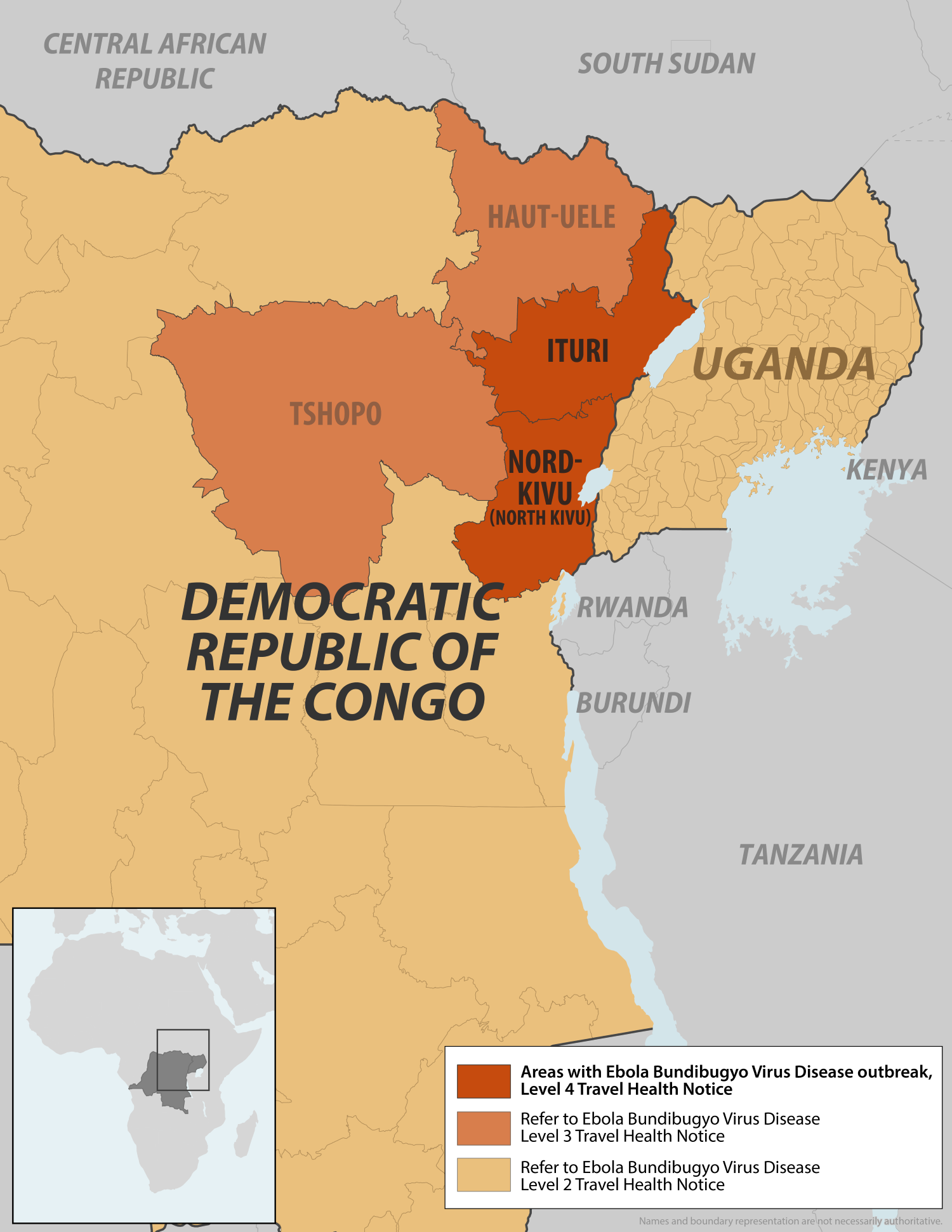
Here, “Bundibugyo Virus Disease” in the legend identifies the cause being discussed. The numbered notice levels describe travel advice for mapped areas; they do not classify viruses. Nor should an undated map be treated as a live statement about where an outbreak is occurring now. Its value here is showing where to find the decisive wording in a visual report: the legend, not merely the colors or the country names.
What to conclude—and what to leave open
When a report explicitly says Ebola virus, Sudan virus, or Bundibugyo virus, you can identify its subject. When it says only “Ebola cases,” “an Ebola outbreak,” or “a suspected Ebola infection,” the virus may still be unspecified. Do not fill that gap from the location, the severity of illness, or memories of an earlier outbreak. Reports can become more specific as laboratory findings are reported.
Virus identity matters without making every other detail predictable. The CDC history describes differences between outbreaks, but a fatality figure from one outbreak is not a fixed property that lets you identify its virus in a new one. Care and outbreak circumstances also affect outcomes. In the same way, all three can cause serious disease, so the name alone does not tell you an individual patient’s course.
There is, however, an immediate practical reason to preserve the distinction: WHO notes that licensed vaccines and virus-targeted therapeutics are available for Ebola virus disease, while approved counterparts are not available for Sudan or Bundibugyo virus disease. This does not mean that care is unavailable for the latter two; supportive care remains important. The details of treatments and vaccines belong later in the course, but their different applicability is already a reason not to treat “Ebola” as a single precise diagnosis.
A dependable way to read the next outbreak headline is to record the explicitly named virus, if any, and keep “not yet specified” as a valid answer. That small discipline prevents a report about Bundibugyo or Sudan virus from quietly becoming a report about Ebola virus in your understanding.
You have met the lesson’s central distinction: “Ebola” may be an umbrella label, while Ebola virus (Zaire), Sudan virus, and Bundibugyo virus identify different causes. Explicit naming or laboratory identification carries more weight than geography, symptoms, or a headline’s shorthand. Next, you will follow what happens after exposure, from viral multiplication through the incubation period to the first symptoms.