Welcome back. In the previous lesson, you distinguished Ebola virus (often called Zaire), Sudan virus, and Bundibugyo virus instead of treating every “Ebola” report as an account of the same infection. The timeline in this lesson applies broadly to Ebola disease caused by these viruses: exposure, multiplication inside the body, an incubation period, and then the first symptoms.
That timeline will help you interpret a report that says someone became ill days after a possible exposure. It also establishes an important boundary for later lessons: days since exposure and days since symptoms began measure different things.
What happens between exposure and illness?
Exposure does not automatically mean infection. The virus must reach a place where it can enter the body, and an infection must become established. We will examine which kinds of contact make that plausible in a later lesson. For now, imagine a person has had an exposure that could lead to infection, and call the day of that exposure day 0.
If infection takes hold, the virus enters cells and uses their machinery to make copies of itself. Some of the cells it infects are immune cells, which normally help defend the body. As new virus particles are produced, infection can spread to other cells and tissues. This is an active process even though the person may still feel entirely well.
The short segment below shows that cellular part of the story. Focus on the difference between a virus entering a cell and the cell producing many new virus particles; you do not need to memorize the cell terminology.
Watch “Ebola Virus” by Armando Hasudungan for a visual account of how infection multiplies inside human cells.
In the segment on human infection, start at cellular multiplication. Watch the immune cell take up virus, the production of more virus, and the connection the presenter makes to the eventual appearance of symptoms. Treat the drawings as a simplified model, not a timetable for when each cellular event occurs.
The body responds to infection, including by releasing inflammatory signals. The first noticeable illness reflects this developing interaction between virus and body. There is no fixed day on which viral multiplication suddenly becomes symptoms for everyone.
The incubation clock
The incubation period is the time from infection or the exposure that caused it to the first symptoms. It is not the length of the whole illness. During incubation, an infected person has no symptoms, even though the virus is multiplying.
Read the CDC’s short statement of the timing before applying it to a timeline. The range and the average answer different questions.
Signs and Symptoms of Ebola Disease | Ebola | CDC
Read the CDC’s “Signs and Symptoms of Ebola Disease” for its exposure-to-symptom window.
Under “Early symptoms,” read the timing paragraph, ending with the sentence that calls the first symptoms “dry” symptoms. Focus on the distinction between the full range and when symptoms begin on average.
Symptoms may appear 2 to 21 days after exposure; 8 to 10 days is the average time to their appearance. An average is not a deadline. Someone who feels well on day 11 has passed the average, but has not passed the full incubation window.
The illustrated timeline below keeps the clocks separate:
| Time | What it means |
|---|---|
| Exposure day 0 | Contact occurs. Whether infection takes hold is not yet established by the contact alone. |
| Following symptom-free days | If infection has taken hold, the virus can multiply without noticeable illness. |
| First symptom, perhaps on day 9 | Incubation ends. Day 0 of illness begins, although it is day 9 since exposure. |
| Later days | Illness may develop further. These are counted from symptom onset when describing its progression. |
Day 9 is an example, not a prediction. The first symptom might appear earlier or later within the 2–21-day window. If a person remains well through 21 days after a single possible exposure, illness from that exposure becomes very unlikely. A new exposure would need its own clock; it would not be dated from the first one.
Why the symptom boundary matters
The ECDC infographic depicts an exposed person who is infected but asymptomatic separately from a symptomatic, infectious person. Its full diagram also shows ways outbreaks spread and are controlled; here, concentrate on the upper portion and the incubation label.
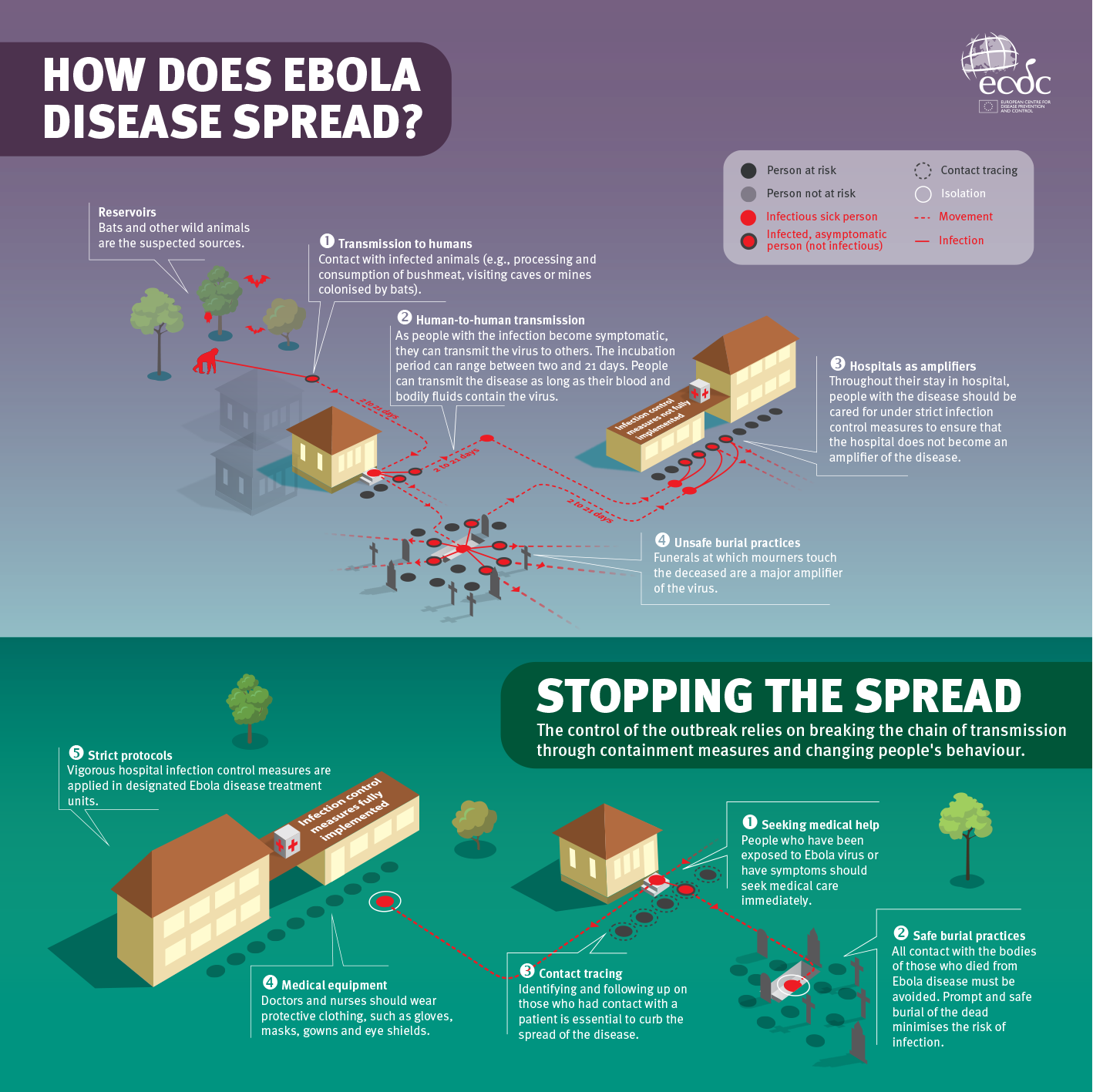
In the usual public-health description of Ebola disease, people do not spread it before they develop symptoms. That is why an infected person can pass through an incubation period without causing onward transmission. Symptom onset changes the situation: it marks the end of incubation and the point at which precautions around a suspected case become urgent. The precise transmission routes and precautions come later; for this lesson, keep the distinction between virus multiplying within someone and virus spreading from that person to someone else.
The first symptoms can be general, such as fever, tiredness, or body aches. Their appearance does not by itself prove Ebola disease—many illnesses begin similarly. Nor must a person have striking symptoms for the incubation period to have ended. A later lesson will look at the fuller symptom pattern, and another will cover how exposure history and testing inform diagnosis.
Conclusion
A useful timeline begins with a possible exposure on day 0. If infection takes hold, the virus uses cells to make more virus while the person may feel well. Incubation ends when the first symptom appears, usually around 8–10 days after exposure but potentially anywhere in the 2–21-day window. From then on, distinguish days since exposure from days of illness.
Next, you will follow the course of symptoms after that first day of illness—including why bleeding is not required to suspect Ebola disease.