Hello! Welcome to your fourth lesson in AI Fundamentals for Clinicians.
In our last session, we opened up the "black box" to see how a neural network processes information. We learned that it uses layers of neurons to build up recognition from simple patterns (like edges) to complex concepts (like a crown on a radiograph).
We ended with a crucial question: How does the network learn the right values for its millions of weights and biases to make these accurate predictions? The answer, in one word, is data.
Today's lesson focuses entirely on this "fuel" for AI. Our goal is to explain the role of training data and why data quality is critical for AI performance. As a future clinician who will use and evaluate AI tools, understanding the data behind the model is arguably the most important skill you can develop. It's the key to separating effective, reliable AI from a tool that might make critical errors.
1. Training an AI: Learning from Examples
In our second lesson, we established that most dental AI uses supervised learning. This means the AI learns by studying a vast number of examples prepared by human experts. The collection of these examples is called the training dataset.
Each example in the training dataset consists of two parts:
- The Input: The raw data you want the AI to analyze (e.g., a dental radiograph).
- The Label (or Ground Truth): The "correct answer" for that input, provided by an expert (e.g., the same radiograph with a carious lesion precisely outlined by an oral radiologist).
The AI's training process is a loop: it looks at an input, makes a prediction, compares its prediction to the expert's label, and then slightly adjusts its internal weights and biases to reduce the error. It repeats this process millions of times with thousands of examples until its predictions consistently match the ground truth.
To see this in action, let's watch a short video that explains this core concept using the example of training a model to detect pneumonia on chest X-rays.
Module 3 - AI in Medical Education : Types of Clinical Data & Asking the Right Questions
This clip from "Module 3 - AI in Medical Education" clearly illustrates the training phase of an AI model using input-output data pairs.
Watch from 05:59 to 07:35. Focus on how the chest X-rays (inputs) and the corresponding labels (pneumonia positive/negative) are used in the 'training phase' to create a 'model'.
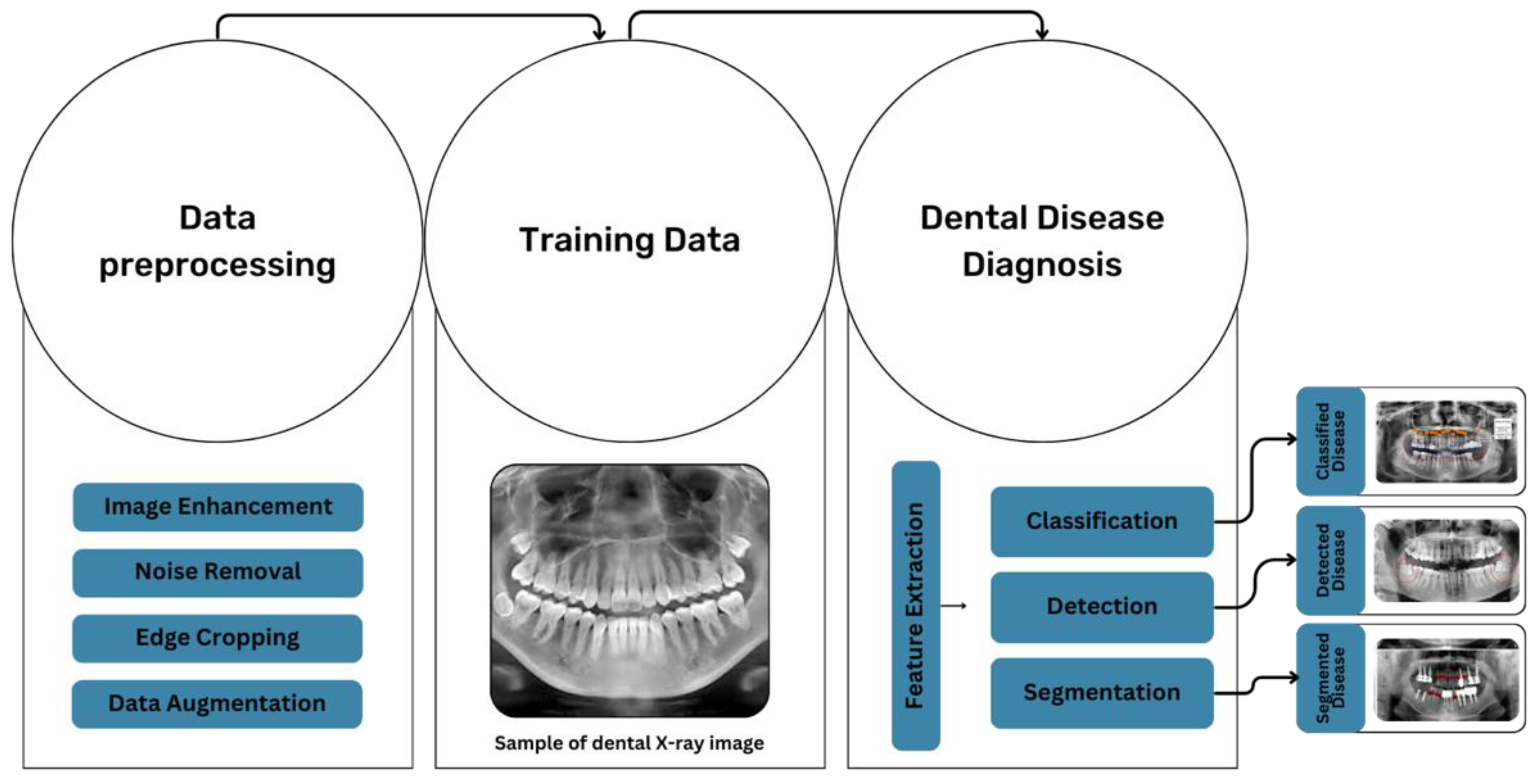
This process of preparing data for training is a major undertaking. The following image shows a typical workflow for a dental AI system. Notice how raw X-ray images go through several preprocessing steps before they even become "Training Data".
To solidify these concepts, let's turn to a white paper from the American Dental Association (ADA) for some formal definitions.
Overview of Artificial and Augmented Intelligence Uses in ...
The ADA's "Overview of Artificial and Augmented Intelligence Uses in..." provides standard definitions for the key terms we're discussing.
Read the definitions for 'Training Dataset' and 'Ground Truth'. These are essential terms you'll encounter frequently when reading AI research.
2. The Golden Rule: Garbage In, Garbage Out
An AI model is a reflection of the data it was trained on. It has no independent knowledge or clinical judgment. This leads to the most important principle in applied AI: Garbage In, Garbage Out (GIGO).
If you train a model on low-quality, inaccurate, or biased data, you will get a low-quality, inaccurate, and biased AI model, no matter how sophisticated its neural network is.

So, what constitutes "garbage" or low-quality data in a dental context? There are three primary culprits:
- Inaccurate labels (poor ground truth).
- Unrepresentative or biased data.
- Insufficient data variety.
Let's break these down.
2.1 The Challenge of "Ground Truth"
The term Ground Truth refers to the expert-provided labels that the AI learns to mimic. But what if the experts are wrong, or what if they disagree?
Establishing a perfect ground truth is one of the biggest challenges in medical AI.
- Expert Disagreement: It's well-documented that even experienced clinicians can disagree on radiographic interpretations. If one expert labels a shadow as incipient caries and another calls it a non-carious anomaly, which one should the AI learn from?
- The "Gold Standard": The absolute gold standard for caries detection would be a histological examination (biopsy) of the tooth, but this is almost never feasible. Therefore, AI developers must rely on a proxy, which is typically a consensus reading by a panel of expert oral and maxillofacial radiologists (OMRs).
This reliance on human expertise has a critical implication.
Overview of Artificial and Augmented Intelligence Uses in ...
Let's return to the ADA white paper, which discusses this very issue.
In the Appendix, find the subsection 'Neural Network Learning'. Read the paragraph that begins 'Since the point of such training is to mimic the behavior of the taggers...'. This highlights a fundamental limitation of supervised learning.
As the text states, a supervised AI can generally not be better than the experts who trained it. It can, however, be more consistent, as it doesn't suffer from fatigue or distraction.
The expertise used to label the data is what gives the data—and the resulting AI—its value.
Module 3 - AI in Medical Education : Types of Clinical Data & Asking the Right Questions
In this Q&A, a leading AI researcher is asked about the importance of expert annotation. His answer is very telling.
Watch from 46:38 to 48:40, and then from 55:54 to 57:09. Listen for his view on the value of data without expertise and why domain experts (i.e., clinicians) are essential in the data creation process.
2.2 The Danger of Data Bias
A model will only perform well on data that looks like the data it was trained on. If the training dataset isn't representative of the diverse patient population you'll see in your clinic, the AI's performance can drop dramatically, and it can even perpetuate and amplify existing health disparities. This is known as data bias.
Imagine an AI trained to detect bone loss, but its training data consists only of radiographs from patients aged 50-70. How well would it perform on a 25-year-old patient with aggressive periodontitis? It might miss the diagnosis because it hasn't "seen" that pattern in that demographic before.
The following TEDx talk gives a powerful, real-world example of this problem in medicine.
Artificial intelligence in healthcare: opportunities and challenges | Navid Toosi Saidy | TEDxQUT
In this clip from "Artificial intelligence in healthcare: opportunities and challenges," the speaker explains data bias using a skin cancer detection app.
Watch from 05:59 to 06:54. Notice how training a model on a predominantly Caucasian population can lead to poor performance on other ethnicities.
This is why, when you evaluate a commercial AI product or a research paper, one of the first questions you should ask is: "On what population was this model trained and tested?" An AI trained exclusively on data from a North American population may not be as effective for patients in your local community if there are significant demographic or environmental differences.
Test your understanding!
A startup company develops an AI to detect third molar impaction. They source all of their training data—10,000 panoramic radiographs—from a single university's oral surgery department. What are two potential sources of bias in this dataset, and how might they affect the AI's performance in a general dental practice?
Show answer
- Selection Bias: The data comes from an oral surgery department, which is a referral center. The cases are likely to be more complex, severe, or symptomatic than those seen in a typical general practice. The AI might become very good at detecting severely impacted molars but may perform poorly at identifying earlier, less obvious cases that a general dentist would want to monitor.
- Demographic Bias: University populations are often skewed towards a specific age group (e.g., 18-25 year olds). If the training data primarily reflects this age range, the AI might be less accurate for detecting or evaluating third molars in older or younger patients. Furthermore, the population around a single university may not be ethnically or socioeconomically diverse, limiting the model's generalizability.
2.3 Data Quantity vs. Variety
Finally, it's not just about the number of images. Variety is often more important than sheer quantity. A training set with 10,000 bitewings from the same X-ray machine, with perfect positioning, is less valuable than a set of 2,000 bitewings that includes:
- Images from different sensors and machines.
- Radiographs with minor positioning errors or artifacts.
- Patients of various ages, genders, and ethnicities.
- A wide spectrum of conditions (from healthy to advanced disease).
An AI trained on a "messy," diverse dataset is more robust and more likely to perform well in the unpredictable reality of a daily dental clinic.
AI vs Radiographs: Caries Detection Accuracy
This short article about caries detection AI summarizes the importance of data quality concisely.
Read the first paragraph under 'AI System Limitations' and the FAQ at the end titled 'What challenges do AI and traditional radiographs face...'. Note how they both point to the quality and diversity of training data as a key challenge.
Conclusion
Today, we've established that data is the lifeblood of AI. Without high-quality, expertly labeled, and representative training data, even the most advanced neural network architecture is useless.
Key Takeaways:
- AI models learn by minimizing the difference between their predictions and the Ground Truth provided by experts in a training dataset.
- The performance of an AI is fundamentally limited by the quality of its training data—the principle of "Garbage In, Garbage Out."
- High-quality data must be accurately labeled by experts, representative of the target patient population to avoid bias, and contain sufficient variety to ensure the model is robust in real-world conditions.
- As a clinical user, one of your most important jobs is to be a critical appraiser of the data behind any AI tool you consider using.
In our previous lessons, we've defined AI, explored how it learns, peeked inside a neural network, and now we understand the data that fuels it. We're now ready to see what these systems actually do. In our next lesson, we will identify the most common AI tasks in dentistry: classification, detection, and segmentation.