Hello! Welcome to your third lesson.
In our last session, we explored the three main ways an AI model learns: supervised, unsupervised, and reinforcement learning. We established that supervised learning, where the AI learns from expert-labeled examples, is the foundation for most diagnostic AI tools in dentistry.
Today, we're going to look inside the "black box" and explore the engine that drives this learning: the artificial neural network (ANN). Our goal is to understand conceptually how a neural network takes an input, like the pixels of a radiograph, and processes it through a series of layers to produce a final prediction, such as "caries detected."
Understanding this structure is essential for you as a future clinician. It demystifies how AI software arrives at its conclusions and provides the conceptual framework needed to interpret the AI research you'll encounter throughout your career.
1. The Anatomy of a Neural Network: Neurons and Layers
The term "neural network" is inspired by the human brain, but an artificial neuron is much simpler. For our purposes, think of a neuron as just a container that holds a number.
Let's begin with a fantastic video from 3Blue1Brown that introduces the basic structure of a neural network using the classic example of recognizing handwritten digits. This is a great analogy for how an AI might learn to recognize a clinical finding in an image.
But what is a neural network? | Deep learning chapter 1
This first clip from "But what is a neural network?" will introduce you to the core components: neurons and layers.
Watch from 02:43 to 04:39. Pay close attention to the concepts of neurons as number-holders ('activations') and the three types of layers: input, hidden, and output.
As the video explained, a neural network is organized into layers:
- Input Layer: This is where the raw data enters the network. For a dental radiograph, each neuron in the input layer would represent a single pixel, and its activation would be a number corresponding to that pixel's brightness (e.g., 0 for black, 1 for white).
- Output Layer: This is the final layer that gives the prediction. For an AI that detects caries, the output layer might have two neurons: one for "caries" and one for "no caries." The neuron with the higher activation value is the network's prediction.
- Hidden Layers: These are all the layers in between. They are called "hidden" because their values aren't directly specified as inputs or read as outputs. This is where the real "thinking" or processing happens.
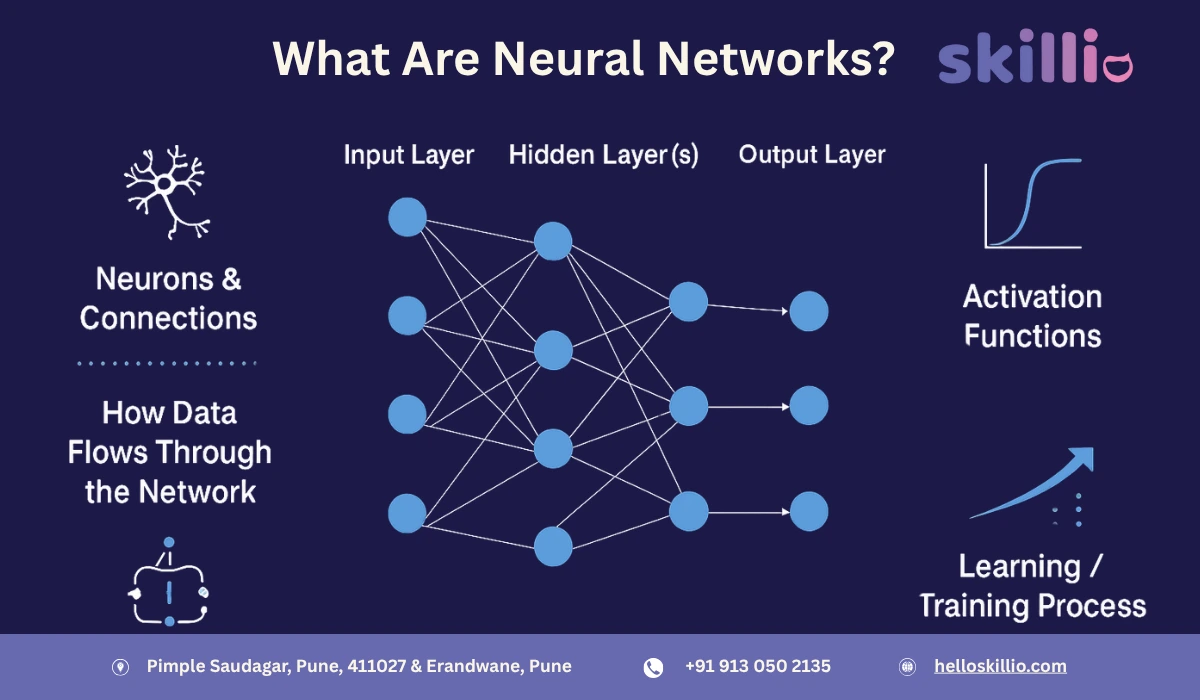
This layered structure is the standard for almost all AI in medical and dental imaging.
Use of Artificial Intelligence in Dentistry
The article "Use of Artificial Intelligence in Dentistry" confirms this structure within a clinical context. It also introduces a specific type of network commonly used for images.
Read the two paragraphs starting with 'An extremely popular class of DL algorithms...'. Notice the description of input, output, and hidden layers, and the mention of Convolutional Neural Networks (CNNs) being ideal for image analysis.
2. How Information Moves Through the Network
So, how do the activations in one layer determine the activations in the next? The process involves three key ingredients: weights, biases, and an activation function.
The next clip from the 3Blue1Brown video explains this mechanism brilliantly without getting lost in heavy mathematics.
But what is a neural network? | Deep learning chapter 1
This section explains the mechanics of how a neuron calculates its activation based on inputs from the previous layer.
Watch from 08:30 to 12:31. Focus on understanding the conceptual roles of weights, the weighted sum, the bias, and the 'squishification' of the activation function.
Let's recap the key ideas from the video:
- Weights: Every connection between neurons in adjacent layers has a weight. A weight is just a number that represents the importance of that connection. A high positive weight means the input from the first neuron strongly excites the second neuron. A negative weight means it inhibits it.
- Weighted Sum: A neuron takes the activation values from all the neurons in the previous layer and calculates a weighted sum. It multiplies each incoming activation by its corresponding connection's weight and adds them all up.
- Bias: This is an extra number that's added to the weighted sum. You can think of it as making a neuron more or less likely to activate, regardless of its inputs. It's a measure of how "trigger-happy" the neuron is.
- Activation Function: The final result (weighted sum + bias) is passed through an activation function, which "squishes" the value into the 0-to-1 range that represents the neuron's final activation. If the result is high, the activation will be close to 1; if it's low or negative, it will be close to 0.
This process is repeated for every neuron, layer by layer, until the wave of activations reaches the output layer, giving the final prediction. The entire network, with its thousands of weights and biases, is essentially one giant, complex mathematical function.

3. The "Intelligence" of Hidden Layers: From Simple to Complex
This brings us to the most fascinating question: What are the hidden layers actually doing? Why is this structure intelligent?
The key insight is that neural networks learn to recognize things in a hierarchy of abstraction. Early layers learn to detect very simple patterns, and subsequent layers combine those simple patterns into more complex concepts.
But what is a neural network? | Deep learning chapter 1
Let's return to the 3Blue1Brown video to get an intuition for this hierarchical feature detection.
Watch from 05:36 to 08:30. The video proposes a 'best hope' for what hidden layers do: combining pixels into edges, edges into sub-components (like loops), and sub-components into full digits.
This idea of building complex features from simple ones is exactly how modern AI works, especially in image analysis. Let's see how this applies to recognizing more complex images, like animals—or, by extension, clinical findings.
What Do Neural Networks Really Learn? Exploring the Brain of an AI Model
The video "What Do Neural Networks Really Learn?" by Rational Animations provides excellent visualizations of this process in a real-world image classifier.
First, watch from 03:39 to 05:11 to understand how 'filters' in early layers detect simple features like edges. Then, watch from 09:49 to 13:45 to see how the network combines simple features (like curves) into more complex ones (like circles, and eventually, entire car bodies or dog heads).
Now, let's apply this powerful concept to dentistry. Imagine an AI trained to detect a crown on a radiograph:
- Early Hidden Layers: Neurons in these layers would act like the simple "edge detectors" from the video. They might learn to activate when they see a sharp transition from dark to light, corresponding to the margin of a restoration or the outline of a tooth.
- Middle Hidden Layers: Neurons here would combine the signals from the edge-detecting neurons. They might learn to recognize specific shapes, like the flat plane of an occlusal surface, the smooth curve of an axial wall, or a large area of uniform radio-opacity characteristic of a metal or ceramic.
- Late Hidden Layers: Finally, neurons in the later layers would combine these complex shapes. A neuron might learn to fire only when it receives signals corresponding to a "tooth-shaped object" underneath a "restoration-shaped object," leading to the final classification of "crown."
The AI isn't programmed to look for these things. It discovers this hierarchy of features on its own during the training process, simply by adjusting its weights and biases to minimize its errors on the labeled training data.
Test your understanding!
Imagine a neural network designed to identify interproximal alveolar bone loss on a vertical bitewing radiograph. Based on the concept of hierarchical feature detection, describe the likely patterns or features that neurons in the early, middle, and late hidden layers might learn to recognize.
Show answer
-
Early Hidden Layers: These neurons would likely learn to detect fundamental patterns in the radiograph. This would include simple horizontal and vertical edges, gradients in radiodensity, and basic textures. For example, a neuron might activate strongly on the sharp, bright line of the enamel, while another might activate on the more diffuse texture of trabecular bone.
-
Middle Hidden Layers: These neurons would combine the simple features from the early layers into more clinically relevant structures. For example:
- One neuron might learn to recognize the Cemento-Enamel Junction (CEJ) by combining signals that represent the junction of the enamel cap and the root surface.
- Another might learn to identify the alveolar crest by detecting the uppermost horizontal boundary of the bone between two teeth.
-
Late Hidden Layers: Neurons in these final hidden layers would learn to recognize the relationship between these complex structures. A neuron might learn to fire (i.e., detect bone loss) when the "alveolar crest" feature is located significantly apical to the "CEJ" feature. The network would learn the specific spatial relationship and distance that an expert clinician would identify as bone loss.
Conclusion
In this lesson, we've conceptually unpacked the mechanics of a neural network. We've moved from seeing it as a "black box" to understanding it as a structured, hierarchical information-processing system.
Key Takeaways:
- A neural network is composed of layers of neurons, which are simple units that hold a numerical activation.
- Information flows from an input layer (raw data), through hidden layers (processing), to an output layer (prediction).
- The connections between neurons have weights, and neurons have biases, which together determine how activations propagate through the network.
- The power of hidden layers lies in their ability to learn a hierarchy of features, building from simple patterns (like edges) to highly complex concepts (like a carious lesion or a crown).
We now know what a neural network is and how it processes data. But how do the millions of weights and biases get set to the right values to make accurate predictions? That is the process of training. In our next lesson, we will focus on the fuel for this process: the training data, and explore why the quality and quantity of this data are absolutely critical for an AI's performance.