Introduction
Welcome to our new module, "Critically Appraising AI Research in Dentistry"! In the previous module, we focused on the practical skills needed to be an effective AI user—how to work with AI software, interpret its findings, and integrate it into your clinical workflow and documentation.
Now, we're going to shift our perspective from being a user to being an astute evaluator. Before you decide to trust and use an AI tool, you need the skills to look past the marketing and critically assess the scientific evidence behind it. This module is designed to give you that ability.
Today's lesson is the first step on that journey. Our goal is to identify the key components of a dental AI validation study. Think of it like learning the basic anatomy of a research paper. Before you can diagnose its health and validity, you need to know how to locate and understand its essential parts. We will focus on four core components: the dataset, the ground truth, the model, and the results.
The Anatomy of an AI Validation Study
Just as a clinical trial paper has a standard structure (like PICO: Population, Intervention, Comparison, Outcome), AI validation studies follow a predictable pattern. When you open a paper claiming to have developed a new AI for detecting caries, you should be looking for these four fundamental building blocks.
- Dataset: The collection of data (e.g., radiographs) used to build and test the AI.
- Ground Truth: The "correct answers" or reference standard used to teach the AI and measure its success.
- Model: The specific AI algorithm or architecture that performs the analysis.
- Results: The performance metrics and visual outputs that demonstrate how well the AI performed its task.
Let's break down each of these components.
1. The Dataset: The AI's "Textbook"
The dataset is the raw material from which the AI learns. In dental AI, this is typically a large collection of images, such as bitewing radiographs, panoramic X-rays, or CBCT scans.
The quality, size, and diversity of this dataset are perhaps the most critical factors influencing an AI model's real-world performance. A model trained only on images from one clinic with one type of X-ray machine may fail completely when used in a different setting.
To understand how this dataset is used, let's review the fundamental process of creating a dental AI model.
An Intro to AI and Dental Caries Detection
This guide from MetDental provides an excellent, concise overview of how a dental AI is developed. It explains the role of data at each stage.
Please read two parts of this document: Start with the section titled 'How Do Dental Caries Detection AI Applications Work?' and read step 1, 'Data Collection.' Then, scroll to 'Appendix 1: Fundamental AI Terminology' and read the definitions for Training Data, Validation Data, and Test Data. Focus on understanding why the dataset is split into these three distinct parts.
As you read, the key concept to grasp is the separation of data. An AI model is:
- Trained on the training set to learn patterns.
- Tuned and adjusted during development using the validation set.
- Finally evaluated on the test set—a completely new set of images it has never seen before—to measure its true performance.
In a research paper, you should look for a clear description of where the data came from (the source) and how it was divided into these three sets. We will explore how to judge the quality of a dataset in our next lesson.
2. The Ground Truth: The "Answer Key"
Once you have a dataset, how does the AI know what to look for? It needs an "answer key," which in machine learning is called the ground truth. The ground truth is the reference standard that defines the correct diagnosis for every image in the dataset.
Establishing a reliable ground truth is absolutely essential, but also incredibly challenging.
Ground Truth: The Foundation of Accurate AI & Machine Learning Models
First, let's get a clear, general definition of ground truth from this short video by IBM Technology.
Please watch the beginning of the video from 00:00 to 02:45. The speaker explains what ground truth is and its vital role in 'supervised learning,' which is the most common type of learning used in dental AI.
Now, let's apply this concept directly to dentistry. Who creates the ground truth for detecting caries on a radiograph? Expert dentists do. But as you know from your own training, diagnostic interpretation can be subjective.
An Intro to AI and Dental Caries Detection
The MetDental guide has a dedicated section that explores the nuances and challenges of creating a reliable ground truth in a dental context.
Please read the section titled 'What is Ground Truth Determination in Dental AI?'. Pay close attention to the challenges it lists, like subjectivity, and the proposed solutions, such as 'Consensus Annotation.'
When you read an AI validation study, the "Methods" section must clearly describe how the ground truth was established. A strong study will use multiple expert annotators (often an odd number to break ties) and report their level of agreement (known as "inter-rater agreement"). A study that uses only one person's opinion for its ground truth, or is vague about the process, should be viewed with skepticism.
3. The Model: The "Engine"
The "model" is the AI algorithm itself—the computational engine that processes the input image and produces an output. You don't need a deep technical understanding of how these models are built (as that's the role of an AI developer), but you should be able to identify what kind of model was used.
In medical and dental imaging, the most common type of model is a Convolutional Neural Network (CNN).
Machine Learning For Medical Image Analysis - How It Works
This video from the JAMA Network does a brilliant job of explaining conceptually how a CNN works without using complex math. It uses an analogy of recognizing letters and words in a document to explain how a CNN recognizes features in an image.
Please watch from 01:01 to 08:35. Focus on understanding the hierarchical process: how the AI starts by finding simple features (like edges) and combines them in successive layers to recognize more complex structures (like a carious lesion).
In a research paper, the authors will state the model architecture they used (e.g., "we used a CNN based on the ResNet-50 architecture"). Your job as a reader isn't to be an expert on ResNet-50, but simply to identify this as the "Model" component of the study. This tells you what kind of engine the researchers used to get their results.
4. The Results: The "Report Card"
Finally, after the model has been trained and evaluated on the test set, the study must present the results. This is the AI's "report card." Results are typically presented in two ways:
-
Performance Metrics: These are statistics that quantify the model's performance, such as sensitivity, specificity, accuracy, and Area Under the Curve (AUC). These metrics tell you precisely how often the AI was right and how it failed. We will dedicate the next few lessons to understanding these metrics in detail.
-
Visual Examples: These show the AI's output on actual images, often with the AI's findings highlighted or outlined. This gives you a qualitative feel for how the AI "sees" the image.

When reading a paper, the "Results" section will contain tables of these metrics and figures showing these kinds of visual outputs.
Putting It All Together: A Clinician's Checklist
Now that we've identified the four core components, how can you systematically look for them in a paper? Researchers and journals use reporting guidelines and checklists to ensure studies are transparent and reproducible. These checklists are fantastic tools for a reader, as they tell you exactly what information a high-quality study should provide.
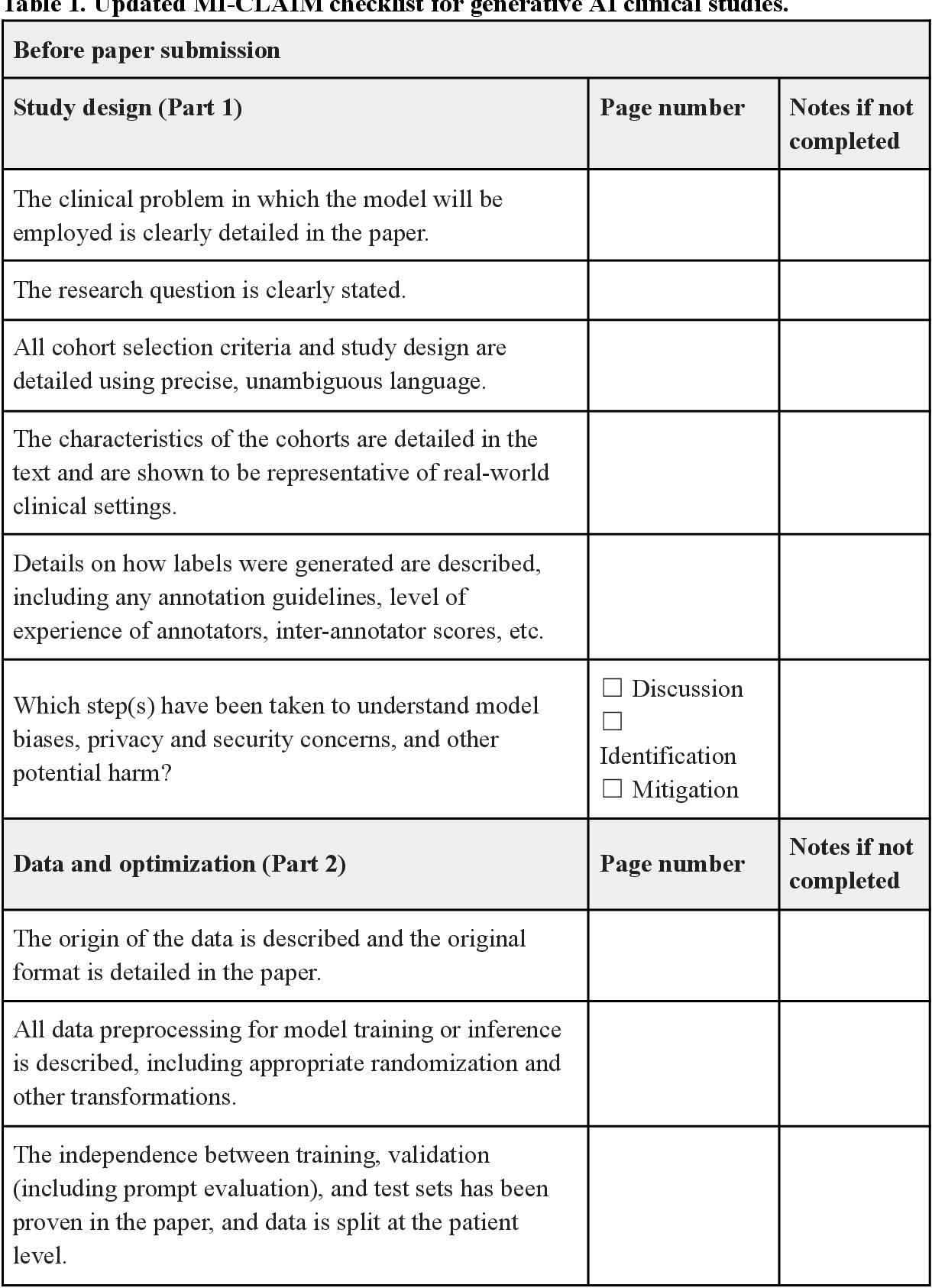
A comprehensive checklist can act as your guide to dissecting any AI paper.
Comprehensive guide and checklist for clinicians to evaluate ...
Let's look at a detailed checklist developed specifically for clinicians to evaluate AI/ML research. This will help you see how the four components we've discussed fit into a formal evaluation framework.
Please open the resource and find Table 4: Checklist for assessing AI and ML articles for clinicians. Scan through the 30 items. You don't need to understand every single one right now, but try to locate the items that correspond to the four components we discussed: Dataset: Look at items #1-7. Ground Truth: Item #8 is a perfect description of what to look for. Model: Look at items #14 (task), #16 (architecture), and #18 (training). Results: Look at item #22 (metrics) and #23 (errors). This table provides a roadmap for everything you should look for in a validation study.
By using such a checklist, you can move from passively reading a study to actively interrogating it, ensuring each key component is present and properly described.
Conclusion
You now have a mental map for navigating any dental AI validation study. By learning to identify these four key anatomical parts, you've taken the first and most important step toward becoming a critical appraiser of AI research.
Key Takeaways:
- A typical AI validation study consists of four main components you must identify:
- Dataset: The collection of images used for training, validation, and testing. Its source and diversity are crucial.
- Ground Truth: The expert-defined reference standard used as the "answer key." Its creation must be robust and transparent.
- Model: The AI algorithm (often a CNN) used to perform the task.
- Results: The performance metrics and visual outputs that serve as the AI's "report card."
- Checklists and reporting guidelines (like STARD-AI or the one we reviewed) provide a systematic way to ensure these components are properly described in a study.
Preview of the Next Lesson
In this lesson, we learned to identify the core components. In the lessons that follow, we will learn how to evaluate them. We'll start by going back to the beginning: the dataset. In our next session, we will focus on how to assess the representativeness and potential for sampling bias in a study's dataset. This will equip you to judge whether an AI model trained in a lab is likely to work for your patients in your clinic.