Hello! Welcome to the final lesson of our module on using dental AI software.
In our last session, we focused on how to communicate AI-assisted findings to patients, emphasizing transparency, the "augmented intelligence" framework, and your role as the ultimate clinical authority. Once you've had that conversation and finalized your diagnosis, the next crucial step is to record everything accurately.
This brings us to today's learning outcome: to document AI-assisted findings appropriately in patient records. Proper documentation is the bedrock of professional practice. It ensures continuity of care, fulfills legal and ethical obligations, and creates a clear record of the clinical reasoning behind your decisions. In this lesson, we will explore the principles and practical methods for creating high-quality clinical notes in an AI-assisted practice.
1. The Core Principles of AI Documentation
Before we look at specific examples, we need to establish the foundational rules. What exactly does "appropriate documentation" mean when an AI is involved? Professional regulatory bodies provide clear guidance on this.
Information on Artificial Intelligence
The Royal College of Dental Surgeons of Ontario (RCDSO) has published an excellent FAQ on AI. Let's start by reviewing their specific recommendations for record-keeping.
On the webpage, please find and read the answer to the question: 'What is important for dentists to document when using AI?' Focus on the three key elements they recommend including in your patient records.
As the RCDSO guidance makes clear, documenting your use of AI involves three essential components:
- Notation of AI Use: Your note should explicitly mention that an AI tool was used as part of the diagnostic or documentation process (e.g., "Radiographs reviewed with the assistance of [Software Name]"). This ensures transparency.
- Record of Patient Discussions: Document any conversations you had with the patient about the AI, including their questions, concerns, and consent, as we discussed in the last lesson.
- Rationale for Clinical Judgment: This is the most critical part. You must document your professional assessment of the AI's output. Did you agree or disagree with its findings? What was the basis for your decision?
This final point reinforces a theme we've seen throughout the course: you are the clinician in charge. The AI provides input, but the patient record must reflect your analysis and conclusions.
This principle of clinician oversight is non-negotiable, whether you are using AI for diagnosis or for helping write your notes.
Four Tips for Getting the Most from Clinical AI Notes - Dentally | Blog
The dental software blog 'Dentally' offers a practical tip that perfectly summarizes this responsibility. It's a simple but powerful idea to keep in mind.
Please read Tip #2, titled 'Edit Before you Save'. Notice the analogy it uses to describe your role.
Thinking of yourself as the "editor-in-chief" is a great way to frame your role. The AI can generate a first draft—whether that's a list of findings or a full paragraph of text—but you have the final say on what goes into the permanent record.
2. Models of AI-Assisted Documentation
In practice, AI can assist with documentation in two main ways: as a diagnostic aid that provides findings for you to document, and as an AI scribe that generates the note itself.
Model 1: Documenting Findings from a Diagnostic AI
This is likely the most common use case you'll encounter. An AI analyzes an image and presents its findings, which you then integrate into your own clinical note.
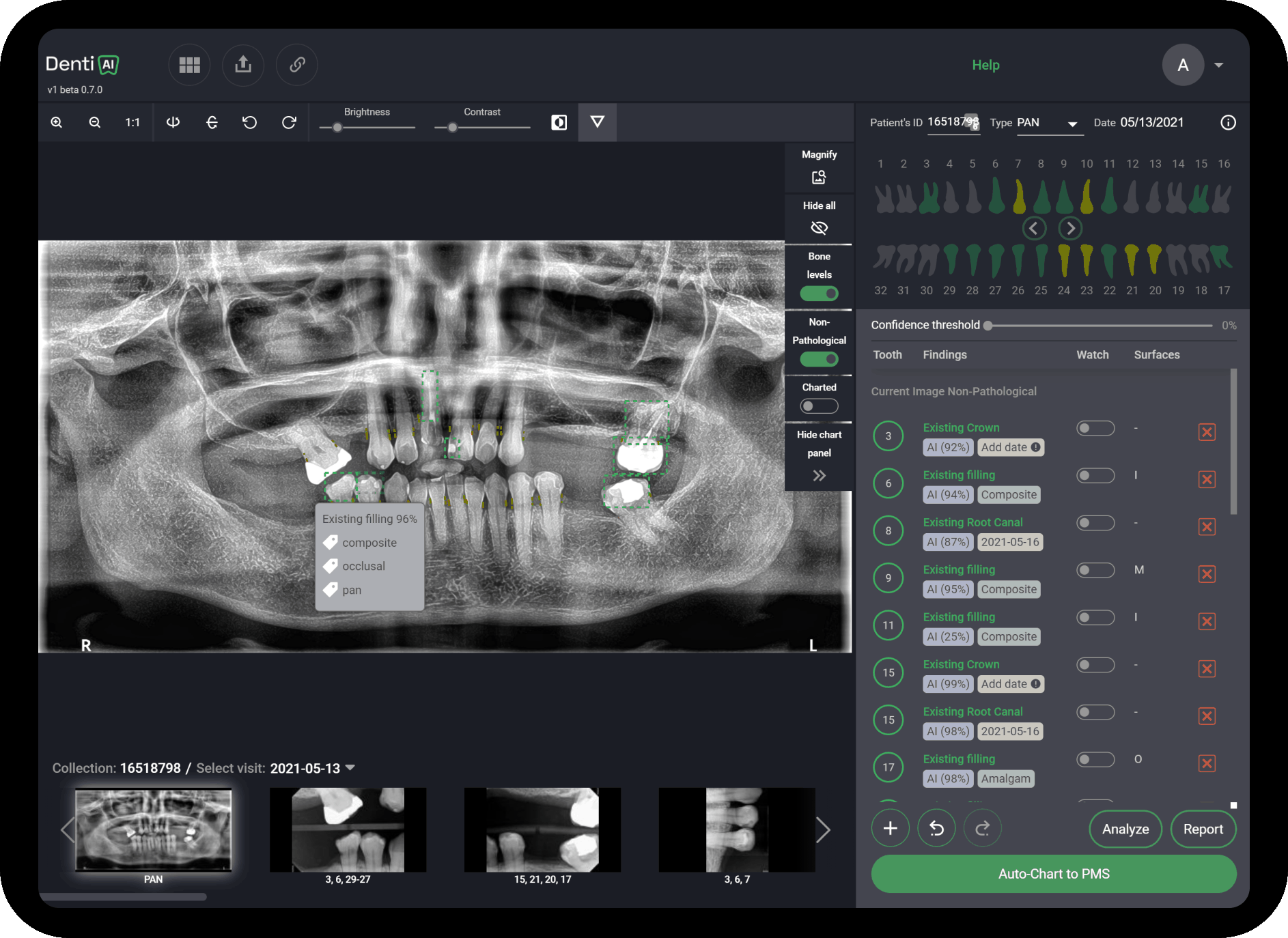

When documenting these findings, you apply the principles from the RCDSO:
- Agreeing with the AI: "Reviewed 4BW radiographs with assistance from [AI Software Name]. AI highlighted, and clinical exam confirmed, incipient E2 lesion on #13-D. Discussed findings and recommended composite restoration; patient consented."
- Disagreeing with the AI: "Reviewed PANO with assistance from [AI Software Name]. AI flagged a possible radiolucency at the apex of #25. Clinical vitality testing was WNL and the area appears consistent with anatomical variation, not pathology. No treatment indicated at this time. Will continue to monitor."
In both cases, you have (1) noted the AI use, (2) stated your clinical judgment, and (3) documented the plan.
Model 2: Using an AI Scribe for Note Generation
A second, rapidly emerging use for AI is as a scribe. Here, you dictate your findings and thoughts, and the AI organizes them into a structured, professional-sounding note. This can dramatically reduce the time spent on administrative tasks.
While this technology is still newer in dentistry, it is becoming more common in medicine. The principles are identical.
Artificial Intelligence Leveraged to Write Medical Documentation in Seconds Saving Hours
Let's watch a demonstration from MedCram that shows how a HIPAA-compliant AI scribe works. Although the example is from medicine, it perfectly illustrates the workflow and potential for dentistry.
Please watch the following segments: 00:13 - 02:36: Understand the problem of documentation burden that AI scribes aim to solve. 11:14 - 13:20: Pay close attention to the concepts of HIPAA compliance and the Business Associate Agreement (BAA), which are essential for protecting patient privacy. 14:37 - 22:11: Watch the live demonstration of dictating a patient story and see how the AI transforms it into a structured note. Notice how the AI corrects spelling and organizes the information. 25:59 - 26:35: This is a critical part. Listen for the speaker's emphasis on the clinician's role as the final authority who must review the AI's output for accuracy.
As the video powerfully demonstrates, AI scribes offer incredible efficiency. However, with great power comes great responsibility. The core message remains the same: you must read, review, and edit the note before you sign it. The AI-generated text is a draft, not a final document. You are legally and ethically responsible for its entire contents.
3. A Complete Dental SOAP Note Example
Let's bring everything together into a single, practical example. Imagine a patient, John Doe, is in for a recall appointment. You use an AI to help analyze his bitewing radiographs.
Here is what an appropriate SOAP note could look like in his chart:
S (Subjective): Patient reports no specific complaints. States he is here for his "usual check-up and cleaning."
O (Objective):
- Updated medical history, no changes. BP 120/80.
- Oral cancer screening negative.
- Periodontal charting completed, generally stable with localized 4mm pockets on posterior molars, no BOP. OHI reviewed.
- Reviewed 4 digital bitewing radiographs taken today with the assistance of DentiAI (v4.2).
- The AI flagged a potential carious lesion on the distal of tooth #29.
- Clinical examination with explorer and visual inspection confirms an incipient E1/E2 lesion.
- The AI also flagged a shadow on the mesial of #19. Upon review, this was determined to be a radiographic artifact (cervical burnout), not caries.
- Discussed all findings with John. Showed him the radiograph on the monitor with the AI's highlight on #29. He understands the need for treatment and the benefit of addressing it while it is small. He had no questions about the use of the AI software.
- Prophylaxis completed.
A (Assessment):
- Incipient caries #29-D.
- Generalized slight, stable periodontitis.
- Good oral hygiene.
P (Plan):
- Schedule patient for #29-D composite restoration.
- Continue 6-month recall for periodontal maintenance and monitoring.
- Patient verbalized understanding of the plan.
This note effectively demonstrates all the key principles:
- It clearly states that AI was used (
DentiAI (v4.2)). - It documents the clinician's rationale for both agreeing with the AI (#29) and disagreeing with it (#19).
- It records that the findings were discussed with the patient.
- The final assessment and plan are based on the clinician's integrated judgment.
Conclusion
Properly documenting AI-assisted findings is not about adding burdensome new steps to your workflow. It is about adapting timeless principles of good record-keeping to a new technological context. By being transparent and clearly articulating your clinical reasoning, you create a robust legal record, ensure continuity of care, and uphold your professional responsibility.
Key Takeaways:
- Your patient records must indicate when an AI tool was used to support diagnosis or documentation.
- Always document your clinical judgment: specify whether you agree or disagree with the AI's output and why.
- Record relevant discussions with patients about the use of AI in their care.
- Whether the AI is a diagnostic aid or a scribe, you are the "editor-in-chief." You are always responsible for the accuracy and completeness of the final note.
Preview of the Next Lesson and Module
This lesson concludes our module on the hands-on use of dental AI. You now have a framework for analyzing radiographs with AI, integrating findings, communicating with patients, and documenting your work.
But how do you know if an AI tool is any good in the first place? In our next module, "Critically Appraising AI Research in Dentistry," we will shift our focus from being an AI user to an AI evaluator. We will start by learning to identify the key components of a dental AI validation study, giving you the skills to look past marketing claims and assess the scientific evidence behind a product.