Hello! Welcome back to our ongoing exploration of Emotional Intelligence.
In our last lesson, we focused on the visual channel of non-verbal communication, learning to differentiate between engagement and disengagement cues through body language. You learned the importance of looking for clusters of signals, establishing a baseline, and considering the context.
Today, we shift our focus from sight to sound. We will tune into the auditory channel to analyze vocal cues—tone, pace, volume, and inflection—to understand underlying emotional states. This skill, often called interpreting paralanguage, is the other half of reading non-verbal communication.
Words tell us what a person wants to say; their voice tells us how they feel about what they are saying. For you, learning to decode these vocal signals is a critical step. It will help you perceive the emotional subtext in conversations, making you a more empathetic and charismatic communicator. It also provides another layer of data to help you manage your social energy by gauging the true emotional climate of an interaction.
1. What is Paralanguage?
Paralanguage refers to the non-lexical components of communication that accompany speech. It's not what you say, but how you say it.
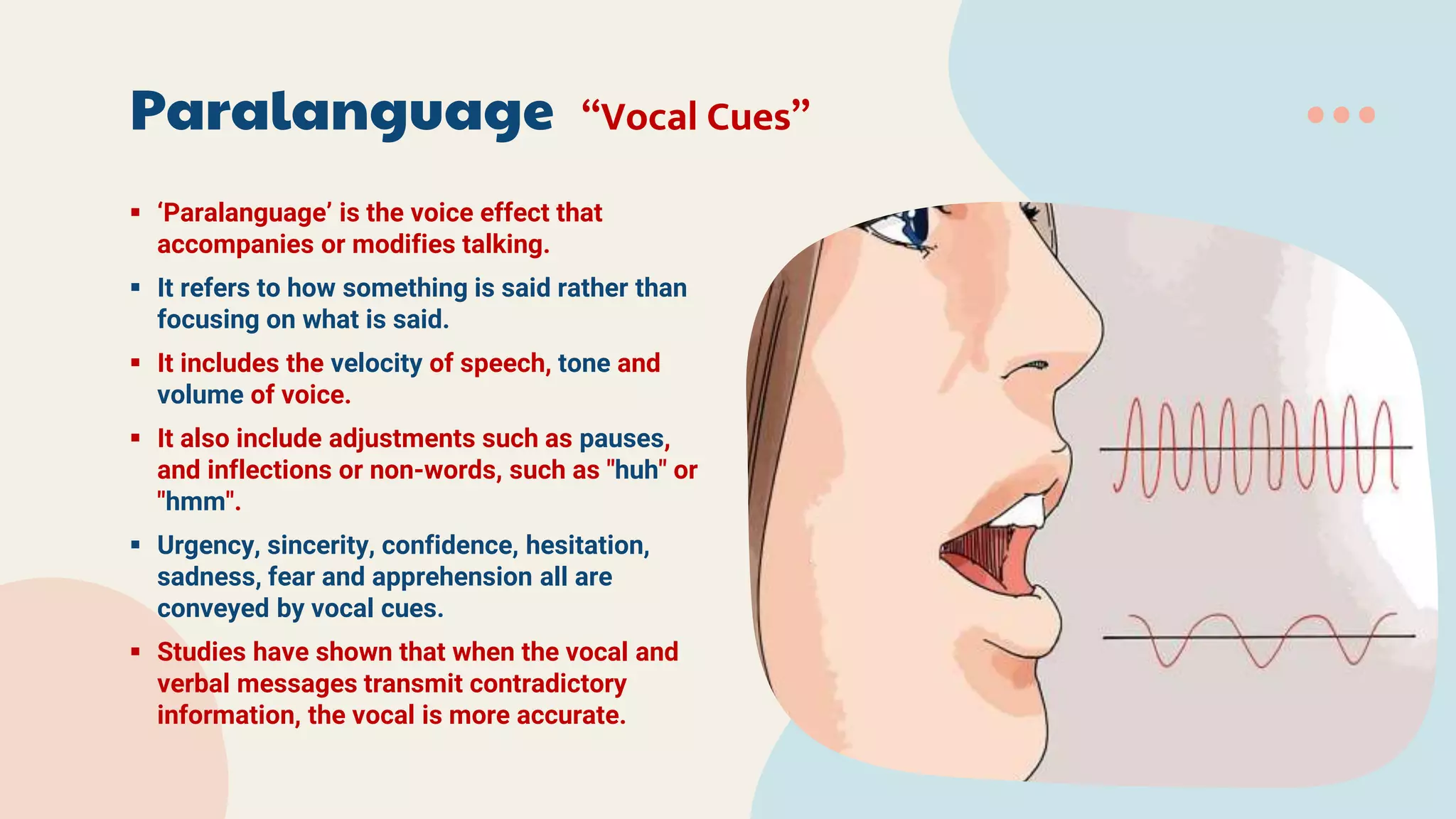
As the image states, a contradiction between words and voice is a significant moment in a conversation. Someone might say, "I'm fine," but their vocal cues might tell a story of sadness, anger, or anxiety. Learning to hear that story is our goal today.
2. The Five Building Blocks of Vocal Cues
To analyze what we hear, we need a clear vocabulary. Just as an economist breaks down a market into variables like supply, demand, and price, we can break down a person's voice into distinct, measurable elements.
We'll use a framework that voice pathologists and communication experts use, focusing on five core components.
Vocal Branding: How Your Voice Shapes Your Communication Image | Wendy LeBorgne | TEDxUCincinnati
Dr. Wendy LeBorgne, a voice pathologist, offers a fantastic breakdown of our 'vocal brand' into five core elements. This framework will give us a precise vocabulary for analyzing what we hear. As you watch, pay attention to how she demonstrates changing just one element to completely alter the perception of a sentence.
Please watch from 02:17 to 10:53. Dr. LeBorgne will introduce and demonstrate the five key elements of voice: intensity (volume), inflection (intonation), rate (pace), frequency (pitch), and quality (timbre). Note the real-world consequences she mentions, such as how 'uptalking' or 'glottal fry' can affect perceptions in a job interview.
To summarize Dr. LeBorgne's points, the five key elements are:
- Intensity (Volume): How loud or soft someone speaks. This can signal confidence, anger, enthusiasm, shyness, or intimacy.
- Rate (Pace): The speed of speech. A fast rate can indicate excitement or nervousness, while a slow rate can suggest thoughtfulness, sadness, or condescension.
- Frequency (Pitch): How high or low the voice sounds. Pitch often rises with stress or excitement and lowers to convey authority or sadness.
- Inflection (Intonation): The "melody" of speech. A varied, dynamic inflection sounds engaging, while a flat, monotone delivery suggests boredom or depression. A rising inflection at the end of a statement ("uptalk") can signal uncertainty.
- Quality (Timbre): The texture of the voice. Is it clear, breathy, harsh, rough, or smooth? This quality can be affected by emotion (e.g., a shaky voice indicating fear) and can also become a habitual trait (e.g., "vocal fry").
3. Decoding Emotions in the Voice
Now that we have the building blocks, let's see how they combine to express specific emotions. Your interest in neuroscience will be helpful here; vocal expression is deeply tied to our limbic system, the emotional center of the brain. When we feel an emotion, our brain triggers physiological changes in our respiratory system and laryngeal muscles, which automatically alter our voice.
This next video provides a practical guide on how to listen for these "tells."
How to Understand Anyone Instantly | Full Audiobook Summary
Let's apply this framework to decode emotions. This audiobook summary provides a practical guide to listening 'between the lines.' It explains how vocal cues can reinforce or contradict the spoken words.
Watch the segment from 18:18 to 24:34. The narrator discusses how tone, pitch, pace, volume, and rhythm reveal underlying feelings like stress, anxiety, confidence, and even deception. Notice the concept of 'vocal leakage,' where true emotions escape through the voice despite contradictory words.
The video introduces the powerful idea of "vocal leakage." Just like micro-expressions, these are involuntary vocal shifts that betray a person's true emotional state.
To create a more structured reference, let's turn to an article that lays out these connections clearly.
How to Read Emotions Accurately Through Voice Tone
This article from PlanetSpark provides a concise, structured summary of common emotions and their typical vocal profiles. It also briefly touches on the neurological basis of vocal expression.
Read the sections 'How to Read Emotions Through Voice Tone,' 'The Science Behind Voice and Emotion,' and 'Common Emotions and Their Vocal Indicators.' Focus on the bulleted lists that map vocal elements (pitch, volume, pace) to specific emotions like happiness, anger, and fear.

To synthesize all this, here is a summary table inspired by research in the field, including the academic paper "Communication of Emotions in Vocal Expression and Music..." by Juslin & Laukka. This is your cheat sheet for connecting vocal patterns to emotions.
| Emotion | Pace (Rate) | Volume (Intensity) | Pitch (Frequency) | Inflection & Quality |
|---|---|---|---|---|
| Anger | Fast | Loud | High | Sharp, tense, clipped rhythm |
| Fear | Very Fast | Varies (can be soft or loud/panicked) | High | Shaky, uneven rhythm, breathy |
| Happiness | Fast | Medium-Loud | High & Varied | Lively, melodic inflection, bright quality |
| Sadness | Slow | Soft | Low | Monotone, flat inflection, falling pitch at ends of sentences |
| Surprise | Abrupt change | Sudden increase | Sharp rise | Wide pitch range, often ending on a high note |
| Confidence | Moderate | Moderate-Loud | Moderate-Low | Steady rhythm, clear quality, declarative inflection |
Test your understanding!
You ask a colleague how their big project presentation went. They reply, "It went fine," in a voice that is slow, soft, and low-pitched with a flat inflection.
What is the likely contradiction between their words and their vocal cues? What is their probable emotional state?
Show answer
The word "fine" is neutral to positive. However, the vocal cues (slow pace, soft volume, low pitch, flat inflection) are a classic cluster for sadness or disappointment. The contradiction suggests the presentation did not go well, and they are likely feeling down about it, even though their words are trying to downplay this. This is a moment where a follow-up question like, "Are you sure? You sound a little down," could open the door to a more meaningful connection.
4. The Golden Rules: Baseline, Clusters, and Context
Just like with body language, a single vocal cue is meaningless in isolation. The rules we established in the last lesson are just as critical here.
-
Establish a Baseline: Everyone has a natural vocal range and speaking style. The first step is to listen for how a person normally sounds. Is their natural pace fast? Is their pitch naturally high? You are listening for changes and deviations from this baseline. A sudden drop in pitch from someone who is normally high-pitched is more significant than a consistently low-pitched voice.
-
Look for Clusters: Don't fixate on one cue. A fast pace alone could mean anything. But a fast pace, combined with high pitch, loud volume, and tense quality, strongly points toward anger or high-stress excitement. You should also cluster vocal cues with the body language cues we've already covered. Do the words, voice, and body all tell the same story? If not, where is the mismatch?
-
Consider the Context: A loud, fast voice at a football game means excitement. A loud, fast voice in a quiet library means something else entirely. Furthermore, cultural norms play a huge role. As the PlanetSpark article noted, what sounds enthusiastic in one culture might sound aggressive in another. A measured, calm tone might signal respect in some contexts, not disinterest.
Your analytical skills from economics are directly transferable here. You wouldn't draw a conclusion from a single data point; you look for trends, correlations, and contextual factors before making an assessment. The same discipline applies to reading people.
Conclusion
You've now added a vital new tool to your social perception toolkit. By learning to dissect vocal signals into their core components—volume, pace, pitch, inflection, and quality—you can move beyond simply hearing words to understanding the emotions that drive them.
Key Takeaways:
- Voice Betrays Feeling: Paralanguage often reveals a person's true emotional state, even when their words try to conceal it.
- Deconstruct to Understand: Analyze conversations using the five elements of vocal cues to get a precise reading of the emotional tone.
- Memorize the Patterns: Associate the typical vocal clusters with basic emotions like happiness, sadness, anger, and fear to speed up your interpretation.
- The Golden Rules Still Apply: Always interpret vocal cues relative to a person's baseline, in clusters with other verbal and nonverbal signals, and within the proper context.
This skill directly supports your goal of becoming a more charismatic and convincing communicator by making you profoundly more aware of your audience's emotional state. It helps you react with more empathy and precision.
In our next lesson, we will combine your knowledge of both body language and vocal cues to tackle a very specific and common challenge: distinguishing between polite interest and genuine enthusiasm in social feedback. This will be a great test of your developing observational powers.