Hello! Welcome back to our module on Emotional Intelligence and Social Awareness.
In our last few lessons, we've been building your non-verbal observation skills piece by piece, from micro-expressions to posture, gestures, and the use of space. You've learned the "three golden rules" of interpretation: look for clusters, establish a baseline, and always consider the context.
Today, we'll synthesize these skills to answer a crucial question in any interaction: Is my conversation partner engaged or disengaged? The ability to differentiate between engagement and disengagement cues is a cornerstone of social awareness. For you, this skill is especially important. It acts as an "energy meter," helping you decide when to invest more in a conversation, when to change topics, or when to make a graceful exit. This reduces the cognitive load of uncertainty and helps make social interactions less draining and more strategic.
1. The Core Distinction: Open vs. Closed
At the most fundamental level, engagement and disengagement are communicated through the body's tendency to be either "open" or "closed." Engagement cues are invitations; they signal comfort, interest, and a desire to connect. Disengagement cues are barriers; they signal discomfort, boredom, disagreement, or a desire to leave.
Let's ground this with a clear definition.
Nonverbal Communication Skills: 19 Theories & Findings
The article 'Nonverbal Communication Skills' from PositivePsychology.com offers a concise definition of this key distinction. We'll use this as our starting point.
Please read the section titled 'Nonverbal communication of successful leaders.' Focus on the explicit definitions and examples provided for engagement and disengagement cues.
As the article notes, engagement is signaled by actions like nodding, tilting the head, and maintaining open body postures. Disengagement is marked by tilting the body away or crossing the arms and legs.
This "open vs. closed" concept is a powerful visual shorthand.
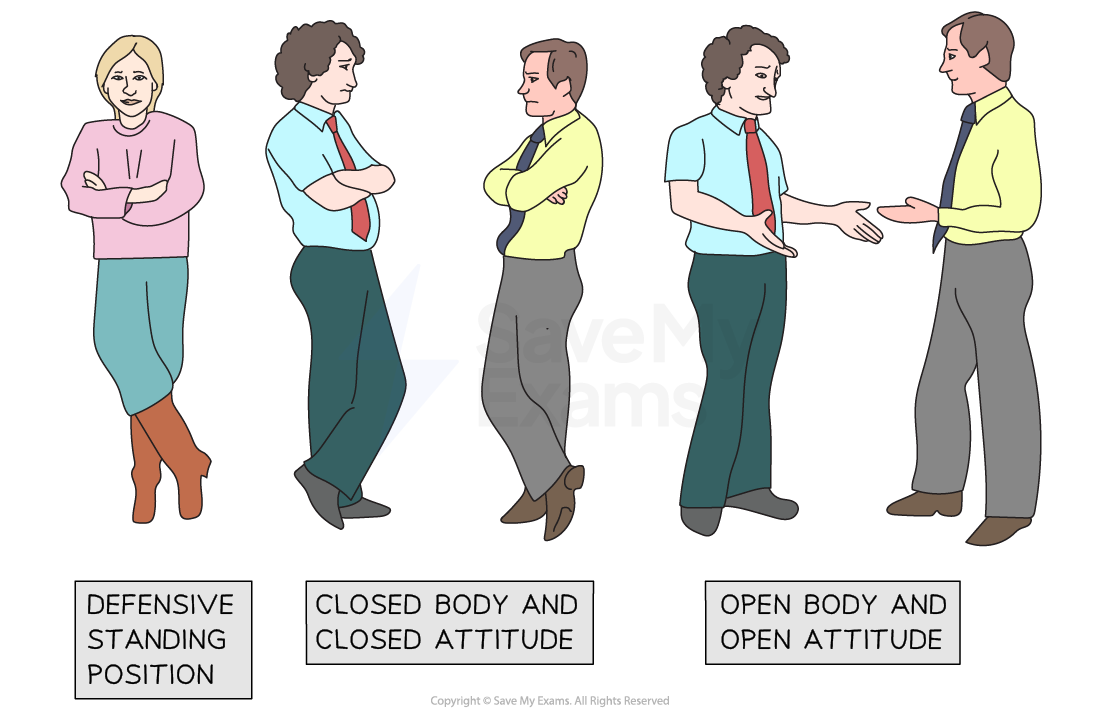
It's also important to recognize that "disengagement" isn't a single feeling. It's a category that includes various internal states.

2. A Catalogue of Engagement Cues ("Green Lights")
Engagement cues are the "green lights" of conversation. They tell you that your message is being received positively and that you should continue, or even go deeper. Here are some of the most common clusters.
- Leaning In & Closing Distance: People unconsciously move toward things they like and are interested in. A partner leaning forward, even slightly, is a classic sign of engagement. This connects directly to the proxemics we discussed in the last lesson.
- Open Body Posture: As we've seen, uncrossed arms and legs signal openness and receptivity. The body is literally not creating a barrier. Look for a relaxed posture with the torso and feet pointing toward you ("fronting").
- Head Tilts and Nodding: A head tilt indicates curiosity and listening. A slow, deliberate nod signals understanding and encouragement. (Remember from our last lesson, a fast, jerky nod can signal impatience).
- Mirroring: If you notice someone subtly adopting your posture or gestures, it's a powerful subconscious sign of rapport and connection. They are literally "on the same wavelength" as you.
- Expressive Face and Eye Contact: Look for genuine smiles that involve the eyes, raised eyebrows indicating curiosity, and steady, comfortable eye contact.
Let's see this in a high-stakes environment.
Former FBI Agent Explains How to Read Body Language | Tradecraft | WIRED
Let's return to the WIRED video with former FBI agent Joe Navarro. He analyzes a poker game, which is a perfect environment for observing authentic engagement and disengagement. Watch for the moment he identifies a player becoming engaged.
Watch the segment from 12:40 to 13:20. Pay close attention to Navarro's commentary on Player #5. He notes the player's hands were previously hidden, but when he becomes interested, 'his hands are fully out... we know that he's engaged and that he's interested.'
This example perfectly illustrates the principles. The player moves from a closed, withdrawn posture to an open, expansive one, clearly signaling his shift in engagement.
3. A Catalogue of Disengagement Cues ("Yellow and Red Lights")
Disengagement cues are the "yellow" and "red lights." They signal that you may be losing your audience's attention or that they are feeling uncomfortable. This is your cue to pause, ask a question, or change the subject.
Social Cues: 17 Types & How To Read Them
The article 'Social Cues: 17 Types & How To Read Them' provides a comprehensive list of common nonverbal signals. Many of these are classic disengagement cues.
Please read through the '17 examples of common social cues.' As you read, mentally categorize each one as primarily an engagement or disengagement cue. Pay special attention to cues like 'Crossed arms,' 'Facing toward or away,' 'Seeming distracted,' 'Looking down at our phones,' and 'Fidgeting.'
Let's consolidate the key disengagement clusters from that article and our previous lessons:
- Creating Barriers and Distance: This is the opposite of leaning in. It includes leaning back, angling the body away (a behavior called "blading"), crossing arms and legs, or placing objects (like a coffee cup or notebook) between you and them.
- Pacifying Behaviors: As we learned, these are self-soothing gestures that indicate stress or discomfort. They include rubbing the neck, touching the face, stroking one's own arm, or fiddling with clothing or jewelry. When you see these, you are seeing a direct reaction to some form of psychological friction.
- Distraction and Escape: The body often reveals a desire to be elsewhere. Look for feet pointing toward an exit, repeated glances at a watch or phone, and restless fidgeting.
- Facial Shutdown: The face can also signal disengagement. Watch for lip compression (lips disappearing), a tensing jaw, a "blank stare," or a polite but unengaged "social smile" that doesn't reach the eyes.
The following video provides short, clear examples of many of these cues.
8 Ways to Read Someone’s Body Language
The YouTube channel TopThink has a concise video that illustrates several key body language cues. We'll watch a few clips that directly relate to disengagement.
Watch the following three short segments: Manipulating Clothing (00:23 - 01:22): Notice how fiddling with clothes or using them as a barrier signals discomfort. Supporting Their Body (01:22 - 02:16): Focus on how slumping back with crossed arms indicates boredom. Touching Their Face (09:50 - 10:37): This reinforces the idea that face-touching is often a sign of stress or nervousness.
Test your understanding!
You are in a debate, presenting a complex point based on economic data. Your opponent is listening with their arms crossed. Is this a reliable sign of disengagement or disagreement? Why or why not? What other cues would you look for to get a more accurate reading?
Show answer
Crossing arms is not a reliable sign on its own. As we've learned, it can be a self-soothing or "self-hugging" gesture, or simply a comfortable position. To get a more accurate reading, you need to look for clusters.
Are they also leaning away? Are their lips compressed? Have they broken eye contact and started scanning the room? Are their feet angled toward the exit? If you see a cluster of these additional disengagement cues, then it's highly likely they are feeling defensive or have mentally checked out. If, however, they are leaning forward, maintaining eye contact, and nodding slightly while their arms are crossed, they are likely still engaged and simply processing your information. The key is to look beyond the single, ambiguous cue.
Conclusion
Mastering the ability to differentiate between engagement and disengagement is like learning to read the music behind the words. It allows you to be more adaptive, responsive, and effective in your communication, whether your goal is to persuade, debate, or build a deeper connection.
Key Takeaways:
- Engagement ("Green Lights"): Signaled by openness. Look for leaning in, open posture, mirroring, head tilts, and genuine smiles. These cues say, "I'm with you, keep going."
- Disengagement ("Yellow/Red Lights"): Signaled by closing off. Look for leaning away, crossed limbs, creating barriers, pacifying gestures, and signs of distraction. These cues say, "I'm feeling friction, something needs to change."
- Read the Cluster, Not the Cue: A single gesture is just noise. A consistent pattern of engagement or disengagement cues is meaningful information.
- Respond, Don't React: When you see disengagement, don't assume it's personal. Use it as data. It might be time to ask a question ("What are your thoughts on that?"), change the topic, or check in ("I see you're busy, should we find another time?").
This skill directly addresses your goal of becoming a more charismatic communicator by making you more attuned to your audience. It helps you manage your social energy by preventing you from wasting it on an unreceptive audience.
In our next lesson, we will add another crucial layer to your observational skills by focusing on the auditory channel. We will learn to analyze vocal cues (tone, pace, volume, inflection) to understand underlying emotional states. Combining what you see with what you hear will give you an even richer, more accurate picture of any social interaction.