Welcome to the first lesson of your course on developing deeper conversational skills. We're starting at the most fundamental level: strategy. Just as an economist analyzes market conditions before recommending a policy, a strategic communicator analyzes the situation before speaking. Your goal to become a charismatic and convincing communicator with the ability to form deep bonds begins not with what you say, but with your ability to understand the landscape of the conversation itself.
This lesson addresses the first learning outcome: Analyze how context, environment, and audience shape communication effectiveness. We will explore why two people can have the exact same conversation and come away with completely different interpretations. By the end of this lesson, you will have a set of analytical tools to deconstruct any communication scenario, which is the first step toward mastering it. This analytical approach can also help manage the feeling of being overwhelmed in social situations, a key aspect of the "energy management" you're interested in.
1. The Power of Context: Why Nothing is Said in a Vacuum
Every word, gesture, and silence is interpreted through a lens. This lens is the context. Before we can adapt our message to an audience, we must first appreciate how profoundly the context shapes meaning.
To get an intuitive feel for this, let's look at how our brains are wired to use context to make sense of the world. The following short article, written for a young audience but based on solid neuroscience (which I know you're interested in), uses simple examples to illustrate this powerful effect.
How Does Social Context Influence Our Brain and Behavior?
This article, 'How Does Social Context Influence Our Brain and Behavior?' from Frontiers for Young Minds, provides excellent visual examples of how context alters our perception of everything from simple shapes to complex human emotions.
Please read the introduction and the section titled 'Context Influences Almost Every Aspect of Our Daily Lives'. Pay close attention to the visual illusions and the Serena Williams example. Think about how a single piece of information (a circle, a facial expression) can have its meaning completely transformed by what surrounds it.
As you saw, the meaning of a facial expression isn't in the face alone—it's in the situation. This brings us to a core idea in communication studies: we don't just send and receive messages like packages. We actively create meaning together.
This process, however, is complicated by our individual "perceptual filters." Watch this short video to understand how these filters work.
How miscommunication happens (and how to avoid it) - Katherine Hampsten
This TED-Ed video, 'How miscommunication happens,' introduces the transactional model of communication. It explains why simply sending a message isn't enough and how our personal backgrounds act as 'filters' that shape the meaning we create.
Watch from the beginning until the timestamp 03:11. Focus on the shift from the 'transmission model' to the 'transactional model' and the list of factors that make up our subjective lenses (knowledge, past experience, age, culture, etc.).
These ideas are captured in two useful models.
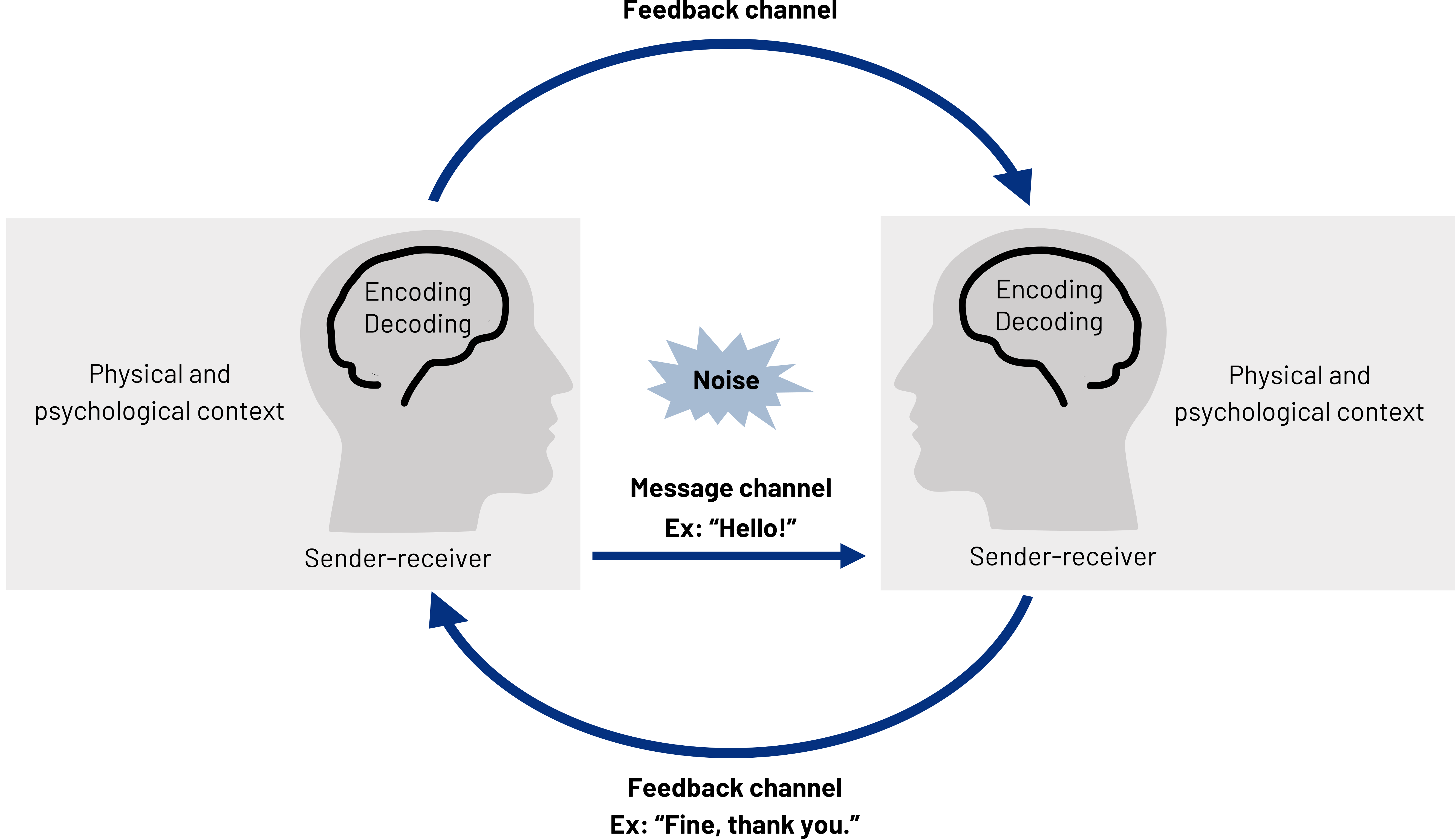
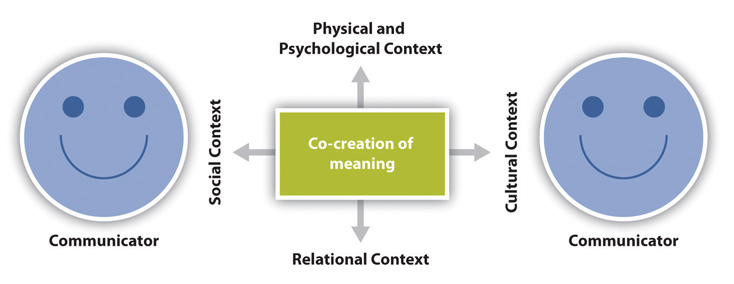
- Physical and Psychological Context: The physical environment (a loud café vs. a quiet library) and the internal states of the communicators (tired, anxious, happy).
- Relational Context: Your relationship and history with the other person. You speak differently to a boss, a best friend, or a stranger.
- Social Context: The unstated rules and norms of the situation. For example, the social rules of a formal debate are very different from those of a casual party.
- Cultural Context: The broader cultural backgrounds, values, and beliefs that influence perception and communication styles.
2. A Framework for Audience Analysis
Now that we understand the importance of context, let's zoom in on the most crucial element within that context: the audience. Since your goal is to be persuasive and build connections, adapting to your audience is paramount.
The following text provides a systematic way to analyze your audience. Given your background in applied economics, you might appreciate this structured, analytical framework. It treats communication as a process that can be optimized through careful preparation.
Managing the Communication Process - Pearson
This excerpt from a Pearson business communication textbook, 'Managing the Communication Process,' offers a professional framework for analyzing a communication situation. We will focus on the section dedicated to audience analysis.
Read the section titled 'Analyzing the audience helps you meet their needs' (pages 30-31). Focus on the distinction between primary and secondary audiences and the concept of 'audience benefits'. The checklist in Figure 2.7 provides a powerful set of questions you can use to prepare for any important conversation.
From this reading, the key is to shift your perspective from "What do I want to say?" to "What does my audience need to hear?". Here are the crucial questions to ask yourself, adapted from the text:
- Knowledge: What does my audience already know? What do they need to know?
- Reaction: How are they likely to react to this information? Are they likely to be supportive, skeptical, or hostile?
- Objections: What questions or objections will they have? How can I prepare to address them?
- Benefits: How will they benefit from my idea or proposal? (This is the most critical question for persuasion).
Test your understanding!
Imagine you are part of a student group for an economics project. You want to convince your group to switch the topic from "Monetary Policy in the EU" to "The Economics of Climate Change." The current topic was chosen by the most outspoken member of the group.
Using the audience analysis questions above, list two potential objections your audience might have and one key benefit you could frame for them.
Show answer
- Potential Objection 1: "We've already started research on the EU topic. Switching now will waste time and put us behind schedule."
- Potential Objection 2: The outspoken member might feel their initial idea is being rejected, leading to a defensive reaction. Their objection might be framed as, "The EU topic is more rigorous and relevant to our course."
- Audience Benefit: You could frame the benefit as, "The climate change topic is very current and has tons of data available, which might make our analysis easier and more impactful. It's also a 'hot topic' that professors are often very interested in, which could help our grade." (This frames the benefit around their potential success and ease of work, not just your personal interest).
3. Application: Matching the Conversational Reality
So, you've analyzed the context and the audience. How do you use that information in the moment? The final step is to correctly identify the type of conversation that is actually happening and align your communication with it. Misunderstanding this is a primary source of miscommunication and failed connections.
This fantastic TEDx talk provides a simple yet profound model for doing just that.
The science behind dramatically better conversations | Charles Duhigg | TEDxManchester
In 'The science behind dramatically better conversations,' Charles Duhigg explains that every discussion contains three potential conversations. The key to connection is identifying which one is happening and matching it.
Please watch from 02:04 to 09:44. Focus on these three key ideas: The three types of conversations: Practical (what's this about?), Emotional (how do we feel?), and Social (how do we relate to each other?). The Matching Principle: the need to be in the same type of conversation to connect. Deep Questions: the tool used to discover which conversation the other person wants to have.
The story of the surgeon is a perfect case study. He failed initially because he assumed his patients were there for a practical conversation (medical advice). His communication was ineffective because he hadn't analyzed the patients' true context: they were terrified and needed an emotional conversation first.
By asking a deep question—"What does this cancer diagnosis mean to you?"—he uncovered the underlying emotional and social anxieties. He matched that emotional conversation, built a connection, and only then could they both effectively move into the practical conversation.
Conclusion
This lesson laid the strategic foundation for all the skills to come. You can't be charismatic, persuasive, or build deep bonds if you're in a different conversational reality than the person you're speaking with. Your main takeaway should be to approach communication not as a performance, but as an act of analysis and adaptation.
Key Takeaways:
- Communication is Transactional: We co-create meaning through our unique perceptual filters, influenced by multiple layers of context (physical, relational, social, cultural).
- Analysis Precedes Action: Before you can communicate effectively, you must analyze the situation. Systematically consider your audience's knowledge, potential reactions, objections, and what benefits them.
- The Matching Principle: True connection happens when you identify and match the type of conversation the other person is having—be it practical, emotional, or social.
- Deep Questions are Your Diagnostic Tool: Use questions that explore values, beliefs, and experiences to uncover the true nature of the conversation.
In our next lesson, we will build directly on this foundation. Now that you know how to analyze a situation, we'll focus on the next step in the strategic process: Define clear communication goals for different interactions. After all, once you understand the landscape, you need to decide where you want to go.