Hello! Welcome back to our course on developing deeper conversational skills.
In our last lesson, we established the strategic foundation for all effective communication: analysis. You learned how to deconstruct any interaction by examining its context, environment, and most importantly, the audience. We saw that communication is a transactional process of co-creating meaning and that connection requires "matching" the type of conversation—practical, emotional, or social—the other person is having.
This lesson takes the logical next step. Once you've analyzed the landscape, you need to decide on your destination. This brings us to our learning outcome: to define clear communication goals for different interactions (e.g., to inform, persuade, connect).
Having a clear goal transforms communication from a reactive, sometimes draining, activity into a proactive, intentional one. It gives you a "why" for every conversation, which helps you maintain focus and steer the dialogue purposefully. For you, this is not just about becoming more convincing; it's also a powerful tool for managing your social energy by making your interactions more efficient and successful.
1. The Power of a Purpose
Why do some conversations feel aimless, while others are sharp and impactful? The difference often lies in intent. Speaking without a clear goal is like setting sail without a compass; you'll drift, but you might not end up anywhere useful.
To explore this idea, let's watch a segment from a TEDx talk that frames this concept as "strategic communication."
It's Not Manipulation, It's Strategic Communication | Keisha Brewer | TEDxGeorgetown
In her talk, 'It's Not Manipulation, It's Strategic Communication,' Keisha Brewer argues that effective communication is simply 'communicating with purpose... to achieve a goal.' She makes a powerful case for why identifying your goal is the first and most critical step.
Please watch from 05:53 to 07:41 and then from 09:51 to 10:16. Pay attention to her definition of strategic communication and the consequences she describes of not identifying a goal.
As Keisha Brewer points out, when you don't identify the goal, you end up "speaking without purpose." Conversations lose their direction. By simply asking yourself, "What do I want to achieve here?" before you speak, you bring clarity and focus to the interaction. This isn't manipulation; it's about creating mutually beneficial outcomes where your message is understood and your objective is met.
2. What Do You Want? The Core Communication Goals
While the possibilities are endless, most communication goals fall into a few key categories. Understanding these helps you quickly identify your primary objective in any given situation.
A useful, simple framework comes from speaker and coach Vinh Giang. He suggests that in any interaction, people are generally looking for one of four things.
How to Build INSTANT Rapport With Strangers!
In this clip from 'How to Build INSTANT Rapport With Strangers!', Vinh Giang breaks down four common desires in communication. Recognizing which of these is the priority for the other person—and for you—is key to a successful interaction.
Watch from 04:34 to 07:24. Focus on the four things people want: Information, Connection, Peace and Harmony, or Fun. Notice how the delivery of the communication changes depending on the goal.
Giang's categories—Information, Connection, Harmony, and Fun—are a great starting point. Let's formalize this and look at the three most common strategic goals in professional and personal settings: to inform, to persuade, and to connect.
The following article provides a clear distinction between the two most fundamental goals: informing and persuading.
Strategic Communication to Inform or Persuade
This article from the University of Virginia's Darden School of Business, 'Strategic Communication to Inform or Persuade,' directly addresses how to choose your primary goal. It forms the first part of a four-element strategic communication process.
Please read the sections 'Knowing Your Purpose' and 'Distinguishing Between Communicating to Inform or Persuade.' Focus on the questions that help you decide whether your goal is to inform or to persuade.
Based on these resources, let's break down the primary goals:
- To Inform: The goal is the clear, efficient transfer of information. You're answering a request, providing an update, or stating facts. The audience is generally neutral or receptive. Your main challenge is clarity and conciseness.
- To Persuade: The goal is to change someone's beliefs, attitudes, or actions. You aren't just presenting facts; you're building a case. This is necessary when your audience might be skeptical, resistant, or simply needs motivation to do something new. This is the heart of debate and influence.
- To Connect: The goal is to build rapport, establish a relationship, and create a deeper bond. Here, the focus is less on the transactional exchange of information and more on the relational subtext. The emotional content of the conversation is just as, if not more, important than the factual content.
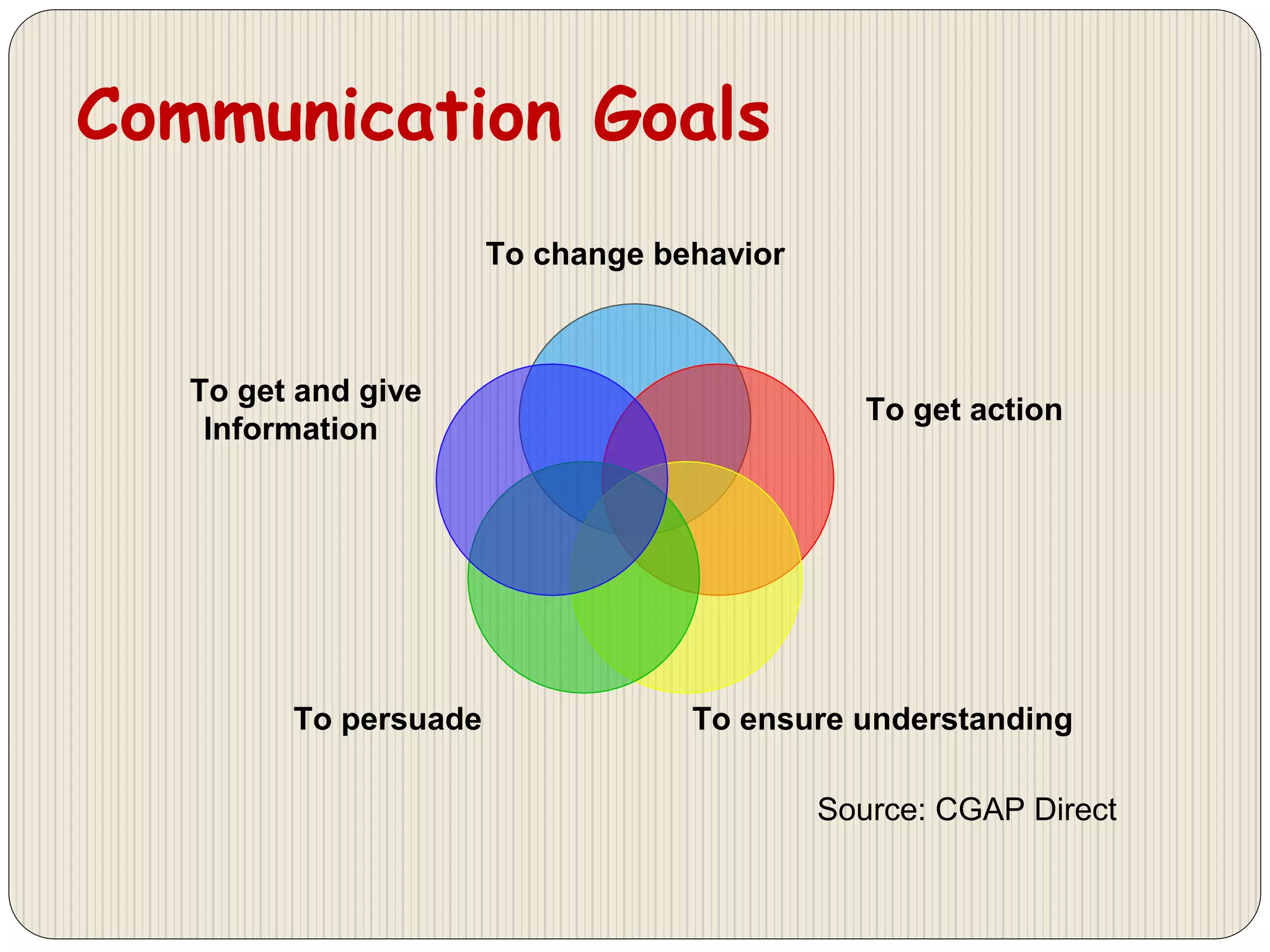
Of course, as the Venn diagram shows, these often overlap. To persuade a skeptical manager, you first need to inform them of the data and connect with them by acknowledging their concerns.
3. From Goal to Strategy: Communication Frameworks
Defining your goal is step one. Step two is choosing a strategy to achieve it. Given your background in economics, you'll appreciate that there are structured models—frameworks—that can dramatically improve your effectiveness, just like economic models help us understand complex systems.
The following resource introduces several powerful frameworks used by leaders. We will focus on a few that map directly to our core goals.
7 Must-Know Communication Frameworks for Leaders
This article, '7 Must-Know Communication Frameworks for Leaders,' provides a toolkit of structured approaches. These frameworks turn abstract goals into concrete, actionable communication plans.
Please read the sections for Framework No. 1 ('What? So What? Now What?'), Framework No. 2 ('BLUF'), and Framework No. 4 ('Think, Feel, Do'). For each one, understand its definition, purpose, and the provided example.
Let's integrate these frameworks with our primary goals.
If Your Goal is TO INFORM...
When your primary goal is to convey information clearly and efficiently, especially to a busy or results-oriented audience, these frameworks are invaluable.
- BLUF (Bottom Line Up Front): This military-derived framework is the epitome of efficiency. You state your main point immediately, then provide the supporting details. This respects the listener's time and ensures your key message is heard even if they get distracted.
- Example: (In an email) "BLUF: The project deadline is being extended to June 30th. This is due to supplier delays..."
- What? So What? Now What?: This is a more narrative structure for informing. It helps your audience not only understand the facts but also their significance and what to do about them.
- What? (The fact): "We finished our competitor analysis."
- So What? (The implication): "It shows our main competitor is capturing a market segment we've been ignoring."
- Now What? (The action): "I recommend we form a task force to develop a strategy for this segment."
If Your Goal is TO PERSUADE or CONNECT...
When you need to win someone over or build a deeper relationship, logic alone is often not enough. You need to engage their emotions and mind.
- Think, Feel, Do: This is a powerful, people-centric framework for influence and change management. It addresses the head, the heart, and the hands.
- Think: What do you want them to understand? (The logical case)
"This new software will automate our reporting process, saving about 5 hours of manual work per week."
- Feel: How do you want them to feel? (The emotional connection)
"I know learning a new system can feel daunting, but we're committed to providing full training and support so everyone feels confident."
- Do: What do you want them to do? (The clear, simple action)
"Please attend the 30-minute introductory session on Friday and try logging in at least once before then."
- Think: What do you want them to understand? (The logical case)
This framework is excellent for persuasion because it preemptively addresses emotional resistance. It's also fantastic for connection because acknowledging feelings ("I know this can be daunting") builds trust and rapport.
Test your understanding!
Imagine you are in a meeting with your student economics club. The club's funds are low. Your goal is to convince the members to approve a new, higher membership fee for the next academic year. This is likely to be an unpopular idea.
Which primary goal (Inform, Persuade, Connect) is most appropriate? And which framework (BLUF, What? So What? Now What?, or Think, Feel, Do) would you choose to structure your proposal? Briefly explain why.
Show answer
The primary goal is clearly to persuade. You need to get them to agree to something they are not inclined to do.
The most effective framework would be Think, Feel, Do. Here's why:
- Simply using BLUF ("We need to raise fees") would likely cause an immediate negative reaction without any context.
- "What? So What? Now What?" is better, but it can still be a bit dry.
- Think, Feel, Do is ideal because it allows you to build a complete case:
- Think: You can present the logical financial data showing why the fee increase is necessary for the club's survival.
- Feel: You can acknowledge their feelings ("I understand that no one likes paying more...") and connect it to positive emotions ("...but this will allow us to continue having great events and guest speakers that make this club valuable.").
- Do: You can clearly state the action you want: "I'm asking you to vote 'yes' on the proposed fee increase for next year."
Conclusion
Today, you've moved from being a passive analyst of a conversation to an active strategist. By defining a clear goal—whether it's to inform, persuade, or connect—you give your communication purpose and direction. This intentionality is a cornerstone of charismatic and effective communication. It allows you to choose the right tools, like the BLUF, "What? So What? Now What?", or "Think, Feel, Do" frameworks, to construct your message for maximum impact.
Key Takeaways:
- Intentionality is Key: Effective communication starts with a clear purpose. Before speaking, ask yourself: "What is my goal?"
- Identify Your Primary Goal: Most interactions have a primary objective, commonly to inform, persuade, or connect.
- Match Your Strategy to Your Goal: Different goals require different strategies. Use efficient, fact-based frameworks like BLUF to inform, and more comprehensive, empathetic frameworks like Think-Feel-Do to persuade and connect.
- Frameworks Provide Structure: Using these models helps organize your thoughts, ensuring your message is logical, compelling, and goal-oriented.
In our next lesson, we will tie together the first two steps of our strategic process. You know how to analyze your audience and how to set a goal. Now, we'll focus on how to apply the principle of audience adaptation to tailor your message for maximum impact, merging your goal with the specific needs and perspective of the person you're speaking to.