Hello! Welcome back to our final module, "Sustainable Social Engagement for Introverts."
In our last lesson, we focused on the crucial skill of assessment. You learned how to monitor your "social battery" using a 1-10 scale and how an energy journal can help you identify what depletes you and what energizes you. This is like an economist gathering data before making a forecast.
Today, we move from data collection to action. Your learning outcome is to develop and implement recovery strategies after socially demanding situations. Now that you can recognize when your energy is low, we'll explore effective, science-backed methods to recharge. Mastering recovery is fundamental to building the social resilience needed to become a charismatic and connected communicator, as it ensures you have the energy to show up as your best self in the interactions that matter most.
1. The Physiology of a "Social Hangover"
You've likely experienced it: after a party, a networking event, or even a long meeting, you feel foggy, irritable, and physically exhausted. This phenomenon is often called a "social hangover," and it has a real physiological basis.
Social interactions, especially those that are highly stimulating or require you to be "on," can over-activate your sympathetic nervous system. Think of this as the body's "accelerator pedal." It triggers a fight-or-flight response, releasing stress hormones like cortisol. While useful in short bursts, staying in this state for too long is draining.
Recovery, therefore, is the process of consciously engaging your parasympathetic nervous system—the body's "brake pedal." This system promotes a "rest and digest" state, allowing your body and mind to restore themselves.
How to REGULATE your nervous system, if you're OVERWHELMED and STRESSED | Science-Proof
To understand this internal 'accelerator' and 'brake,' let's watch a short explanation from Dr. Faye Bate. She clearly breaks down how our nervous system responds to stress.
Watch from 01:15 to 03:01 to learn about the sympathetic and parasympathetic nervous systems. Then, continue from 03:45 to 06:24 to understand the role of the stress hormone cortisol and why chronically high levels lead to that drained feeling.
This "social hangover" isn't just a vague feeling; it has concrete symptoms. Recognizing them is the first step to addressing them.
Social Hangovers Are Real: An Introvert's Guide to ...
This article, 'Social Hangovers Are Real,' provides a relatable definition and a useful list of symptoms that can help you identify when you're experiencing social depletion.
First, read the section 'What the Heck Is a Social Hangover?' to solidify your understanding of the concept. Then, review the bullet points under 'The Signals That Screamed “Social Hangover”' to see how this can manifest physically, mentally, and emotionally.
Now that you can identify a social hangover, let's explore a toolkit of strategies to recover from one, organized by how quickly you need relief.
2. Immediate Relief: Micro-Recovery in the Moment
Sometimes you can't just leave a situation when your battery hits 30%. You might be in the middle of a work event or a family gathering. In these cases, you need quick, discreet techniques to take the edge off and prevent a complete crash.
Introvert Social Battery Drained? 9 Ways to Recharge
The article 'Introvert Social Battery Drained?' offers several excellent 'micro-recovery' techniques you can use when you're on the go and can't take an extended break.
Read section 6, 'Quick Recovery Techniques for Busy Days.' Pay close attention to the '2-Minute Reset' and the 'Desk Recovery Techniques.' These are practical tools for managing energy depletion in real-time.
For a more structured immediate response when you can find a few minutes of privacy, the 20-Minute Reset Method is highly effective. It combines three powerful elements:
- Sensory Reduction: Find a quiet space (a bathroom, your car, an empty office) and reduce sensory input (dim lights, silence notifications).
- Breathing Regulation: Use a technique like the 4-7-8 breath (inhale for 4, hold for 7, exhale for 8) to activate your parasympathetic "brake pedal."
- Mental Decluttering: Quickly write down whatever is on your mind to offload cognitive stress.
This protocol is detailed in section 2 of the article "Introvert Social Battery Drained? 9 Ways to Recharge" you just looked at.
3. Short-Term Recovery: The Recharge Session
Micro-recoveries are for triage. The real restoration happens after the socially demanding event is over. This is when you intentionally dedicate time to refilling your energy reserves.
A key principle here is one we touched on in the last lesson: the more depleted you get, the longer it takes to recover. Leaving an event at 30% battery might require an hour of quiet time to recover. Pushing through until you're at 1% could lead to a social hangover that lasts for days.
The most important recovery strategy is also the simplest: sleep.
How to REGULATE your nervous system, if you're OVERWHELMED and STRESSED | Science-Proof
Let's return to Dr. Bate's video. She makes a compelling case for why sleep is the non-negotiable foundation of nervous system regulation and recovery.
Watch the segment from 10:53 to 13:28. Notice her analogy of not being able to fuel a car while driving it. This highlights why your body needs the downtime that sleep provides to truly reset.
Beyond sleep, your recovery time should be filled with activities that are genuinely restorative, not just distracting. Scrolling through social media, for example, is a low-restoration activity because it still involves processing social information and external stimuli.
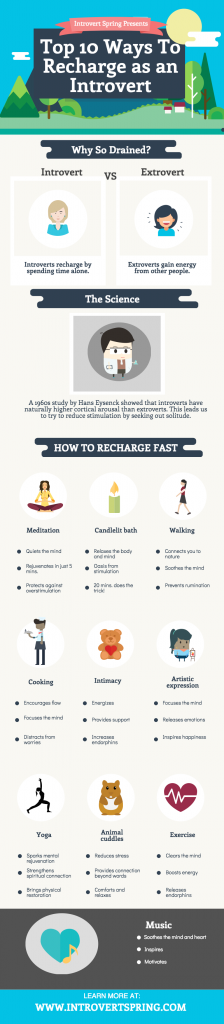
Introvert Social Battery Drained? 9 Ways to Recharge
The 'Introvert Social Battery Drained?' article provides a fantastic framework for choosing recovery activities by categorizing them into tiers based on how restorative they are.
Read section 4, 'Energy-Restoring Activities for Drained Introverts.' Focus on the difference between Tier 1 (High-Restoration), Tier 2 (Moderate-Restoration), and Tier 3 (Low-Restoration) activities. Use this to identify which activities will be most effective for you.
Test your understanding!
You've just finished a three-hour impromptu speaking competition at your club. You feel completely drained (your battery is at 10%). You get home and have two hours before you need to sleep. Which of the following would be the most effective high-restoration recovery strategy, according to the resources?
a) Watching a new, complex thriller movie.
b) Calling a friend to vent about the competition.
c) Scrolling through Instagram to see what your friends are up to.
d) Taking a warm bath while listening to instrumental music.
Show answer
The correct answer is d) Taking a warm bath while listening to instrumental music.
This is a Tier 1 (High-Restoration) activity. It reduces sensory input, calms the nervous system, and requires minimal cognitive processing. The other options are less effective for deep recovery:
- a) A new, complex movie requires significant cognitive energy to follow the plot.
- b) Calling a friend is still a social interaction, which drains your battery.
- c) Scrolling Instagram is a Tier 3 (Low-Restoration) activity that provides stimulation without genuine rest.
4. Long-Term Prevention: Designing a Recovery-Centric Lifestyle
The ultimate goal is not just to get good at recovering from crashes, but to prevent them from happening in the first place. This involves shifting from a reactive to a proactive mindset. Given your background in economics, you can think of this as moving from emergency bailouts to sound fiscal policy.
This means building recovery time into your life with the same seriousness as any other commitment.
Introvert Social Battery Drained? 9 Ways to Recharge
Let's explore the concept of 'Strategic Solitude Planning.' This approach treats your recovery time as a non-negotiable part of your schedule.
Read section 3, 'Strategic Solitude Planning.' Pay special attention to the idea of a 'social energy budget' and blocking out recovery time in your calendar. This transforms recovery from an afterthought into a deliberate strategy.
A great way to make this practical is by establishing daily rituals that protect and restore your energy.
Exhausted After Socializing? This Question Changed Everything For Me
In this final clip, Jamie Social outlines several daily rituals that can help you manage your energy budget proactively.
Watch the section on 'Daily rituals' from 15:29 to 17:35. Note the ideas of a morning ritual to build reserves, strategic scheduling during the day, and an end-of-day ritual to decompress.
5. Application: Create Your Personal Recovery Plan
Now it's time to put all this together into a customized plan. A generic strategy is good, but a personal one is what will make a real difference.
Introvert Social Battery Drained? 9 Ways to Recharge
The article 'Introvert Social Battery Drained?' concludes with a step-by-step guide to creating your own plan. This is your final exercise for today's lesson.
Read section 9, 'Creating Your Personal Recovery Plan.' Use the questions under 'Step 1: Assess Your Current Situation' to reflect on your own patterns. Then, use 'Step 2: Design Your Personal Recovery Kit' as a template to brainstorm your own physical and digital resources for recovery.
Your Action Step:
Based on the reading above, take 10 minutes to outline your own Personal Recovery Plan. In a notebook or document, answer the following:
- Biggest Drainer: What is one specific, recurring social activity that drains you the most? (e.g., "Weekly team meetings," "Impromptu speaking at my club").
- Micro-Recovery Tactic: What is one 2-minute reset you will try the next time you feel drained during an event?
- High-Restoration Activities: List three Tier 1 activities that you genuinely enjoy and can use to recharge after an event.
- Strategic Solitude: Look at your calendar for the coming week. Where can you block out one 30-minute "recovery appointment" with yourself after a planned social or work commitment?
Conclusion
Today you've moved beyond simply identifying social exhaustion to building a comprehensive toolkit to combat it. By understanding the underlying physiology and implementing strategies across different timescales, you can take control of your energy.
Key Takeaways:
- A "social hangover" is a real physiological state caused by an overstimulated sympathetic nervous system. Recovery is about activating the parasympathetic "brake."
- Micro-recovery techniques (like deep breathing or a 2-minute reset) are for in-the-moment energy management.
- Short-term recovery involves high-restoration activities (like nature walks or creative expression) and prioritizing sleep after draining events.
- Long-term prevention is about proactively scheduling solitude and building daily rituals to manage your "social energy budget."
- A personalized recovery plan is your most powerful tool for sustainable social engagement.
Preview of the Next Lesson:
Now that you know how to assess your energy and recover it, our next lesson will focus on being even more proactive. The learning outcome is to "Strategically plan social engagements to align with personal energy cycles." We will explore how to choose which events to attend, how to structure your social calendar, and how to prepare for demanding interactions to minimize energy loss from the start.