Hello! Welcome back to our module on Ethical Persuasion and Influence.
In our last lesson, we explored Dr. Cialdini's powerful principles of influence and introduced the crucial idea of being an "influence detective"—someone who ethically highlights genuine reasons for agreement. Today, we will build directly on that foundation by examining the boundary between ethical persuasion and unethical manipulation.
Your goal for this lesson is to evaluate the ethical implications of using specific persuasion techniques in various contexts. This is a critical skill for anyone who wants to be not just a charismatic communicator, but also a trustworthy and respected one. Understanding this distinction will help you build the deeper, more authentic bonds you're aiming for.
The Persuasion-Manipulation Continuum
Persuasion and manipulation aren't always two distinct categories; they often exist on a spectrum. At one end, you have ethical persuasion that respects the other person's autonomy. At the other, you have deceitful manipulation that undermines it.

So, what defines the line? Is it the technique itself? The outcome? Let's establish a clear philosophical foundation.
Defining the Line: It's All About Intention
The core difference between persuasion and manipulation isn't the method used, but the intention behind it. An emotional appeal can be a genuine attempt to build empathy (persuasion) or a "guilt trip" designed to coerce (manipulation).
The following article by philosopher Robert Noggle provides a very clear and powerful definition of manipulation.
How to tell the difference between persuasion and manipulation
In this article, 'How to tell the difference between persuasion and manipulation' from Aeon, Noggle argues that manipulation is wrong because of the manipulator's intent to degrade someone's decision-making process.
Please read the two sections starting with 'It appears, then, that whether an influence is manipulative depends on how it is being used.' and ending with '...the essential immorality of manipulation.' Focus on the central argument: what makes an influence manipulative is the attempt to get someone to adopt what the influencer knows is an inappropriate belief, emotion, or mental state.
As the article explains, the essential immorality of manipulation is the intent to make another person make a mistake.
- A liar wants you to adopt a false belief.
- A manipulator might do that, or they might want you to feel an inappropriate emotion (like baseless jealousy), doubt your sound judgment, or attribute importance to the wrong things.
Ethical persuasion, in contrast, aims to help someone make a better decision by leading them to believe, feel, or pay attention to the right things. This perfectly aligns with Cialdini's "influence detective," who uncovers and points to genuine reasons for agreement.
Recognizing Unethical Persuasion in Practice
With this definition in hand—that manipulation involves intentionally degrading someone's decision-making—let's look at what this looks like in the real world.
The Unethical Use of Influence Principles
In our last lesson, we learned about principles like scarcity and reciprocity. These can be used ethically, but they are also frequently abused.
The following video from Charisma on Command does an excellent job of showing how these principles can be twisted for manipulative purposes.
Words That Win: How To Instantly Influence Anyone (use ethically)
This video, 'Words That Win,' revisits several influence principles but explicitly warns about their unethical applications. It provides clear examples of what to watch out for.
Please watch the following three segments: Scarcity (02:41 - 04:42): Notice how creating false scarcity is a deliberate attempt to make you feel an inappropriate sense of urgency. Reciprocity (06:24 - 08:06): Pay attention to the 'rejection-then-retreat' technique. This is designed to make you feel an inappropriate sense of obligation. Authority (08:06 - 09:40): See how using mere symbols of authority, without real substance, is intended to make you trust what you shouldn't. As you watch, consider how each of these manipulative tactics fits Noggle's definition of getting you to make a mistake.
These examples highlight a clear pattern: manipulation often involves faking the conditions under which an influence principle would naturally work.
The video concludes with what I believe is the single most important ethical filter for a persuader. Let's watch that final, crucial segment.
Words That Win: How To Instantly Influence Anyone (use ethically)
This final clip from 'Words That Win' presents the core mindset that separates ethical influencers from manipulative ones. It's a simple but profound test.
Watch from 10:56 to 12:06. Absorb the key lesson: Don't persuade someone to do something unless you genuinely believe it's good for them. This is your ethical North Star.
Advanced Manipulation: The Machiavellian Playbook
Beyond misusing influence principles, there are more systematic forms of manipulation, often seen in propaganda and large-scale influence campaigns. Your interest in history and geopolitics will provide a rich context for understanding these darker patterns.
This next video explores manipulative tactics through the lens of Niccolò Machiavelli, whose name has become synonymous with cynical manipulation. Understanding this "dark side" is your best defense against it.
Why Obvious Lies Make Perfect Propaganda – Machiavelli Knew This
The video 'Why Obvious Lies Make Perfect Propaganda' from Philosophy Coded unpacks four powerful manipulative strategies. Recognizing these is key to defending your own critical thinking.
I'll break this down by technique. For each, I'll introduce the concept and then direct you to the right part of the video. Exploiting Cognitive Overload (02:51 - 05:57): The manipulator offers a simple, emotionally satisfying lie to someone overwhelmed by complex reality. The simple narrative feels like a relief, so the brain accepts it without scrutiny. Manufacturing Truth Through Repetition (05:57 - 09:25): This is the 'illusory truth effect.' A lie, repeated often enough, starts to feel familiar and therefore true, even if you know it's false. The manipulator drowns out the truth with volume. The Illusion of Choice (09:25 - 12:20): The manipulator presents a limited menu of pre-approved options. You feel a sense of agency by choosing, but you never question who designed the menu. This makes you defend a choice you didn't truly shape. Performing Virtue (12:20 - 16:23): This is perhaps the most insidious. The manipulator fakes signals of morality (generosity, integrity) to win trust. Your brain is wired to trust these signals, so you stop auditing their actual, hidden behavior. Please watch these segments and think about where you might have seen these tactics in media, politics, or even personal interactions.
Test your understanding!
Imagine a political leader is facing a scandal about their environmental policy. They respond by making a very public, large donation to a wildlife fund and giving a speech full of praise for climate activists. Their supporters share clips of the speech widely on social media.
Which of the Machiavellian tactics we just discussed are being used here?
Show answer
At least two tactics are at play:
- Performing Virtue: The leader is using a public act of generosity (the donation) and praise for activists to project an image of being pro-environment. This is a classic move to win trust and divert attention from the actual policy scandal, which may be harmful.
- Repetition: By having supporters share the clips widely, they are using volume to make the performance of virtue more visible than the details of the scandal. This creates an 'ambient reality' where the leader is associated with environmentalism, regardless of their actual policies.
A Framework for Ethical Persuasion
Now that you can spot manipulation, let's turn to the positive side: how to actively practice ethical persuasion. The key is to build a communication style based on principles that enhance, rather than degrade, others' decision-making.
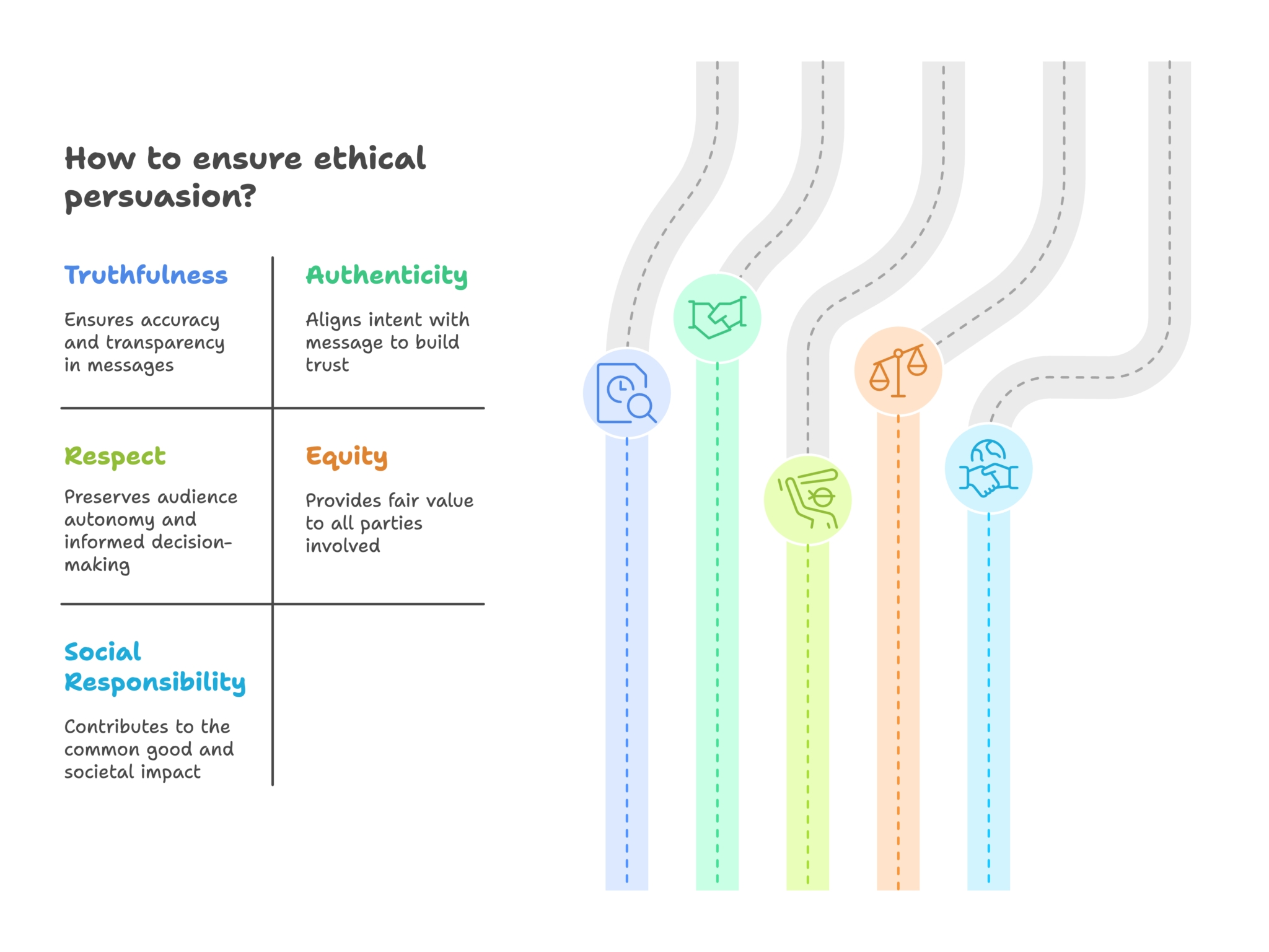
This framework serves as an excellent guide for ensuring your communication is both effective and honorable. The following article provides science-backed techniques that align perfectly with these pillars.
Neuroscience of Persuasion: How to Ethically Influence in ...
The article 'Neuroscience of Persuasion' offers practical, ethical techniques rooted in how the brain actually works. It reinforces the idea that ethical influence is about partnership, not control.
Please read the sections 'How to Apply Neuroscience to Ethical Persuasion' and 'Community Corner'. Pay attention to: How techniques like 'Engage the Brain’s “Social Safety Switch”' and 'Present Choices, Not Commands' directly counter the fear and control used in manipulation. The 'Community Corner' question, which once again confirms that the difference between persuasion and manipulation lies in intention.
Notice how the ethical technique of "Presenting Choices" is the positive counterpart to the manipulative "Illusion of Choice." The ethical version offers genuine options that respect the person's agency, while the manipulative version offers a false choice where all outcomes serve the manipulator.
Your Ethical Evaluation Toolkit
To bring this all together, here is a simple checklist you can use to evaluate the ethics of any persuasive attempt—whether it's your own, or one directed at you.
- Intention: Is the goal to help the other person make a better, clearer decision, or to trick them into making a mistake for my own benefit?
- Truthfulness: Am I being an "influence detective" by pointing to real facts, similarities, and social proof? Or am I being a "smuggler" by inventing or distorting them?
- Autonomy: Does this approach respect the person's intelligence and freedom to choose? Or does it try to short-circuit their reasoning with fear, pressure, or cognitive tricks?
- Benefit: Do I genuinely believe this outcome is good for them? Is it a mutually beneficial (win-win) proposal?
If you can answer "yes" to these questions, you are on solid ethical ground.
Conclusion
Today, we've moved from simply understanding influence to analyzing its ethical core. You now have a robust framework for distinguishing between persuasion that builds trust and manipulation that destroys it.
Key Takeaways:
- The line between persuasion and manipulation is defined by intention. Manipulation seeks to degrade decision-making, while ethical persuasion seeks to enhance it.
- Manipulators often misuse influence principles by faking the conditions (e.g., false scarcity, feigned authority).
- Advanced manipulation tactics include exploiting cognitive overload, using repetition to create illusion, offering false choices, and performing virtue to mask vice.
- Ethical persuasion is built on truthfulness, respect for autonomy, and a genuine belief that the proposed outcome is beneficial for the other person.
Preview of the Next Lesson:
Now that we have established this firm ethical foundation, we can begin building powerful persuasive structures upon it. In the next lesson, we will learn how to create a persuasive narrative using the problem-agitate-solution structure. This storytelling technique is one of the most effective ways to ethically engage others and move them to action.