Hello! Welcome to the next lesson in your course on changing a tyre.
In the previous lesson, you learned how to safely stow the damaged tyre and all your tools, clearing the way for you to get back on the road. Now that the physical work is done, it's time to understand the crucial rules of driving with a temporary spare tyre.
This lesson addresses a key safety topic: explaining the driving limitations of a temporary spare tyre, such as speed and distance. These aren't just recommendations; they are strict limits designed to protect you and your vehicle. As someone with a background in design, you'll appreciate that these spare tyres are designed for a very specific, limited purpose, and using them outside that purpose can lead to failure.
Part 1: Not All Spares Are Created Equal
First, it's important to know what kind of spare tyre you're dealing with. Most modern cars come with a "temporary spare," often called a "donut," to save space and weight. Some larger vehicles, like trucks and SUVs, may have a "full-size spare."
How Long Can I Drive on a Spare Tire?
To understand the difference, please read this brief section from an AutoZone article.
Read the section 'What Is a Spare Tire?'. Focus on the descriptions of a 'full-size spare' and a 'temporary spare' to understand their fundamental differences.
As the article explains:
- Full-Size Spare: An identical match to your other tyres. If you have one of these, you can generally drive on it normally, though it's still wise to get your original tyre repaired soon.
- Temporary Spare ("Donut"): Smaller, thinner, and lighter. This is a temporary fix only.
The rest of this lesson will focus on the limitations of the much more common temporary "donut" spare.
Part 2: The Rules of the Road for Donut Spares
Driving on a donut spare requires you to follow strict speed and distance limits. The most common guideline is easy to remember.
How Long Can You Drive On A Spare Tire?
This article from SimpleTire introduces a simple rule of thumb for driving on a spare.
Please read the introduction and the section 'The "50/50 Rule" (Quick Facts)'. This will give you the core numbers you need to remember.
This "50/50 Rule" is your primary guide:
- Maximum Speed: 50 mph (~80 km/h)
- Maximum Distance: 50 miles (~80 km)
Some manufacturers may state a slightly longer distance, like 70 miles, but 50/50 is the safest and most common rule. The limitations are often printed directly on the tyre's sidewall or on a bright sticker on the wheel itself.
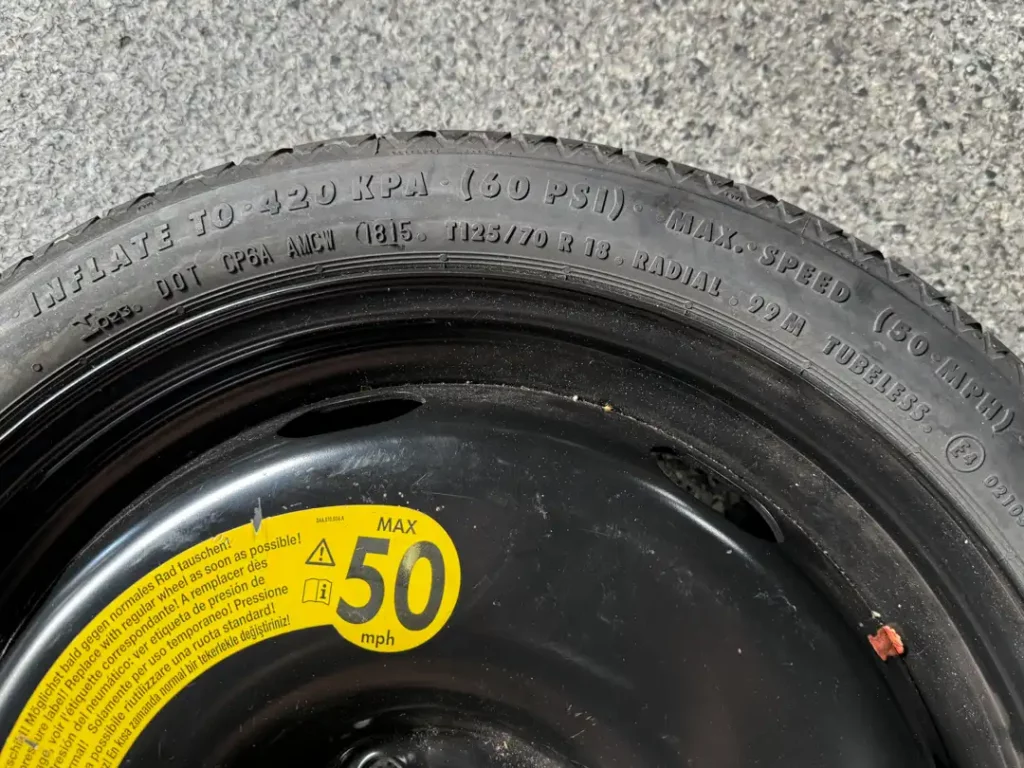
This visual summary is also a helpful reference for the different types of spares and their limits.

Part 3: Why These Limits Are So Important
You now know the what, but your goal is to understand the why. Exceeding the speed and distance limits isn't just risky; it's actively dangerous and can cause expensive damage to your car. The donut spare is a marvel of compromise in product design—it's made to be small and light, but that comes at the cost of performance, durability, and safety.
How Long Can You Drive On A Spare Tire?
To understand the serious risks involved, please read this section from the SimpleTire article.
Read the section '2. Are there risks of extended spare tire use?'. Pay close attention to the four key risks: Drivetrain Stress, Reduced Braking & Handling, Braking System Issues, and Blowout Hazard.
Let's break down those risks:
- Drivetrain Stress: The donut is smaller than your regular tyre. This means it has to spin faster to keep up, forcing a part of your car called the differential to work constantly. Extended use can cause the differential to overheat and fail, leading to a very expensive repair.
- Reduced Braking & Handling: The donut has a very narrow tread, meaning less rubber is in contact with the road. This significantly increases your stopping distance and makes the car less stable when turning. You must drive more cautiously, leaving extra space between you and the car in front.
- Braking System Issues (ABS & ESC): Your car's safety systems, like the Anti-lock Braking System (ABS) and Electronic Stability Control (ESC), are calibrated for four identical tyres. The different size and rotation speed of the donut can confuse these systems, causing them to work incorrectly or even shut off when you need them most.
- Blowout Hazard: These tyres are not built for durability. Driving at high speeds generates a lot of heat, which the thin, lightweight donut cannot dissipate effectively. This heat buildup drastically increases the risk of a sudden and dangerous tyre blowout.
In short, the limitations are there because the spare tyre is fundamentally different in its design and construction from a standard tyre.
Conclusion
You are now ready to drive away from your roadside stop, but with a new awareness of the temporary nature of your solution. The goal of changing a tyre is not to continue your trip as planned, but to get your vehicle safely to a repair shop.
Key Takeaways:
- Most cars have a temporary "donut" spare, which is smaller and lighter than a standard tyre.
- The guiding principle for driving on a donut is the "50/50 Rule": no faster than 50 mph and for no more than 50 miles.
- These limits exist for critical safety reasons: the donut offers poor grip, can damage your car's drivetrain, may disable safety systems, and is prone to overheating and blowouts at high speeds.
- Always treat a spare tyre as a temporary bridge to get you to the nearest garage.
In the final lesson of this course, we will cover the necessary next steps, including what to do when you arrive at the garage to get your original tyre repaired or replaced.