Hello! Welcome to your next lesson in the "Essential Mathematical Foundations" module.
In our previous lesson, we established a strong geometric intuition for eigenvalues and eigenvectors—the special vectors that a matrix transformation only scales, without changing their direction. This concept of identifying the fundamental "axes" of a transformation is a powerful one.
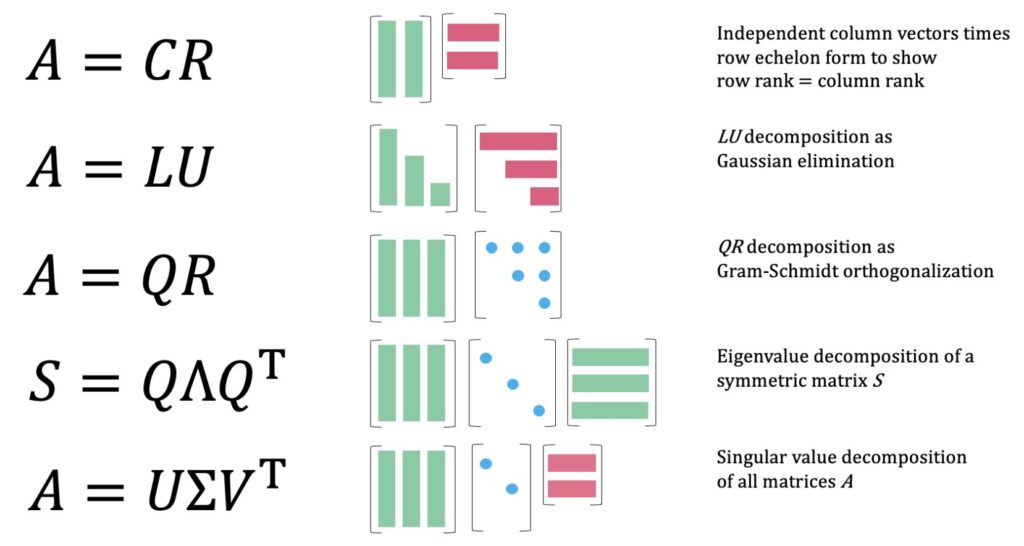
Today, we'll build on this by exploring matrix decomposition, also known as matrix factorization. This is the idea of breaking down a complex matrix into a product of simpler, more structured matrices. Just as factoring a number like 12 into 2 × 2 × 3 can reveal its properties, decomposing a matrix can reveal its fundamental actions and make certain computations much easier.
Our learning outcome for this lesson is to explain the purpose of matrix decompositions like LU and Singular Value Decomposition (SVD). We will focus on what these decompositions are and, most importantly, why and when you would use them—a key skill for your GATE exam.
1. What is Matrix Decomposition?
Before diving into specific methods, let's clarify the main idea.
Matrix Decomposition Series: 8 — The Principles and Methods of ...
This article from Medium provides a clear, high-level introduction to the concept of matrix factorization.
Read the first two subsections under 'The Concept of Factorization', starting from 'Defining Factorization' and ending just before 'Types of Factorization'. Focus on the core idea: breaking a matrix into a product of other matrices to simplify it or reveal its internal structure.
In essence, matrix decomposition helps us in two primary ways:
- Simplifying Computations: It can transform a difficult problem (like solving a large system of equations) into several easier ones.
- Understanding Data: It can uncover latent structures and features within data, which is fundamental to machine learning.
Let's now look at two of the most important decompositions mentioned in your syllabus: LU and SVD.
2. LU Decomposition: The Computational Workhorse
LU decomposition is a method that factors a square matrix into the product of a lower triangular matrix (L) and an upper triangular matrix (U).
Purpose: Efficiently Solving Systems of Linear Equations
The main purpose of LU decomposition is to speed up the process of solving systems of linear equations of the form . Solving this directly can be computationally expensive, especially if you need to solve for many different vectors using the same matrix .
To understand why this decomposition is so useful, let's see it in action.
Further Matrix Decompositions: LU, Cholesky, QR, and SVD
The following video from Professor Dave Explains clearly demonstrates the process and purpose of LU decomposition.
Watch the segment from 00:29 to 03:11. Pay close attention to how the problem Ax = b is transformed into two simpler, sequential problems: Lc = b and Ux = c.
As the video explained, once we have , we can rewrite as . We then solve this in two simple steps:
- Forward Substitution: Let . First, solve for . Since is lower triangular, this is very fast.
- Back Substitution: Now that you have , solve for . Since is upper triangular, this is also very fast.
The key takeaway is that LU decomposition transforms one complex problem into two simple ones. It's a foundational technique in numerical linear algebra, valued for its efficiency in computational tasks rather than data analysis.
3. Singular Value Decomposition (SVD): The Data Science Powerhouse
Singular Value Decomposition is arguably the most important and versatile matrix decomposition in data science. It works for any matrix, not just square ones.
SVD states that any matrix can be factored into three other matrices:
- : An orthogonal matrix whose columns are the "left singular vectors."
- (Sigma): An diagonal matrix containing non-negative numbers called singular values.
- : The transpose of an orthogonal matrix , whose columns are the "right singular vectors."
Connecting SVD to Eigenvalues
SVD is a generalization of the eigendecomposition we studied in the last lesson. The singular values and singular vectors of are directly related to the eigenvalues and eigenvectors of and .
The following video explains this connection and the overall concept of SVD very well.
Further Matrix Decompositions: LU, Cholesky, QR, and SVD
Let's return to the video from Professor Dave Explains to understand SVD.
Watch the segment from 06:16 to 09:09. Focus on these key points: SVD is a generalized version of diagonalization that works for any matrix. The singular values (\sigma_i) are the square roots of the eigenvalues of A^TA. The columns of U and V are the eigenvectors of AA^T and A^TA, respectively. Its applications lie in encoding a matrix's 'spectral information' for use in statistics and computer science.
Purpose: Analyzing and Simplifying Data
Unlike LU decomposition, which is primarily for numerical computation, SVD is a cornerstone of data analysis and machine learning. Its power comes from its ability to break down a transformation into three intuitive steps: rotation (), scaling (), and another rotation ().
The singular values in are ordered from largest to smallest, indicating their importance. This allows for several powerful applications:
-
Dimensionality Reduction & Low-Rank Approximation: This is the most critical application. By keeping only the top singular values (and the corresponding columns in and ), you create the best possible rank-k approximation of the original matrix . This is the mathematical engine behind Principal Component Analysis (PCA), allowing you to reduce the number of features in your data while preserving the most important information (variance).
-
Data Compression: The low-rank approximation is a form of lossy data compression. For example, an image can be represented as a matrix. A low-rank approximation of this matrix can capture the essence of the image with far less data.
-
Numerical Stability: SVD is the most numerically stable decomposition. While it's slower than LU, it's the preferred method for solving linear systems when the matrix is ill-conditioned (i.e., close to being singular).
4. Comparison: When to Use LU vs. SVD
For your exam, knowing when to apply each method is crucial.
Matrix Decomposition Series: 8 — The Principles and Methods of ...
This article provides a direct comparison of different decomposition methods, which will help summarize the key differences.
First, read the subsections on 'Singular Value Decomposition (SVD)' and 'LU Decomposition' under the heading 'Computational Methods of Factorization'. Then, read the subsection 'Factorization (QR Decomposition, LU Decomposition) vs. SVD' under the 'Comparison with Other Matrix Decomposition Methods' heading. Focus on the advantages, limitations, and applicable scenarios for each.
Here is a summary of the key differences:
| Feature | LU Decomposition | Singular Value Decomposition (SVD) |
|---|---|---|
| Matrix Type | Square matrices | Any matrix |
| Primary Goal | Computational efficiency | Data analysis and interpretation |
| Main Use Case | Fast solution of | Dimensionality reduction (PCA), data compression, recommender systems |
| Key Components | (Lower and Upper triangular) | (Orthogonal, Diagonal, Orthogonal) |
| Speed | Faster | Slower |
| Stability | Can be numerically unstable | Most numerically stable |
Conclusion
In this lesson, we explored the purpose behind two fundamental matrix decompositions. By breaking down matrices into simpler, structured components, we can either make computations more efficient or gain deep insights into the data they represent.
Key Takeaways:
- Matrix Decomposition is the process of factoring a matrix into a product of other matrices to simplify problems and reveal underlying structure.
- LU Decomposition () is a computational tool. Its main purpose is to solve systems of linear equations quickly and efficiently. Think of it as a tool for numerical computation.
- Singular Value Decomposition () is an analytical tool. Its main purpose is to understand the structure of data, perform dimensionality reduction, and create low-rank approximations. It is the powerhouse behind techniques like PCA. Think of it as a tool for data analysis.
Preview of the Next Lesson:
We've now concluded our brief tour of essential linear algebra concepts. In the next lesson, we will pivot to the final topic in this module: Calculus and Optimization. We will begin by reviewing how to use derivatives to find the maxima and minima of functions, a critical skill for training almost any machine learning model.