Welcome back. The previous lesson showed how to check an over-the-counter pain plan for dose limits, interactions, and personal risks. Hormonal treatment is a different kind of option: rather than relieving cramps only when they occur, it can change the menstrual cycle so that future periods are less painful.
This lesson takes about 35–40 minutes. It covers how hormonal methods may help, what benefit the evidence supports, and why a clinician needs to consider your health history and preferences before recommending one.
Changing the cycle, not just treating a cramp
In primary menstrual pain, prostaglandins released around the start of a period contribute to strong uterine contractions. An NSAID such as ibuprofen reduces prostaglandin production at that time. Hormonal treatments act further upstream: depending on the method, they may suppress ovulation, make the uterine lining thinner, or both. With less lining to shed, bleeding and the associated cramping may lessen.
These methods are generally used over successive cycles, not as instant relief for a severe cramp today. They can be useful when pain repeatedly disrupts daily life, when NSAIDs are unsuitable or insufficient, or when contraception is also wanted. Hormonal treatment may also relieve pain associated with some underlying conditions, but improvement alone does not establish that the pain was primary rather than secondary.
Should Periods Hurt? - Causes, Treatments, Medication
Watch “Should Periods Hurt? - Causes, Treatments, Medication” by Dr Simi Adedeji for a short explanation of why hormonal treatment can reduce cramps and why suitability needs an individual review.
Watch hormonal options for the explanation of cycle suppression and the hormonal intrauterine system. Then watch individual suitability for the reminder about medical risks. One nuance to keep in mind: not every hormonal method stops ovulation. The hormonal intrauterine device acts largely by thinning the uterine lining, and ovulation can continue.
The main options and their likely benefits
“Birth control” describes several different treatments, not one interchangeable medicine. Combined hormonal methods contain estrogen and progestin; examples include the pill, patch, and vaginal ring. Progestin-only methods include some pills, the implant, injection, and hormonal intrauterine device (IUD, also called an intrauterine system). Their effects on bleeding and their practical demands differ.
Dysmenorrhea: Painful Periods | ACOG
Read ACOG’s FAQ to see which hormonal methods it presents as options for painful periods, including the hormonal IUD.
In the FAQ answers on hormonal birth control, begin with the answer starting “Birth control methods that contain estrogen and progestin.” Read the method overview, then continue into the next answer about the hormonal IUD. Read the bleeding changes. Focus on the distinction between methods that can reduce pain and a guarantee that any one method will do so for everyone.
Combined methods commonly make bleeding lighter and cramps less severe. Some people use a pill schedule with planned breaks and a withdrawal bleed; a clinician may instead discuss taking active pills continuously to reduce how often bleeding occurs. The schedule is a treatment choice, not an instruction to alter a prescription independently.
A hormonal IUD releases progestin mainly in the uterus. Bleeding often becomes lighter over time and may stop, although irregular bleeding can occur, particularly early on. A copper IUD is different: it contains no hormone and can make bleeding or cramps worse for some people. Other progestin-only methods may reduce pain, but their bleeding patterns can be less predictable. No method promises a pain-free period.
What the evidence supports—and what it does not
The strongest evidence in the supplied research concerns the combined oral contraceptive pill for primary menstrual pain. Read the Cochrane summary with two separate decisions in mind: whether it helps on average, and whether its drawbacks are acceptable to a particular person.
Combined oral contraceptive pill (OCP) as treatment for primary dysmenorrhoea | Cochrane
Read Cochrane’s plain-language summary for the measured benefits and adverse effects of combined oral contraceptive pills. It provides more specific evidence than a general claim that hormonal treatment “works.”
Under “Study characteristics,” read the study overview. Under “Key results,” read from “OCPs compared to placebo” through the paragraph on weight gain, especially benefits and harms. Continue to “Different OCPs compared to each other” and “OCP compared to a non-steroidal anti-inflammatory medicine”; read the regimen comparison. Notice where the authors describe evidence as uncertain rather than treating an unproven difference as no difference.
Across the studies Cochrane reviewed, combined pills reduced pain by an average of 0.7 to 1.3 points more than placebo on a 0–6 pain scale. That is evidence of a benefit on average, not a prediction of exactly how much relief an individual will get. The review could not establish whether pills relieve pain better than NSAIDs.
The trade-offs matter. Compared with placebo, combined pills increased irregular bleeding in the reviewed trials and probably increased headaches and nausea. Continuous pill use might reduce pain more than a schedule with breaks, but the evidence for that additional benefit is less certain, and irregular bleeding may be more common. These findings concern combined pills; they should not be copied directly onto the hormonal IUD, implant, or injection.
Why treatment is clinician-guided
A clinician’s task is not merely to choose an effective method. It is to match a method to medical risks, other medicines, pregnancy plans, and the kind of treatment you would be willing to use.
For example, estrogen-containing methods are unsuitable for some people because of risks such as blood clots or stroke. A clinician will check relevant history, including blood clots, migraine with aura, high blood pressure, smoking in combination with age, and other conditions or medicines that affect safety or effectiveness. Progestin-only methods have a different risk profile, but they are not automatically suitable for everyone either. The hormonal IUD also involves an insertion procedure; its suitability and any need for infection assessment are considered individually.
Preferences can change the best choice even when several methods are medically suitable. Someone may value avoiding a daily tablet, prefer to avoid a procedure, want lighter or less frequent bleeding, or find unpredictable spotting particularly disruptive. Plans to become pregnant are especially important because these methods are contraceptives while in use. A clinician can explain what to expect from a proposed method, its side effects, and when to review it if pain or bleeding remains troublesome.
The clinical flowchart below places contraceptive hormones alongside NSAIDs as possible treatment for a typical primary-pain pattern. Its other important message is that atypical symptoms or pain that does not respond need reassessment. It is a simplified clinical pathway, not a sequence to follow independently or a reason to delay care.
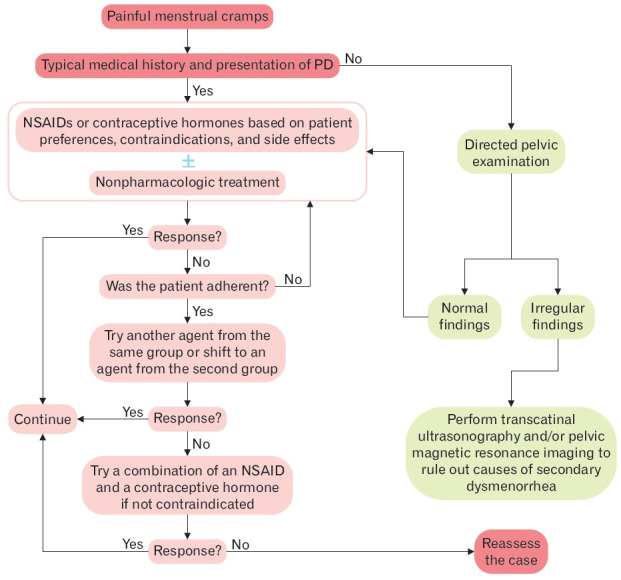
Hormonal treatment should not be used to dismiss new, worsening, or persistent pain. Likewise, possible pregnancy with unusual pain, sudden severe or one-sided pain, fainting, fever, or other concerning symptoms calls for timely assessment rather than waiting to see whether a hormonal method helps.
Key takeaways
Hormonal methods can reduce menstrual pain by changing ovulation and/or the uterine lining; they are cycle-level treatment, not immediate rescue medicine. Combined pills have evidence of average pain relief in primary dysmenorrhea, alongside increased irregular bleeding and some other side effects. Other hormonal options may help, but their benefits and burdens differ. Medical history determines what is safe to consider, while your contraception goals and preferences help determine what is worth choosing.
The next lesson turns to non-medicine relief—particularly heat, exercise, and TENS—and how to weigh their evidence and limitations.