Introduction
In our last lesson, we established the importance of idempotency, implementing patterns to ensure that retrying an agent's actions doesn't lead to duplicate side effects. This makes our retry logic safe. However, it begs a crucial question: what is the final recourse for a task that continues to fail even after exhausting its retry budget? A task cannot be retried indefinitely, as this would lock up resources and potentially mask a deeper, unrecoverable issue.
This lesson addresses that final step in the failure handling chain: designing and implementing a dead-letter handling strategy. Drawing on your background in distributed systems, you are already familiar with the concept of a Dead-Letter Queue (DLQ) as a foundational pattern for reliability. Today, we will adapt this classic pattern to the unique challenges of agentic systems. We'll explore how to categorize agent-specific failures, what constitutes a useful "dead-letter" message for later diagnosis, and how a DLQ serves not as a task graveyard, but as the starting point for powerful recovery and analysis workflows.
1. The Dead-Letter Queue: First Principles
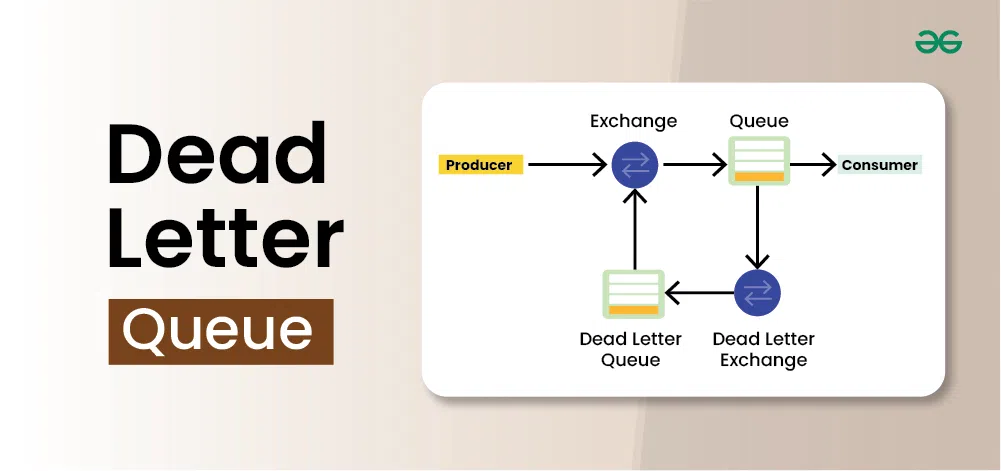
At its core, a Dead-Letter Queue is a mechanism in a message-driven architecture for storing messages that cannot be processed successfully. Instead of being discarded or endlessly retried, the problematic message is moved to a separate "dead-letter" queue. This simple act achieves two critical goals:
- Unblocking the Consumer: It prevents a single "poison pill" message from halting the processing of all subsequent messages in the main queue.
- Preserving the Failure: It saves the failed message and its context for later inspection, debugging, and potential reprocessing.
The video below provides a concise overview of how DLQs fit into a typical message-driven architecture, complementing retry policies to build a robust system.
Handling Failures in Message Driven Architecture
This video from the "CodeOpinion" channel explains the role of a dead-letter queue when retry mechanisms like exponential backoff are insufficient.
Please watch the segment on dead-letter queues. The key concept here is moving a message that has exhausted its retry budget to a separate queue to avoid holding up the consumer.
This fundamental pattern provides the foundation for our agent's ultimate failure handling strategy.
2. Categorizing Agent Failures for DLQ Routing
While the DLQ concept is standard, its effective implementation in an agentic system requires a more nuanced approach to failure classification. Unlike a traditional microservice where failures are often binary (e.g., database connection failed), agents introduce a spectrum of probabilistic and model-specific errors. Deciding which failures warrant immediate dead-lettering versus further retries is a critical design decision.
The following article provides an excellent taxonomy for these failures.
Dead Letter Queues and Retry Policies for Production AI Agent Systems | Brandon Lincoln Hendricks
This article by Brandon Lincoln Hendricks details failure modes specific to AI agents and how to categorize them for robust retry and DLQ logic.
Please read the first two main sections of the article. Start with the introduction to understand the unique challenges. Then, read the section categorizing failures. Pay close attention to the three buckets: Transient, Model, and Permanent failures.
As the article explains, we can structure our logic as follows:
- Transient Failures (Retry): These are temporary issues like network timeouts or
503 Service Unavailableerrors. Our existing retry strategies (e.g., exponential backoff) are designed for these. A task should only be dead-lettered if it hits the maximum retry count for a transient failure, suggesting a longer-term outage. - Permanent Failures (Direct to DLQ): These are deterministic, unrecoverable errors. Examples include authentication failures (invalid API key), schema validation errors on input, or core business logic violations. There is no point in retrying these; they should be routed directly to the DLQ for immediate investigation.
- Model Failures (Retry with Modifications or DLQ): This is the most complex category, unique to agents. It includes token limit violations, response parsing errors, or safety filter triggers. Here, a simple retry is often ineffective. The best strategy might be an "intelligent retry" (e.g., reducing the prompt size, switching to a fallback model) for one or two attempts. If these modified attempts also fail, the task should then be moved to the DLQ.
Your agent's error handling logic should explicitly implement this categorization to route failures intelligently, saving compute resources and providing a cleaner signal in the DLQ.
3. The Anatomy of a Dead-Lettered Task
A DLQ's value is directly proportional to the quality of the data it contains. A dead-lettered message that only includes the original task payload is of limited use. For effective debugging and reprocessing, the message must be an exhaustive record of the task's failed lifecycle.
Dead Letter Queues and Retry Policies for Production AI Agent Systems | Brandon Lincoln Hendricks
This article provides a checklist of the essential context that should be included with every message sent to the DLQ.
Please read the section titled Essential Context in Every DLQ Message. This list is your blueprint for a useful DLQ message schema.
Your dead-lettered task object should be a rich data structure containing, at a minimum:
- Correlation IDs: A unique
request_idorrun_idto trace the task across all system logs and services. - Original Payload: The initial request that triggered the agent task.
- Agent & Model State: The specific model version (
gpt-4-turbo-2024-04-09), the full (sanitized) prompt sent to the LLM, and key details about the agent's internal state or memory at the time of failure. - Failure History: A complete log of all retry attempts, including the error message, status code, and timestamp for each attempt. This history is crucial for distinguishing a task that failed once due to a permanent error from one that failed five times due to a persistent transient error.
- Security & PII: Before logging this rich context, it's vital to sanitize the data, redacting sensitive information like API keys, passwords, and personally identifiable information (PII) to maintain security and compliance, as noted in the article's "Security Considerations" section.
By capturing this level of detail, you transform the DLQ from a failure log into a fully replayable test case.
4. Reprocessing and Recovery Workflows
A DLQ should not be a final destination. It is the entry point to a set of recovery workflows, which can range from fully automated to fully manual.

This multi-stage pattern is a powerful concept. The first DLQ can trigger automated reprocessing logic. For example:
- Bulk Reprocessing: A bug fix is deployed for a prompt template. A script can then pull all related failures from the DLQ, apply the fix, and resubmit them to the main queue.
- Selective Reprocessing: Analytics on the DLQ might reveal a pattern, like a specific tool failing. An automated process can re-queue only those tasks, perhaps routing them to a fallback tool.
If automated reprocessing fails, the task moves to a final "human intervention" queue. Here, operators can use a dashboard to inspect the full task context, manually edit parameters, and decide to either retry the task or mark it as definitively failed.
Dead Letter Queues and Retry Policies for Production AI Agent Systems | Brandon Lincoln Hendricks
This article outlines the key scenarios for building effective reprocessing pipelines.
Read the section Building Reprocessing Pipelines to understand the design of these three essential recovery workflows: bulk, selective, and manual override.
5. Dead-Lettering in Advanced Orchestration
In the more complex, stateful agent architectures we are moving towards, the concept of dead-lettering applies at a finer granularity. Instead of an entire multi-step task failing, a single step or WorkUnit within that task might fail permanently.
In the Promise/Work pattern, when a WorkUnit exhausts its retries, the system's Reconciler marks its status as FAILED. This is the logical equivalent of dead-lettering that specific unit of work. However, instead of simply parking it in a queue, this failure triggers a higher-level process: dynamic re-planning.
This article on the Promise/Work pattern demonstrates an advanced form of dead-letter handling where a failed sub-task triggers an intelligent re-planning process in the orchestrator agent.
Please read the section titled Dynamic Re-Planning. The replan_on_failure code snippet is particularly important.
As illustrated in the article, when a WorkUnit fails, the orchestrator agent analyzes the situation. It assesses the impact of the failure on the overall Promise and decides on a course of action:
- Find an Alternative Path: Can another sequence of
WorkUnitsachieve the same goal? - Accept Partial Fulfillment: Can the remaining, non-dependent
WorkUnitsbe completed to deliver a partial result? - Fail Gracefully: Is the failed
WorkUnitso critical that the entirePromisemust be marked as failed?
This represents a significant evolution of the DLQ concept. The "dead letter" is not just stored; it becomes an active signal that drives intelligent adaptation within the agent system itself.
Conclusion
You have now designed the final safety net in our agent's reliability stack. By integrating dead-letter handling, you ensure that no task is lost and that catastrophic failures don't cascade through the system. This pattern is indispensable for building production-grade agents that are observable, debuggable, and recoverable.
Key Takeaways:
- DLQs are for Terminal Failures: A DLQ is the designated destination for tasks that have exhausted all retry and recovery attempts.
- Categorization is Key: Not all agent failures are equal. Your system must distinguish between transient, permanent, and model-specific failures to route them correctly.
- Context is Everything: A dead-lettered message is only as valuable as the diagnostic data it contains. A full, sanitized execution trace is essential.
- Recovery over Graveyards: A DLQ should trigger analysis and reprocessing workflows (both automated and manual), not just accumulate failed tasks.
- Intelligent Re-planning: In sophisticated orchestrators, a "dead-lettered" sub-task can trigger a dynamic re-planning process, allowing the system to adapt to failure rather than simply giving up.
Preview of the Next Lesson:
We've now addressed failures of individual actions and tasks. But many agentic workflows are multi-step processes with real-world side effects (e.g., charge credit card, then book flight, then send confirmation). If a step in the middle of this sequence fails, how do we "undo" the actions that already succeeded? In our next lesson, we will implement the Saga compensation pattern, a crucial technique for maintaining data consistency and rolling back actions in a failed multi-step operation.