Introduction
In our previous lessons, we built a robust error-handling foundation for our agent, incorporating retry logic, circuit breakers for service stability, and fallback mechanisms for graceful degradation. These patterns address how to react to failures. However, the very act of retrying introduces a new, critical challenge: how do we prevent a repeated action from causing duplicate side effects? A retry after a network timeout could lead to a customer being charged twice or a duplicate order being placed—failures that are often far worse than the original error.
This lesson directly addresses that problem. We will focus on implementing idempotent tool execution, a fundamental pattern from distributed systems engineering that is absolutely essential for production-grade agents. Your background in distributed systems means you're already familiar with the concept of idempotency. Our goal will be to apply this principle rigorously to the unique context of agentic workflows, where non-deterministic LLM behavior and multi-step actions complicate its implementation. You will learn how to design and implement tool wrappers that allow for safe, repeatable retries, ensuring that an action's side effect occurs exactly once, no matter how many times the agent attempts it.
1. The Idempotency Principle in Unreliable Networks
Before diving into agent-specific designs, let's quickly re-establish the first principles of idempotency. In any system where a client communicates with a server over an unreliable network—which defines every agent-to-tool interaction—we can't guarantee exactly-once delivery. A request might be lost, or the response might be lost, leaving the client in a state of uncertainty.
This short video provides an excellent and concise refresher on this core problem.
Idempotency, a key term in distributed systems | Software Engineering Dictionary
This video from the "Studying With Alex" channel breaks down the concept of idempotency from first principles, explaining why network unreliability makes "exactly-once" operations so difficult.
Please watch the following segments: The definition of idempotency using simple, clear examples. The core problem, which explains how network failures lead to ambiguous "at-most-once" or "at-least-once" scenarios. The solution, showing how combining retries with an idempotent operation achieves the desired "exactly-once" effect. The implementation of this solution using app-generated request IDs, which is the central pattern we will be building upon.
The key takeaway is that by making an operation idempotent and then retrying it until we get a success confirmation, we can transform an unreliable "at-least-once" system into a reliable "exactly-once" system for side effects. The mechanism for achieving this—a unique, client-generated request ID—is the cornerstone of our implementation.
2. The Unique Challenge of Idempotency in Agents
While the principle is standard, its application in agentic systems presents unique complexities. Unlike a traditional backend service where a retry is typically for a single, well-defined API endpoint, an agent's retry loop can be far more complex.
Idempotent AI Agents: Retry-Safe Patterns for Production
This article from BuildMVPFast provides a sharp analysis of why idempotency is both more critical and harder to implement for agents than for standard APIs.
Please read the first two sections of the article, the introduction and Why agents break differently than regular APIs.
As the article highlights, the core issue is the separation of non-deterministic LLM decisions from the deterministic side effects they trigger. An agent might decide to call a sequence of three tools. If the second tool fails and the entire "think" step is retried, the LLM might generate a slightly different plan. More importantly, the first tool, which already succeeded, might be called again. This is where idempotency becomes non-negotiable. Our goal is to ensure that even if the LLM decides to call the same tool with the same parameters multiple times, the underlying real-world action only happens once.
3. The Idempotency Key Pattern
The standard solution is the idempotency key. This is a unique, deterministic identifier that the client (our agent orchestrator) generates for each action that has a side effect. This key represents the intent to perform an action.
The logic flow is simple and powerful, as illustrated in the following diagram.
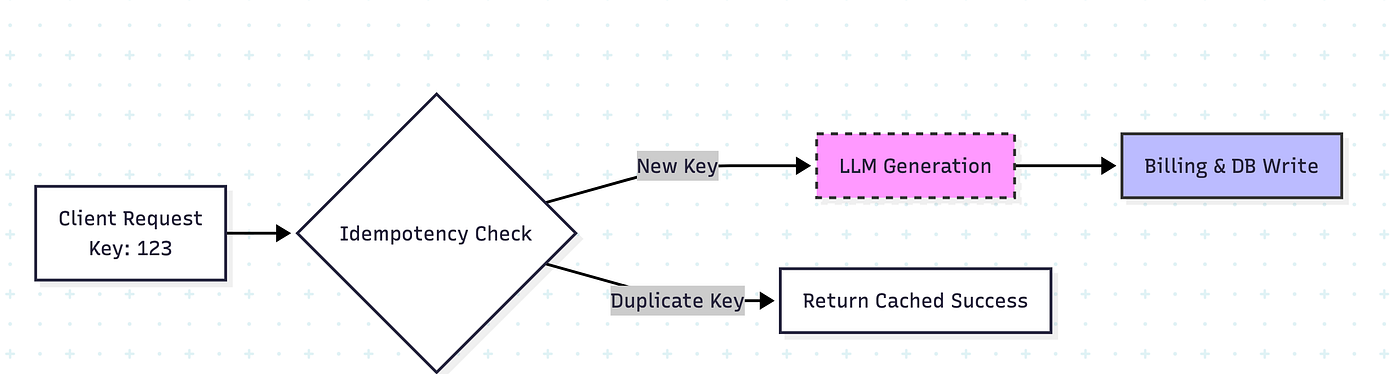
A flowchart showing a client request. An idempotency check determines if the key is new or a duplicate. If new, the LLM generation and subsequent database write occur. If a duplicate, the cached success response is returned immediately.
3.1. Generating a Deterministic Key
The most critical aspect of this pattern is that the key must be deterministic. It must be generated from inputs that do not change across retries. Using datetime.now() or uuid.uuid4() at call time would defeat the entire purpose, as each retry would generate a new key.
A robust key is typically a hash of stable properties of the task, such as the overall run ID and the step index within the workflow.
Idempotent AI Agents: Retry-Safe Patterns for Production
This article provides a clear recipe for generating deterministic keys and warns against common anti-patterns.
First, read the section The idempotency key pattern. Pay close attention to the make_idempotency_key function, which demonstrates how to construct a key from stable identifiers. Then, jump to the section Anti-patterns that silently break idempotency to reinforce what to avoid, specifically the warnings against using timestamps or random UUIDs.
3.2. Implementation: External and Internal Tools
Once you have a key, you can implement idempotency in two primary ways, depending on the tool being called.
-
External APIs (e.g., Stripe, PayPal): Many payment and SaaS APIs support an
Idempotency-KeyHTTP header. For these tools, your agent's tool executor simply needs to generate the deterministic key and include it in the request header. The third-party service handles the deduplication logic. -
Internal Tools (e.g., database writes, email sends): For tools you control or that don't support idempotency keys natively, you must implement the deduplication logic yourself. This is typically done with a dedicated deduplication table or an "action log" in your database (or a key-value store like Redis).
This architectural diagram shows how an "Idempotency Store" fits into a larger agent system, serving a "Tool Gateway."
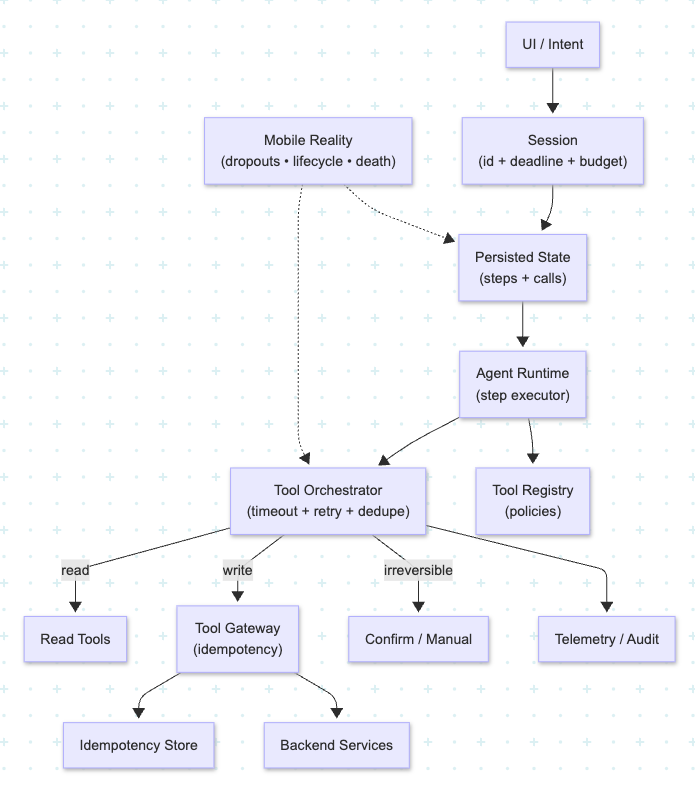
A high-level agent architecture diagram. The 'Tool Orchestrator' directs 'write' operations through a 'Tool Gateway', which uses an 'Idempotency Store' to ensure idempotent execution before interacting with 'Backend Services'.
The implementation pattern for this is crucial for correctness and draws directly from distributed systems principles.
Idempotent AI Agents: Retry-Safe Patterns for Production
Let's examine a concrete implementation of a deduplication table and the correct, race-condition-free logic for using it.
Please read the section The dedup table. Focus on these two critical elements: The Schema: The agent_action_log table uses the idempotency_key as its primary key, which allows the database to enforce uniqueness. The Execution Order: Note the author's hard-won advice: INSERT then execute. You must first attempt to "claim" the idempotency key by inserting it into the log. If this fails with a unique constraint violation, you know the action has already been performed (or is in progress) and can return the cached result. Only after successfully claiming the key should you execute the action.
This "claim-then-execute" logic is vital. If you were to execute the action first and then write to the log, a system crash between the two steps would leave you in an inconsistent state where the action was performed but not recorded, leading to a duplicate action on the next retry.
The following video provides another perspective on the implementation, including storage duration (TTL) and request validation.
Idempotency - What it is and How to Implement it
This video by Alex Hyett covers the practical details of implementing an idempotency layer for a web service, which directly translates to our agent's tool gateway.
Watch these key implementation details: Generating and Scoping Keys: This covers how to create a unique key and scope it properly (e.g., by user and API path) to avoid collisions. Storing Keys and Responses: This explains why persistent, shared storage (like Redis or DynamoDB) is necessary and outlines the core logic of checking the store before execution. Storage Duration and Validation: This discusses setting a TTL for keys and an advanced technique of hashing the request body to prevent key reuse with different payloads.
4. A Practical Tool Wrapper
To integrate this into our agent, we don't want to rewrite this logic for every tool. Instead, we can create a decorator or a higher-order function that wraps any tool function we want to make idempotent.
Here is a conceptual Python implementation that combines these ideas. This idempotent_tool wrapper would live in your agent's orchestration or execution layer.
import hashlib
import json
from functools import wraps

# Assume 'action_log_store' is an interface to Redis or a DB table
# with methods like .get(key) and .set(key, value, status)
# and .claim(key) which tries to reserve the key.

def make_idempotency_key(run_id: str, step_index: int, tool_name: str, tool_params: dict) -> str:
    """Creates a deterministic idempotency key."""
    # Sorting the params ensures that {'a': 1, 'b': 2} and {'b': 2, 'a': 1} produce the same key.
    params_str = json.dumps(tool_params, sort_keys=True)
    raw_key = f"{run_id}:{step_index}:{tool_name}:{params_str}"
    return hashlib.sha256(raw_key.encode()).hexdigest()

def idempotent_tool(action_log_store):
    def decorator(tool_func):
        @wraps(tool_func)
        async def wrapper(run_id: str, step_index: int, **kwargs):
            tool_name = tool_func.__name__
            key = make_idempotency_key(run_id, step_index, tool_name, kwargs)

            # 1. Check if the action was already completed successfully
            existing_action = await action_log_store.get(key)
            if existing_action and existing_action.status == 'COMPLETED':
                print(f"Idempotency hit: Returning cached result for key {key}")
                return existing_action.result

            # 2. Claim the key ("INSERT then execute")
            try:
                await action_log_store.claim(key)
            except UniqueViolationError:
                # Another process is already working on this.
                # Here you might wait and poll, or simply return a conflict.
                print(f"Idempotency conflict: Action for key {key} is in progress.")
                # For simplicity, we'll error. A more robust system might poll.
                raise Exception("Action in progress by another process.")

            # 3. Execute the action
            try:
                result = await tool_func(**kwargs)
                # 4. Mark as completed and store the result
                await action_log_store.set(key, result, status='COMPLETED')
                return result
            except Exception as e:
                # 5. Handle execution failure
                await action_log_store.set(key, str(e), status='FAILED')
                raise e
        return wrapper
    return decorator

# --- Example Usage ---

# @idempotent_tool(action_log_store=my_redis_store)
# async def send_confirmation_email(user_id: str, order_id: str):
#     # ... logic to call an email service ...
#     print(f"Sending email to {user_id} for order {order_id}")
#     return {"status": "sent", "email_id": "xyz-123"}
In your agent's main loop, when it's time to execute a tool, you would call the wrapped function, passing in the necessary context (run_id, step_index) to allow the decorator to construct the key and perform its checks.
Conclusion
You have now integrated a critical reliability pattern into our agent architecture. By enforcing idempotency, we have made our agent's actions safe to retry, protecting our system and its users from the harmful side effects of duplicate operations. This moves our agent significantly closer to being production-ready.
Key Takeaways:
- Idempotency for Agents is Non-Negotiable: Retries and network failures are inevitable. Idempotent design is the only way to ensure that side effects occur "exactly once."
- The Idempotency Key is the Core Pattern: A unique, deterministic key generated from stable properties of the agent task is the foundation of the solution.
- "Claim then Execute": For internal tools, you must first reserve the idempotency key in a persistent store before executing the action to prevent race conditions and ensure correctness during crashes.
- Systemic Implementation: This logic should be implemented systemically, for instance as a decorator or a gateway, rather than being repeated inside every tool.
Preview of the Next Lesson:
We've built mechanisms to retry, to fail over, and to do so safely. But what happens when an action is fundamentally flawed or a service is down for an extended period, and all retries are exhausted? A task can't remain in a failed-retry loop forever. In our next lesson, we will implement dead-letter handling, a pattern for gracefully managing tasks that have failed permanently, allowing for later analysis and manual intervention without halting the entire system.