Introduction
In our last lesson, we explored the bias-variance tradeoff, which explains why models might underfit or overfit by generalizing the concept of model "error". We saw that our goal is to find a balance that minimizes the total error on unseen data. However, to train a model, we need to move from this abstract idea of "error" to a precise, quantifiable metric.
This lesson directly addresses that need. You will learn about loss functions, the specific mathematical functions used to measure a model's error during training. A loss function tells the model exactly how wrong its predictions are, and the entire training process is an attempt to find model parameters that minimize this loss. Understanding which loss function to use for which problem is a fundamental skill for any ML practitioner and is a key topic for the certification exam.
Today, you will learn to describe common loss functions like Mean Squared Error (MSE) and cross-entropy, and know when each applies.
1. The Role of a Loss Function
At its core, a loss function (or cost function) is a method of evaluating how well your algorithm models your dataset. If your predictions are totally off, your loss function will output a higher number. If they're pretty good, it'll output a lower number. As you tune your model, it tries to minimize this loss function value.
To get a clear high-level overview of what a loss function is and why it's central to training an AI model, please watch the beginning of this video.
What is a Loss Function? Understanding How AI Models Learn
This clip from IBM Technology provides an excellent conceptual introduction to loss functions, explaining their purpose as a mathematical measure of error that guides model improvement.
Watch the video from the beginning until 02:18. Focus on how the loss function quantifies the difference between a predicted value and the actual value (the 'ground truth').
The key takeaway is that the loss function acts as the objective for the optimization algorithm (like gradient descent). The algorithm adjusts the model's internal parameters (weights) to find the combination that results in the minimum possible loss.
Loss functions are designed for specific types of ML problems. The two main categories you need to know are for regression and classification tasks.
2. Loss Functions for Regression Tasks
Recall that regression tasks involve predicting a continuous numerical value, like the price of a house or a future temperature. The loss function measures the distance between the predicted number and the actual number.
The two most common regression loss functions are Mean Squared Error (MSE) and Mean Absolute Error (MAE).
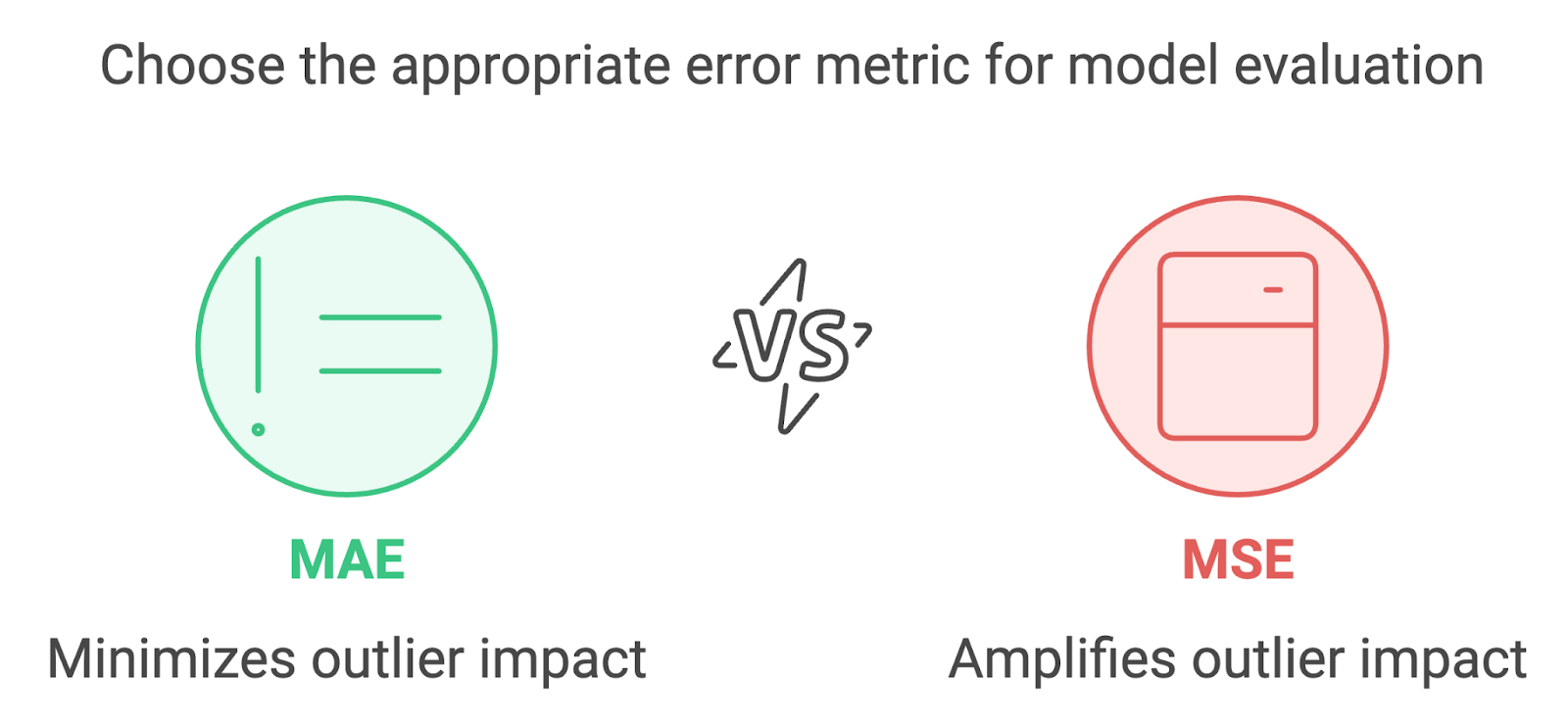
Let's break them down.
Mean Squared Error (MSE or L2 Loss)
MSE calculates the average of the squared differences between the predicted values and the actual values.
The formula is:
where is the actual value and is the predicted value.
- Key Property: By squaring the error, MSE penalizes large mistakes much more severely than small ones. For example, an error of 10 is penalized 100 times more than an error of 1 ( vs ).
- When to Use: Use MSE when your data is relatively clean of outliers, and you consider large errors to be particularly undesirable. The resulting model will be biased towards making fewer large errors.
Mean Absolute Error (MAE or L1 Loss)
MAE calculates the average of the absolute differences between the predicted and actual values.
The formula is:
- Key Property: MAE treats all errors linearly. An error of 10 is penalized only 10 times more than an error of 1. This makes it significantly more robust to outliers than MSE.
- When to Use: Use MAE when your dataset contains outliers that you don't want to overly influence the model's training.
Huber Loss
Huber Loss offers a compromise between MSE and MAE. It behaves like MSE for small errors but switches to behaving like MAE for large errors. This gives it the benefits of both: it's less sensitive to outliers than MSE but is still smooth around the actual value (which is good for optimization).
To see these three functions explained with a practical example, watch the next segment of the video.
What is a Loss Function? Understanding How AI Models Learn
This segment of the IBM video clearly explains MSE, MAE, and Huber Loss, highlighting their different sensitivities to outliers.
Watch from 02:18 to 05:39. Pay close attention to the example of forecasting YouTube views and how the different loss functions react to the large prediction error.
3. Loss Functions for Classification Tasks
In classification, the goal is to predict a discrete category (e.g., spam or not spam, dog or cat). The most common and important loss function for classification is Cross-Entropy Loss, also known as Log Loss.
Cross-Entropy Loss (Log Loss)
Cross-entropy measures the performance of a classification model whose output is a probability between 0 and 1. The loss increases as the predicted probability diverges from the actual label. It heavily penalizes predictions that are both confident and wrong.
There are two main versions you need to know:
-
Binary Cross-Entropy: Used for two-class classification problems.
The formula for a single prediction is:
Where is the actual label (0 or 1) and is the predicted probability of the class being 1. -
Categorical Cross-Entropy: Used for multi-class classification problems (more than two classes).
The formula is an extension that sums the log loss over all classes:
Where is a binary indicator if class is the correct classification for observation , and is the predicted probability of observation being of class .
To get an intuitive feel for this concept, let's return to the IBM video.
What is a Loss Function? Understanding How AI Models Learn
This final clip explains Cross-Entropy loss using an analogy of 'uncertainty' or 'entropy'. It also briefly mentions Hinge Loss.
Watch from 05:39 to 08:01. Focus on the core idea: cross-entropy measures the difference between two probability distributions—the one your model predicted and the 'true' distribution (where the correct class has 100% probability).
A note on Hinge Loss: The video mentions Hinge Loss. For the exam, you should know that Hinge Loss is primarily associated with Support Vector Machines (SVMs) and is designed to find the decision boundary that maximizes the margin between classes.
4. Summary and Decision Framework
Choosing the right loss function is crucial. Your choice communicates the objective to the model. The following reading provides a concise guide to help you make this decision, which is exactly the kind of knowledge tested on the exam.
Loss Functions in Machine Learning - Applied AI Course
This article from Applied AI Course provides a section dedicated to selecting the right loss function. It summarizes the key factors to consider.
Read only the section titled 'Choosing the Right Loss Function'. This provides an excellent, high-level decision framework based on problem type, outliers, and model architecture.
For quick revision, a summary table or "cheat sheet" is invaluable. The image below provides a perfect at-a-glance reference for the most common loss functions, their formulas, and their primary use cases.
Conclusion
In this lesson, we demystified the concept of "error" by defining the specific mathematical loss functions that quantify it. These functions are the heart of the model training process, serving as the target for optimization.
Key Takeaways:
- A loss function scores how well a model's predictions match the actual data, with the goal of training being to minimize this score.
- For regression tasks, your primary choices are:
- MSE (L2 Loss): Sensitive to outliers; use when large errors are especially bad.
- MAE (L1 Loss): Robust to outliers; use when your data may be noisy.
- Huber Loss: A hybrid that balances the properties of MSE and MAE.
- For classification tasks, the standard is Cross-Entropy Loss (Log Loss):
- Binary Cross-Entropy for two-class problems.
- Categorical Cross-Entropy for multi-class problems.
- The choice of loss function depends directly on the problem type (regression/classification) and the characteristics of your data (e.g., presence of outliers).
We have now covered how a model's performance is measured (loss functions) and diagnosed (bias-variance). This concludes our initial block on core ML concepts. We will now shift our focus to the practical steps of the ML workflow, starting with the data itself.
In the next lesson, we will begin our journey into Data Preparation and Feature Engineering. We'll start with a fundamental and unavoidable challenge: describing common strategies for handling missing data.