Welcome to the first lesson in our new module on experimental design. In our previous modules, we focused on building predictive models to forecast lingerie appeal and classify styles. Now, we shift our focus from prediction to controlled experimentation. Instead of asking "Can we predict which style will be a top pick?", we'll ask, "Is there a statistically significant difference in appeal between these specific styles?"
This is a critical distinction in data-driven design. Today, you will learn how to design a one-way Analysis of Variance (ANOVA) experiment to test for significant differences in mean appeal scores across three or more bra styles, such as comparing a push-up, a balconette, and a plunge bra. This powerful technique, central to the field of experimental design, allows you to move beyond simple two-way comparisons and draw robust conclusions about multiple options at once.
From Pairwise Comparisons to ANOVA
Let's set up a scenario. You have three bra styles you are considering for a key photoshoot: a push-up, a balconette, and a plunge. You want to determine if one style is perceived as more appealing than the others.
A natural first thought might be to run a series of t-tests:
- Push-up vs. Balconette
- Push-up vs. Plunge
- Balconette vs. Plunge
However, as you know from your statistics background, this approach has a significant flaw: it inflates the Type I error rate. If you set your significance level () to 0.05 for each test, the overall probability of making at least one false positive conclusion across the three tests becomes much higher than 5%. This is the "multiple comparisons problem."
ANOVA elegantly solves this by testing all three means simultaneously in a single test, keeping the overall family-wise error rate at your desired level ().
Designing Your One-Way ANOVA Experiment
A well-designed experiment is the foundation of a valid statistical conclusion. For our lingerie comparison, designing a one-way ANOVA experiment involves four core components: defining variables, formulating hypotheses, ensuring assumptions are met, and establishing a data collection protocol.
1. Defining the Variables
First, we must clearly define our independent and dependent variables.
- Independent Variable: This is the categorical variable that defines our groups. In our scenario, the independent variable is Bra Style, and it has three levels: Push-up, Balconette, and Plunge.
- Dependent Variable: This is the quantitative variable we are measuring to compare the groups. Let's define it as the Appeal Score, a rating on a 1-10 scale provided by a panel of evaluators (e.g., a photographer and a stylist) after seeing a model in each style.
The article "One-way ANOVA" from Scribbr provides an excellent overview of this setup.
One-way ANOVA | When and How to Use It (With Examples)
This article clearly explains the appropriate context for using a one-way ANOVA.
Read the section When to use a one-way ANOVA. Notice how our lingerie example perfectly fits the description: one categorical independent variable (Bra Style) with three levels, and one quantitative dependent variable (Appeal Score).
2. Formulating the Hypotheses
Every experiment begins with a clear, testable question, which we formalize with null and alternative hypotheses.
- Null Hypothesis (): There is no difference in the mean appeal scores among the three bra styles.
- Alternative Hypothesis (): At least one bra style has a mean appeal score that is different from the others.
Note that ANOVA's initial result will not tell us which specific style is different, only if a difference exists somewhere among the groups.
The following resource provides a concise explanation of setting up these hypotheses.
One Way ANOVA: Statistical Testing Made Simple - Six Sigma
This guide from Six Sigma offers a very clear, step-by-step breakdown of the process.
Please read the section Setting Up Your Hypothesis. Pay attention to the mathematical and verbal definitions of the null (H_0) and alternative (H_a) hypotheses.
3. Meeting the Assumptions
For the results of an ANOVA to be valid, the experimental design and the resulting data must satisfy three key assumptions. Your background in experimental design will make these familiar, but let's place them in our lingerie context.
-
Independence of Observations: Each appeal score rating must be independent of all others. This is a design consideration. To achieve this, you should randomize the order in which the model presents the three bra styles. If the push-up is always first, fatigue or novelty could become a confounding variable. Each rating should be a separate, unbiased judgment.
-
Normality: The appeal scores for each bra style should follow a normal distribution. For example, if you collected 20 ratings for the plunge bra, those 20 scores should be approximately normally distributed. This is an assumption you check after collecting the data.
-
Homogeneity of Variance (Homoscedasticity): The variance (or spread) of appeal scores should be roughly equal across all groups. The variability in ratings for the push-up bra should be similar to the variability for the balconette and the plunge. Significant differences in variance can invalidate the results. This is also checked after data collection, often using Levene's test.
This article provides a great summary of these foundational assumptions.
One Way ANOVA: Statistical Testing Made Simple - Six Sigma
We'll return to the Six Sigma guide to review the assumptions.
Read the section Key Assumptions Of One Way ANOVA. This section details the three core assumptions and what to do if they are violated.
4. The Data Collection Protocol (The Blueprint)
With the above elements in place, we can now outline a full experimental plan:
- Objective: To determine if there is a statistically significant difference in mean appeal scores between push-up, balconette, and plunge bra styles.
- Setup:
- One model.
- One consistent set of raters (e.g., photographer, stylist).
- Standardized environment: consistent lighting, background, and pose.
- Procedure:
- Create a randomized schedule for presenting the three styles (e.g., Plunge, Push-up, Balconette; then Balconette, Plunge, Push-up, etc.).
- For each presentation, have the raters independently and privately assign an Appeal Score (1-10).
- Collect a sufficient number of ratings for each style. The question of "how many" is a matter of statistical power, which we will address in the next lesson.
- Record the data, linking each score to the corresponding bra style.
The Logic of ANOVA: Partitioning Variance
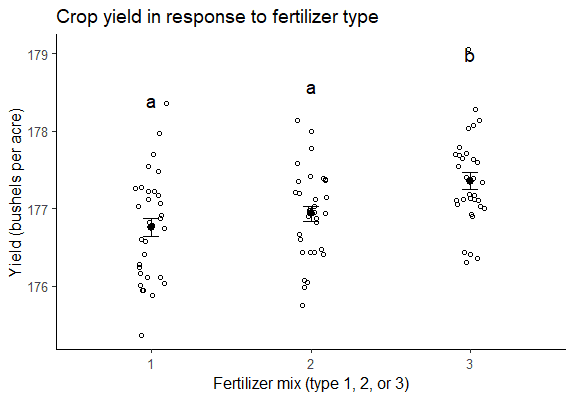
At its core, ANOVA works by comparing the variation between the groups to the variation within the groups. This is measured by the F-statistic.
F-statistic = (Variance between groups) / (Variance within groups)
- Variance between groups (the "signal"): How much do the mean appeal scores of the push-up, balconette, and plunge styles differ from each other and from the overall average score? If this is large, it suggests the bra styles have a real effect.
- Variance within groups (the "noise"): How much do the individual appeal scores vary within a single style's group? This represents random error, natural differences in opinion, and other unmeasured factors.
If the "signal" (variance between groups) is substantially larger than the "noise" (variance within groups), the F-statistic will be large, leading to a small p-value and a rejection of the null hypothesis.
The plot below illustrates what the data from such an experiment might look like. ANOVA tests whether the differences in the means of these groups are statistically meaningful relative to the spread of the data points within each group.
Practice Exercise: Design Your Own Experiment
Now it's your turn to design an experiment. You want to compare four types of lingerie bottoms: thong, brazilian, boyshort, and high-waist. Your dependent variable is a 'versatility score' (rated 1-20 by a stylist, indicating how well it pairs with other pieces).
Outline the complete design for a one-way ANOVA experiment. In your answer, please be sure to:
- State your independent and dependent variables and their levels.
- Formulate the null () and alternative () hypotheses.
- Describe the key conditions you would need to control during data collection to satisfy ANOVA's assumptions (especially independence).
Conclusion
In this lesson, you have learned the fundamental principles of designing a one-way ANOVA experiment. This is the first and most critical step in statistically comparing multiple design options.
Key Takeaways:
- ANOVA is used to compare the means of three or more groups, avoiding the problem of inflated Type I error from multiple t-tests.
- Designing an ANOVA experiment requires defining your categorical independent variable (e.g., Bra Style) and your quantitative dependent variable (e.g., Appeal Score).
- You must formulate clear null and alternative hypotheses before collecting data.
- A valid design requires careful attention to the assumptions of ANOVA: independence of observations, normality, and homogeneity of variance. Randomizing the trial order is a key part of satisfying the independence assumption.
In our next lesson, we will build directly on this foundation. Having designed the experiment, the next logical question is: "How many ratings do I need to collect?" We will answer this by performing a power analysis to determine the minimum sample size required to detect a meaningful difference between your lingerie styles.