Hello! Welcome to the final lesson of your capstone module and the entire workshop curriculum. In our last session, we focused on identifying high-value opportunities to apply your new data skills by looking for problems in your daily work. You learned how to shift from a tool-first to a problem-first mindset and brainstormed potential projects.
Now, we bring everything together. This lesson is about turning your best idea into a concrete, personal commitment. Our learning outcome is to create a personal action plan for implementing data-driven decision-making. This plan will be your roadmap for applying what you've learned when you get back to your office, ensuring the skills from this workshop lead to tangible results.
Let's transform your intention into action.
Part 1: Why a Personal Action Plan?
The goal of this workshop was not just to learn about AI and Power BI, but to empower you to make better, faster, and more confident decisions. A personal action plan is the bridge between the knowledge you've gained here and the impact you can create in your workplace.
Making decisions based on data guards against bias, helps you set measurable goals, and ultimately improves business processes. However, adopting a data-driven approach doesn't happen by accident; it requires a deliberate first step.
Data-Driven Decision Making: A Step-by-Step Guide [2025]
The article 'Data-Driven Decision Making: A Step-by-Step Guide' from Asana highlights the key benefits of this approach. Understanding these benefits will help you articulate the value of your action plan to yourself and others.
Please read the section titled 'Benefits of data-driven decision making.' Focus on how using data helps you make confident decisions, guard against biases, and set measurable goals. These are the outcomes your action plan will help you achieve.
Your action plan is your personal commitment to achieving these benefits by tackling one specific, manageable problem.
Part 2: A Framework for Your Action Plan
To create an effective plan, we won't start from scratch. We will adapt a professional framework used by consultants to guide AI implementation projects. This will give your personal plan a robust, logical structure.
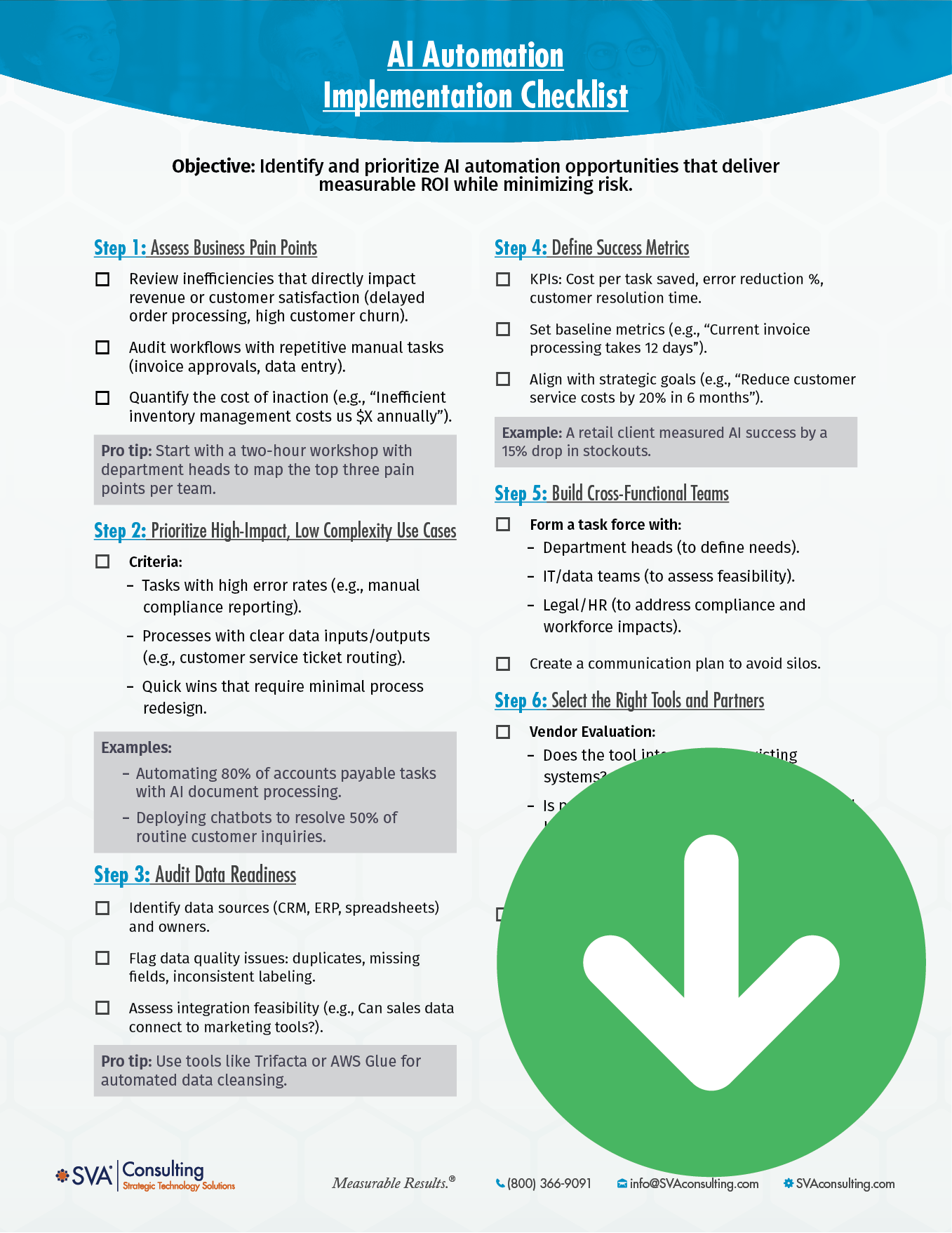
The AI Implementation Checklist: Stop Buying Tools Before ...
The article 'The AI Implementation Checklist' by Max Braglia outlines a 5-phase framework that starts with the business problem and moves methodically toward a solution. We will use its core logic to structure your personal plan.
Read through the five phases of the checklist (Problem Discovery, Impact Assessment, Solution Validation, Implementation, Scale and Optimize). As you read, think about how you can apply this 'problem-first, start-small' mindset to the opportunity you identified in our previous lesson.
The key idea is to de-risk your effort by focusing on a small, high-impact problem and proving the value quickly. This creates momentum and makes it easier to get support for future projects.
Part 3: Building Your 4-Week Action Plan
Based on that professional framework, here is a simple template for a 4-week personal action plan. The goal is to go from a defined problem to a working prototype that demonstrates value.
Your Personal Action Plan Template
1. Opportunity You've Selected:
(Name the project you chose from the previous lesson's brainstorming activity. e.g., "Automate the weekly report on marketing campaign performance.")
2. The Core Business Question:
(What specific question will this project answer? e.g., "Which marketing channels are giving us the best return on investment this month?").
▶ Week 1: Define and Quantify the Problem (Corresponds to Problem Discovery & Impact Assessment)
- Goal: Solidify your understanding of the problem and its cost.
- Actions:
- Document the "As-Is": Write down the current manual steps.
- Quantify the Pain: Estimate the hours you spend on this task per week/month. (e.g., 2 hours/week * 4 weeks = 8 hours/month).
- Identify Data Sources: Where does the data currently live? (e.g., "Export from Salesforce," "Excel file from Finance").
▶ Week 2: Scope the Solution & Data (Corresponds to Solution Validation)
- Goal: Define what "done" looks like for your prototype and confirm you can get the data.
- Actions:
- Sketch Your Dashboard: On a piece of paper, draw the one or two key visuals that would answer your business question.
- Confirm Data Access: Make sure you can access and export the data identified in Week 1. This is a critical step!
- Define Success: What is the single metric you want to improve? (e.g., "Reduce report creation time from 2 hours to 10 minutes").
▶ Week 3: Build the Prototype (Corresponds to Implementation)
- Goal: Use your Power BI skills to build V1 of your solution.
- Actions:
- Connect & Clean: Use Power Query to import and perform basic cleaning on your data (e.g., remove duplicates, filter rows, change data types).
- Build the Visual: In Power BI, create the simple dashboard you sketched in Week 2. Do not aim for perfection!
- Save Your Work: Save your Power BI file. You've built a reusable asset.
▶ Week 4: Share and Iterate (Corresponds to Implementation & Optimization)
- Goal: Get feedback to prove the concept and plan your next step.
- Actions:
- Share with a Colleague: Show your prototype to a trusted peer or your manager. Ask them: "Does this help answer our business question?"
- Gather Feedback: Write down one or two suggestions for improvement.
- Plan Next Step: Based on the feedback, decide what to do next. (e.g., "Add a slicer for region," "Incorporate data from another source").
Part 4: Your Workshop Activity: Draft Your Personal Action Plan
Now it's your turn to put this into practice. This activity will be the culmination of the entire workshop.
-
Individual Work (15 minutes):
- Take the opportunity you prioritized in the previous lesson.
- Using the template above, fill out each section of your personal 4-week action plan. Be as specific as possible. Don't overthink it; the goal is to create a realistic plan, not a perfect one.
-
Pair and Share (10 minutes):
- Find a partner.
- Each of you take 5 minutes to explain your action plan to the other person.
- Your partner's job is to listen and ask clarifying questions, acting as your first "accountability buddy." Does the plan seem achievable? Is the business question clear?
Test your understanding!
A manager's action plan includes the goal "Improve HR analytics." Why is this a weak starting point for an action plan, and how could you advise them to refine it using the template?
Show answer
"Improve HR analytics" is too broad and vague. It's a goal, not a plan.
To refine it, you would guide them through the template:
- Opportunity: Ask them to pick one specific, painful HR process. Is it tracking employee turnover? Analyzing time-to-hire? Let's say they choose "Manually tracking reasons for employee turnover."
- Business Question: Refine this into a clear question, like "What are the top 3 reasons employees in the sales department left the company last quarter?"
- Action Steps: Now they can create concrete weekly actions, such as quantifying the hours spent on the manual report (Week 1), sketching a Power BI visual showing reasons for leaving (Week 2), building it (Week 3), and sharing it with the Head of Sales (Week 4).
This transforms a vague ambition into a concrete, actionable project.
Conclusion and Workshop Farewell
Congratulations! You have just created a personal roadmap to apply everything you've learned. This action plan is the critical final step that turns two days of learning into lasting change and tangible business value.
Key Takeaways from This Lesson:
- An action plan is the bridge between learning and doing.
- Start with a single, specific, and meaningful business problem.
- Use a structured, week-by-week plan to build momentum and show results quickly.
- Your first prototype is for learning and feedback, not perfection.
Over the past two days, you have journeyed from the fundamental concepts of AI to the practical, hands-on skills needed to clean data in Power Query, build insightful reports in Power BI, leverage its AI features, and identify opportunities for impact. You are now equipped not just with tools, but with a new way of thinking about business challenges.
As you return to your roles, remember that you are now leaders who can champion a more data-driven culture within your teams. Start with your personal action plan, demonstrate the value of this approach, and empower others to do the same. Thank you for your engagement, and I wish you the best of luck in your data-driven journey.