Welcome to the first lesson of your workshop series on AI for business managers. This initial module, "AI Fundamentals for Business Decisions," lays the essential groundwork for the entire course.
In this lesson, we will focus on the most fundamental question: What exactly is AI, and how is it different from the traditional software and automation tools your managers use every day? By the end of this session, you'll be equipped to explain this distinction clearly and confidently, setting the stage for all the practical applications in Power BI and Excel that will follow.
Understanding this core difference is not just academic. It's the key to helping your audience recognize where AI can provide genuine value and where simpler, traditional solutions are more appropriate.
1. What is AI? A Practical Definition for Managers
Let's start by demystifying the term "AI." For a business context, a complex technical definition isn't necessary. A much more effective approach is to focus on its function.
A great way to frame this for your workshop is to define intelligence as the ability to solve problems and make decisions. From there, Artificial Intelligence (AI) is simply a computer's ability to solve problems and make decisions.
This definition is simple, intuitive, and directly relates to what managers do every day. To solve problems, we rely on our understanding of how the world works. We use mental "models" to make predictions. For example, if we see dark clouds, our mental model of weather predicts rain. AI works in a similar way, but it uses computer models.
To explore this concept in a non-technical way, watch the following video. It provides clear, relatable examples that will be perfect for your audience.
AI for Business: A (non-technical) introduction
This video from Shaw Talebi offers a non-technical introduction to AI, defining it in a business context. It explains the concept of 'models' as a way to understand the world, which is a cornerstone of intelligence.
Watch the segments from 1:09 to 4:23. Pay close attention to how intelligence is defined as problem-solving and how the video introduces mental models versus computer models.
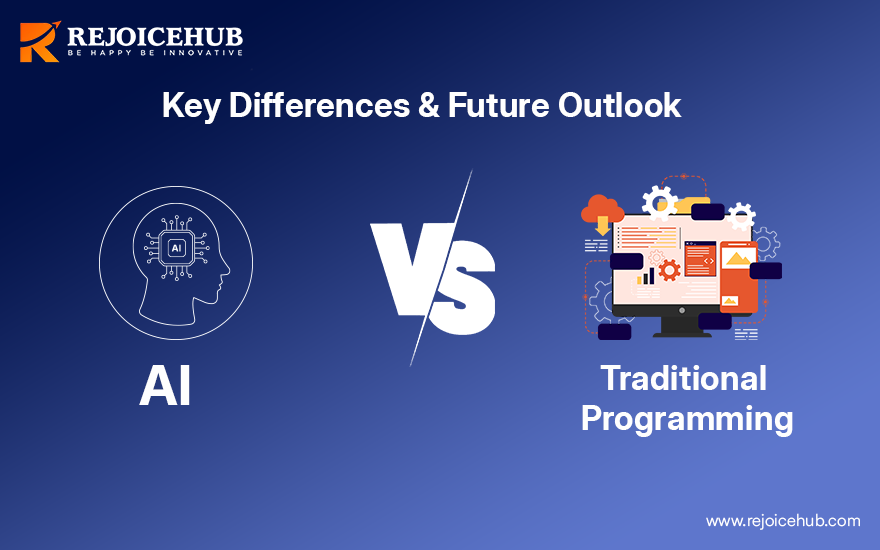
2. The Core Difference: Rules vs. Learning
The most significant distinction between traditional software and AI lies in how they get their instructions.
-
Traditional Software is rule-based or principle-driven. A programmer writes explicit, step-by-step instructions (an algorithm) for every possible scenario. Think of it like a detailed recipe or a flowchart. The software is programmed to perform a task. If it encounters a situation that wasn't coded, it will fail or produce an error.
-
AI Software is data-driven. Instead of being given explicit rules, it is given a large amount of data (examples) and "learns" the patterns and rules on its own. This process is called Machine Learning (ML), which is the most common type of AI in business today. The software is programmed to learn how to perform a task.
A concise way to summarize this for your workshop is:
Conventional software is programmed to perform a task. AI is programmed to learn to perform a task.
The following article explains this crucial difference using business-centric examples.
What is Artificial Intelligence? AI vs Traditional Software
The article 'What is Artificial Intelligence? AI vs Traditional Software' by Belitsoft provides concrete examples to illustrate the difference between a rule-based approach and a learning-based approach.
Read the sections titled 'You can't write the code for a car to navigate a roundabout, but AI can' and 'Rule-based chatbots vs AI chatbots'. These provide excellent, easy-to-understand analogies and a direct comparison that your audience will find very clear.
3. Comparing the Two Approaches
Now that we have the core concepts, let's break down the comparison into key characteristics. Traditional software and AI differ in their stability, transparency, and how they handle data.
The video below gives a clear, structured comparison across several important aspects.
AI Systems vs Traditional Coding
This video from IBM Technology, 'AI Systems vs Traditional Coding', directly compares the two approaches, covering aspects like stability, scalability, control, and data handling.
Watch from 3:08 to 6:51. The first part (3:08-4:06) describes traditional programming as a deterministic 'recipe.' The second part (4:06-6:51) provides a brilliant side-by-side comparison. Note the discussion of the 'black box' problem—this is an important concept to be aware of when discussing AI's limitations with managers.
To give your workshop audience a quick visual reference, you can use a simple comparison table.
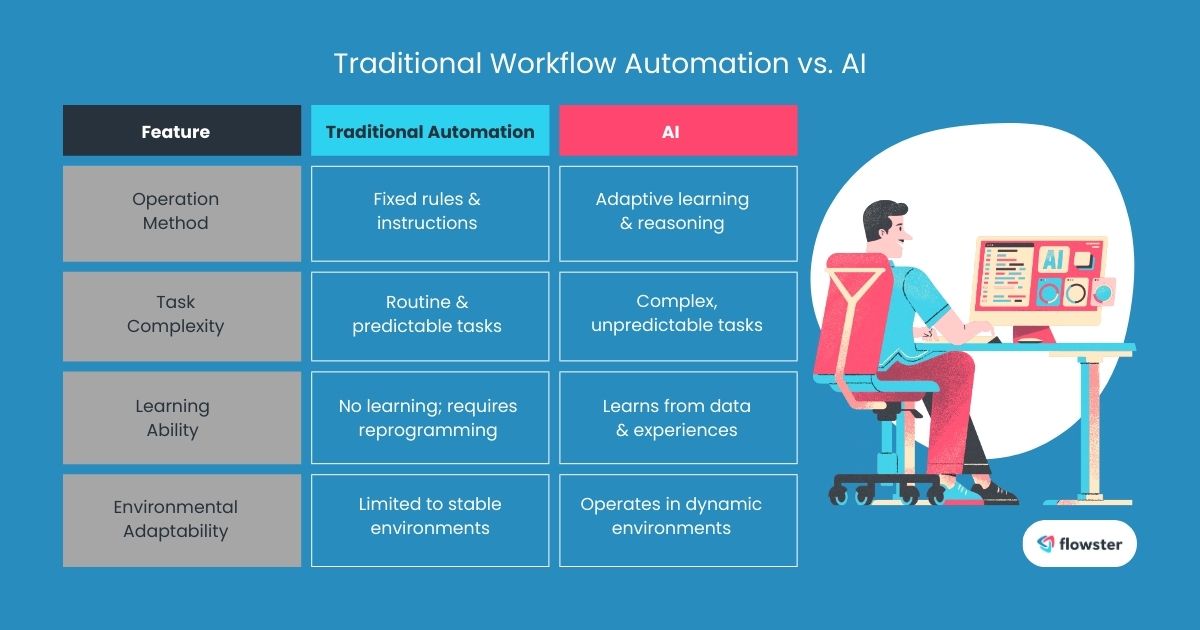
For a more detailed breakdown that you can discuss point-by-point, consider the following table which contrasts traditional automation (a form of traditional software) with AI automation.
| Aspect | Traditional Software / Automation | AI Software / Automation |
|---|---|---|
| How it Works | Follows explicit, predefined rules (if-then-else) |
Learns patterns and relationships from data |
| Decision Making | Simple, binary (yes/no), rule-based | Complex, probabilistic, context-dependent |
| Data Requirements | Requires structured, clean data (like in a spreadsheet) | Can handle structured and unstructured data (text, images) |
| Adaptability | Static; requires manual reprogramming to change | Adaptive; improves over time as it gets more data |
| Error Handling | Breaks or stops when it encounters an exception | Can often handle unexpected inputs and adapt |
| Best For | Repetitive, stable, clearly defined tasks | Complex, ambiguous, or evolving tasks |
Test your understanding!
For each scenario below, decide whether a traditional software solution or an AI-powered solution would be more appropriate.
- A system to automatically send a "Happy Birthday" email to customers on their birthdate listed in a database.
- A tool to analyze thousands of customer support emails to identify the most common complaints and their underlying causes.
- A program to calculate the final price of an order, including item costs, taxes based on state law, and a fixed shipping fee.
- A feature in a streaming service that suggests movies you might like based on your viewing history and the history of millions of other users.
Show answer
- Traditional Software. This is a simple, rule-based task:
IFtoday's date matches the customer's birthdate,THENsend a pre-written email. - AI-powered Solution. This requires understanding natural language, recognizing different ways people express frustration, and clustering similar complaints. This is a task of pattern recognition in unstructured data, perfect for AI.
- Traditional Software. This is a deterministic calculation based on a fixed set of rules (tax laws, shipping fees). There is no ambiguity or learning required.
- AI-powered Solution. This is a classic recommendation system. It involves finding complex patterns in massive amounts of user behavior data to make a prediction (what you are likely to enjoy). It would be impossible to write explicit rules for this.
4. Why This Matters for Business
The choice between traditional and AI-powered solutions has a direct impact on business outcomes. When presenting to managers, tying these technical differences to business value is critical.
The article below does an excellent job of outlining the business impact.
AI vs. Traditional Automation: Key Differences and ...
The article 'AI vs. Traditional Automation' from L Leverage.ai frames the comparison in terms of business impact, which is highly relevant for your management audience.
Read the section 'Business Impact: What's Actually at Stake'. Focus on how AI and traditional automation affect operational efficiency, error rates, scalability, and employee experience. These are the key talking points for a management team.
Here's a summary of the key business implications:
- Efficiency: Traditional automation speeds up repetitive tasks. AI automation can handle more complex, end-to-end processes, often leading to greater efficiency gains.
- Scalability: Traditional systems are hard to scale for variable processes, as each new variation may require new rules. AI systems can scale more easily because they learn to adapt to variation.
- Flexibility: AI thrives in dynamic environments where rules or inputs change. Traditional software requires costly reprogramming when faced with change.
- Employee Experience: Traditional automation can sometimes shift human work to simply managing the exceptions the software can't handle. AI can augment human intelligence, freeing up employees for more strategic, high-value work.
Conclusion
In this lesson, we established the fundamental difference between AI and traditional software.
Key Takeaways:
- AI vs. Traditional Software: Traditional software operates on explicit, pre-programmed rules. AI learns its own rules by finding patterns in data.
- Rules vs. Learning: This is the core distinction. Traditional systems are told how to do a task; AI systems learn how to do it from examples.
- Business Relevance: This difference is crucial for identifying the right problems to solve. AI excels at tasks involving complexity, ambiguity, and prediction, while traditional software is best for stable, repetitive, rule-based processes.
Preview of the Next Lesson:
Now that you have a solid conceptual foundation, the next lesson, "Identify common AI applications relevant to business operations," will make these ideas more concrete. We will explore real-world examples of how businesses are using AI today, helping the managers in your workshop connect these concepts to their own operational challenges.