Hello! Welcome to your next lesson.
In our previous module, we focused on getting customers through your door with local marketing. Now, we'll shift our focus to ensuring they have a fantastic experience once they're inside—even when things don't go perfectly.
This lesson is about learning how to handle customer complaints and product returns effectively. A well-handled complaint can transform a negative situation into a positive one, turning a frustrated customer into a loyal advocate for your beauty mini-market. Given your background in the digital space, where customer service is often handled through text or email, we will focus on the nuances of managing these interactions face-to-face.
Mastering this skill is not just about damage control; it's a fundamental part of building a strong brand reputation and retaining the customers you've worked so hard to attract.
1. Turning Complaints into Opportunities
No business is immune to customer complaints. A product might not meet expectations, a shade might look different in natural light, or a customer might simply change their mind. The key isn't to avoid complaints entirely, but to have a reliable process for resolving them that leaves the customer feeling heard and respected.
A structured approach ensures that you or your staff can handle these sensitive situations confidently and consistently. Let's explore a practical, six-step framework for managing customer complaints.
Retailers: How To Handle A Customer Complaint in Six Steps
To understand a proven method for handling these interactions, please read the following article from The Retail Doctor. It outlines a clear, step-by-step process.
Read the entire article, focusing on the six steps provided. Pay close attention to the sequence of the steps, from listening actively to using the experience as a training tool.
As the article highlights, the process is about de-escalation and resolution. Let's summarize and contextualize these steps for your beauty mini-market:
-
Listen Fully (Steps 1 & 2): When a customer is upset, your first job is to listen without interrupting. Let them explain the entire situation. In a beauty context, this could be frustration over a product causing a mild skin reaction or a mascara that smudged despite being advertised as "smudge-proof." Avoid the urge to jump in with a solution immediately. Use active listening cues like nodding and maintaining eye contact to show you are engaged.
-
Empathize and Identify the Goal (Step 3): Start with a sincere apology, such as, "I'm so sorry to hear you had that experience." This validates their feelings without necessarily admitting fault. Then, shift to a solution-oriented mindset by asking a simple question: "What would be the ideal outcome for you?" or "How can we make this right?" This puts the customer in a collaborative position rather than an adversarial one.
-
Present a Solution (Step 4): Based on what they want and what your store policy allows (we'll cover this next), clearly state what you can do. Instead of saying, "I can't give you a cash refund on an opened item," frame it positively: "What I can do is offer you full store credit to find a product that you'll love, or we can exchange it for a different shade right now." Empowering your staff to handle most issues without needing a manager's approval is crucial for a smooth customer experience.
-
Confirm Satisfaction (Step 5): After the exchange is made or the store credit is issued, check in one last time. A simple, "Are you satisfied with this solution?" gives the customer a final chance to voice any lingering concerns and ensures the issue is truly resolved.
-
Train and Improve (Step 6): Every complaint is a learning opportunity. Was the product information misleading? Does a specific brand have a high rate of returns? Discuss these incidents with your team to refine your processes, product selection, and customer service skills.
2. Crafting a Clear and Fair Return Policy
Having a process for handling the interaction is half the battle. The other half is having a clear and fair return policy that sets expectations for both customers and staff. A good policy builds trust and can be a competitive advantage.
First, let's clarify the difference between a "return policy" and a "refund policy," as they are often used interchangeably but have distinct meanings.
Return Policies For Small Businesses Best Practices
The following article from Detrack provides excellent best practices for small businesses creating a return policy. It starts by defining the key terms.
Read the section titled 'What is the difference between a return and a refund policy?' to understand the distinction.
In essence, a return policy is the overarching set of rules for bringing items back, which may result in a refund, exchange, or store credit. A refund policy specifically details the conditions under which money is returned to the customer. For your store, you will create a single, comprehensive "Return & Exchange Policy."
Why Your Beauty Mini-Market Needs a Return Policy
Coming from e-commerce, you know a return policy is essential. In a physical store, it serves three key purposes:
- It builds customer confidence: Customers are more willing to try a new or expensive product if they know there's a safety net.
- It helps you compete: A customer-friendly policy can be a reason for shoppers to choose your store over a competitor with a stricter policy.
- It provides clarity and legal protection: A well-defined policy protects your business from unreasonable demands and provides a consistent framework for decision-making.
Key Components of a Retail Return Policy
A strong return policy leaves no room for ambiguity. It should clearly answer four questions for the customer. This infographic provides a great visual summary.
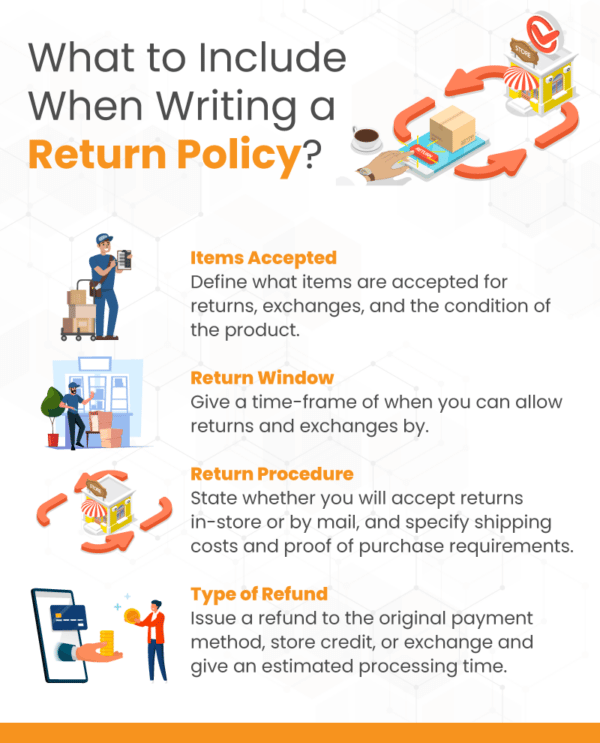
Let's look at the key elements to include in your policy, with special considerations for beauty products.
Return Policies For Small Businesses Best Practices
Now, let's dive into the specifics of what your policy should contain. This next section of the same Detrack article breaks it down component by component.
Read the section titled 'What is included in a return policy?'. Pay attention to the distinctions between returns, refunds, exchanges, and warranties.
Here's how to apply these components to your beauty mini-market:
-
What can be returned?
- Condition: This is critical for cosmetics. You will likely need a tiered policy. For example:
- Unopened and unused products: Can be returned for a full refund or exchange.
- Opened or lightly used products: Can be exchanged or returned for store credit only. This is a common practice for beauty retailers like Sephora and Ulta, as it allows customers to find the right shade without financial risk, but protects the business from straight cash losses.
- Exclusions: Final sale items, items bought on deep discount, and gift cards are typically non-returnable.
- Condition: This is critical for cosmetics. You will likely need a tiered policy. For example:
-
What is the timeframe?
- A 14 or 30-day window is standard in retail. A 30-day window is generally seen as more customer-friendly.
-
What is the procedure?
- Proof of Purchase: Always require a receipt or be able to look up the transaction in your Point of Sale (POS) system. This is crucial for preventing fraudulent returns.
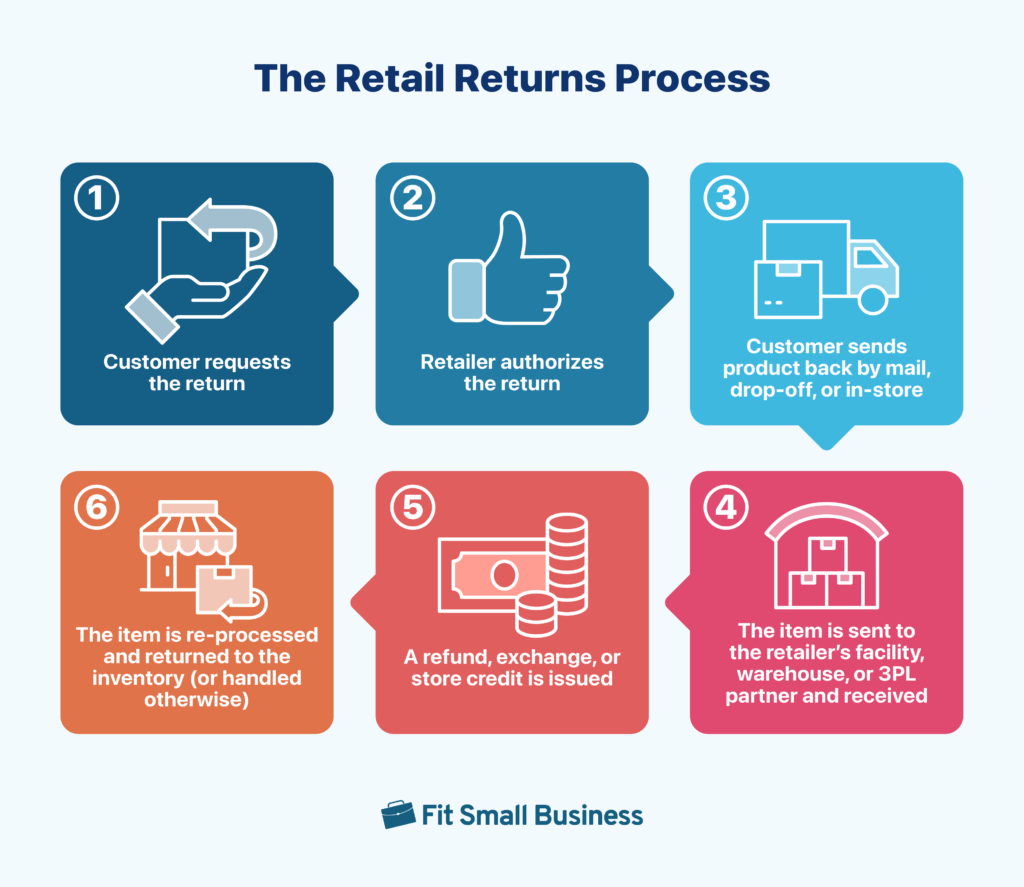
- Process: The infographic below shows the typical lifecycle of a returned item. For your store, the customer brings the item in, you authorize the return based on your policy, you issue the refund/credit/exchange, and then you process the item (either restock if sellable or damage it out if used).
- What is the outcome?
- Refund: To the original form of payment (e.g., credit card, cash).
- Store Credit: Issued on a gift card or to a customer's store account. This is a great option for opened items, as it keeps the money within your business.
- Exchange: A direct swap for another product, either the same item (e.g., undamaged box) or a different one.
Writing and Communicating Your Policy
Once you've decided on the terms, the final step is to write and display the policy clearly.
Return Policies For Small Businesses Best Practices
The Detrack article also offers excellent advice on how to write and implement your policy effectively.
Read the section 'Tips for creating a successful return policy system.' Focus on the advice to use clear language and communicate the policy to both customers and staff.
Key best practices:
- Use simple language: Avoid legal jargon.
- Be consistent: Don't change the policy frequently.
- Make it visible: Post it clearly at your cash wrap and on your website.
- Train your staff: Every employee must understand the policy inside and out.
Finally, let's look at some examples you can adapt. The "Flexible Return Policy (Boutique Style)" is an excellent model for a specialty store like yours.
Return Policies For Small Businesses Best Practices
To help you get started, the article provides several policy templates. Review them to see how these components come together.
Read the section 'Example Return Policies for Small Businesses.' Pay special attention to Example #3, the 'Flexible Return Policy (Customer-Friendly / Boutique Style),' as it's a great starting point for a high-touch retail environment.
Application Exercise
Let's put this all together. Imagine the following scenario in your store:
A customer returns to your store the day after purchasing a popular foundation. She is visibly disappointed and says, "I tried this foundation this morning, and it's much darker on my skin than it looked in the store. I've only used one pump. I have my receipt."
Take a moment to think about how you would handle this:
- How would you apply the six-step complaint handling process in this interaction? (What would you say and do at each step?)
- Based on the "Flexible / Boutique Style" policy, what resolution would you offer her? (A refund, exchange, or store credit?) Why?
This exercise connects the human interaction part with the policy part, which is where effective management happens. The ideal approach would be to listen, empathize ("I understand how frustrating that can be..."), and offer an exchange for the correct shade or store credit, as the item has been used. This resolves her problem while protecting your business.
Conclusion
In this lesson, we've established a comprehensive framework for managing customer complaints and returns.
Key Takeaways:
- Customer complaints are opportunities to demonstrate excellent service and build loyalty.
- A structured, empathetic process—Listen, Empathize, Solve, Confirm—is essential for resolving issues effectively in a face-to-face setting.
- A clear, fair, and visible return policy is fundamental to managing customer expectations and protecting your business.
- For a beauty store, your policy must specifically address the return of opened or used products, with store credit or exchanges being excellent resolution options.
By mastering these skills, you ensure that even negative experiences can contribute positively to your store's reputation.
Next Lesson Preview:
Now that we've covered how to recover from potentially negative customer experiences, we'll move on to proactively building positive long-term relationships. In our next lesson, you will learn how to design a customer loyalty program to reward your best customers and encourage repeat purchases.