Introduction
Welcome back! In our last lesson, you successfully set up a sample inventory tracking system, populating it with product data and initial stock counts. Your system is now ready to track what you have, but a crucial question remains: when should you reorder products to avoid running out?
Today's lesson answers that question directly. Our learning outcome is to calculate reorder points and safety stock levels for key product categories. We will break down these two essential inventory management concepts. First, you'll learn the theory behind them and why they are vital for preventing lost sales and managing cash flow. Then, we will walk through the specific formulas and apply them to a practical example for your beauty mini-market.
This skill bridges the gap between simply tracking inventory and proactively managing it, ensuring your most popular products are always available for your customers.
What are Safety Stock and Reorder Points?
Before we get into calculations, let's define our key terms. In retail, running out of a popular product means a lost sale and a disappointed customer. On the other hand, ordering too much ties up your cash in stock that isn't selling. Safety stock and reorder points are the tools you use to find the right balance.
- Safety Stock: This is the extra inventory you keep on hand as a buffer to protect against unexpected events. These could be a sudden spike in customer demand for a product or a delay in delivery from your supplier. It's your "just in case" inventory.
- Lead Time: This is the time, usually measured in days, between placing an order with your supplier and receiving the products at your store.
- Reorder Point (ROP): This is the specific inventory level that triggers you to place a new order. It's calculated to ensure that new stock arrives just as you are about to dip into your safety stock.
To see why this is so important in a beauty business, let's review some practical advice.
How to Manage Inventory at a Beauty Salon
This article from Squareup offers tips for managing inventory in a beauty salon. It highlights the importance of reorder points in a real-world context.
Please read section '7. Establish reorder points'. Notice how it connects reorder points to preventing stockouts, avoiding service interruptions, and the key factors you need to consider: daily usage, lead time, and safety stock.
Now, let's learn how to calculate these values. We'll start with safety stock.
Calculating Safety Stock
The goal of safety stock is to account for variability. How much do your sales fluctuate? How reliable are your suppliers? The more uncertainty, the more safety stock you need.
A common way to calculate safety stock uses a statistical approach to give you confidence that you can meet demand. The formula is:
This might look complex, but each part is straightforward. Let's watch a video that breaks it down clearly.
How To Figure Out Safety Stock
This video, 'How To Figure Out Safety Stock' by Calon Heindel, provides a step-by-step guide to the formula and its components.
Watch the entire video (from 00:12 to 06:39). As you watch, focus on understanding these three key inputs: Lead Time (L): The time (in days) from ordering to receiving stock. Standard Deviation of Daily Demand (\sigma_{d}): A measure of how much your daily sales vary from the average. The video shows how to calculate this in a spreadsheet. Service Level (and Z-score, Z): The probability you won't stock out. A 95% service level is a common target, which corresponds to a Z-score of approximately 1.65. This is a business decision based on how critical it is to not run out of a particular item.
To summarize the video's points:
- Service Level (Z-score): This is your desired performance. A 95% service level means you aim to have the product in stock for customers 95% of the time. You can look up the corresponding Z-score from a standard table or use a spreadsheet function like
NORM.S.INV(). - Standard Deviation of Demand: For a new store, you won't have this data yet. You'll start by making an educated guess based on your market research and refine it as you collect real sales data.
- Lead Time: This is information you get from your suppliers.
Calculating the Reorder Point
Once you know your safety stock level, calculating the reorder point is simple. You just need to figure out how much stock you'll sell while waiting for your new order to arrive and add your safety stock to that number.
The formula is:
The first part, (Average Daily Sales × Lead Time), is often called Demand During Lead Time.
Let's watch a short video that puts this all together.
How To Calculate Re-Order Point | ROP
From the same creator, this video 'How To Calculate Re-Order Point | ROP' connects the safety stock calculation to the final reorder point.
Please watch the video from the beginning to 04:16. It builds directly on the safety stock concept and shows how to combine it with 'demand during lead time' to find the final ROP.
The video makes it clear: when your inventory for an item hits the reorder point, you place a new order. By the time that order arrives, you will have sold through your "demand during lead time" stock, and your inventory level will be at or near your safety stock level.
This visual summary helps to tie all the formulas together.
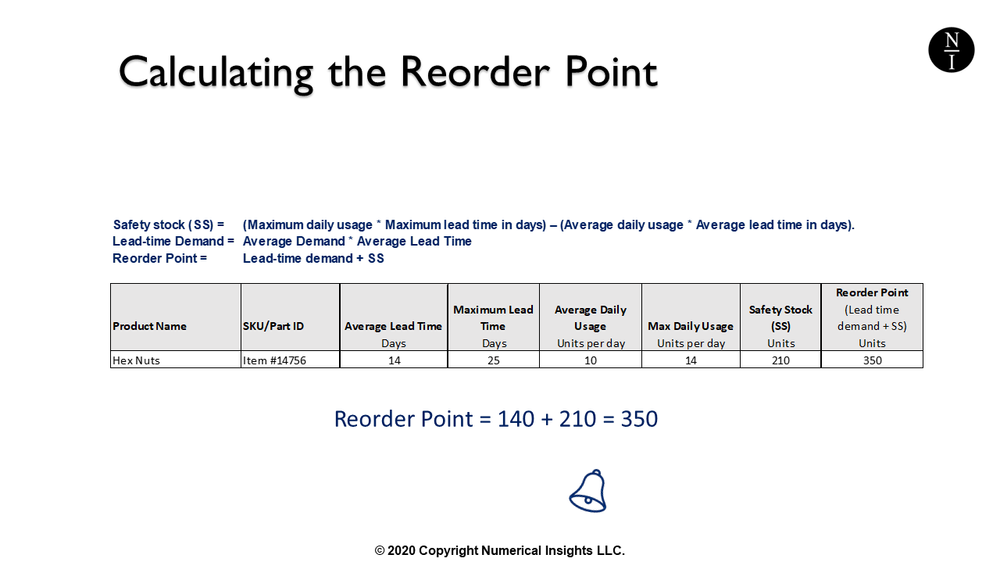
A Practical Example for Your Beauty Mini-Market
Let's apply this to one of the products from our previous lesson: The Ordinary Niacinamide 10% + Zinc 1% Serum.
Step 1: Gather Your Data
Since you're starting out, you'll need to estimate these values. As your store operates, you will replace these estimates with real data.
- Average Daily Sales: Based on your research, you expect to sell 5 units per day.
- Lead Time: Your supplier, ProBeauty Supply, has a reliable delivery time of 4 days.
- Standard Deviation of Daily Sales: Sales for trendy products can be variable. You estimate the standard deviation to be 3 units.
- Desired Service Level: This is a popular product, so you want to avoid stockouts. You choose a 95% service level, which gives a Z-score of 1.65.
Step 2: Calculate Your Safety Stock
Using the formula:
You should aim to always have at least 10 units of this serum on hand as a buffer.
Step 3: Calculate Your Reorder Point
Now, use the ROP formula:
The Result:
Your reorder point for The Ordinary Niacinamide serum is 30 units. When your inventory level for this product drops to 30, you need to place a new order with ProBeauty Supply. Most modern POS systems, like the Square system we looked at, allow you to set this "low-stock alert" for each item.
Here's an example of what this looks like in a spreadsheet calculator:

Conclusion
You now have a powerful toolset for making smart ordering decisions. By understanding and calculating safety stock and reorder points, you can significantly reduce the risk of stockouts for your key products while avoiding tying up too much money in excess inventory.
Key Takeaways:
- Safety Stock is your insurance against variability in customer demand and supplier delivery. It's calculated based on your desired service level, demand variability, and lead time.
- The Reorder Point is the inventory level that triggers a new order.
- The core formula is ROP = (Average Daily Sales × Lead Time) + Safety Stock.
- For a new business, you will start with estimates and refine these calculations as you gather real sales data.
Preview of the Next Lesson:
Knowing when to reorder is one half of the puzzle. For a beauty business, the other half is managing the products you have on the shelf to ensure they don't expire. In our next lesson, we will focus on how to manage product shelf life and expiration dates for beauty and cosmetic products, building on the FIFO (First-In, First-Out) principle we touched on previously to minimize waste and ensure product quality.