Introduction
Welcome back! In our last lesson, you created a "long list" of potential suppliers by identifying different types of wholesalers and distributors and learning where to find them. This was a crucial first step in building the product foundation for your beauty mini-market.
Today, we'll turn that long list into a high-quality short list. The goal is to move from simply finding suppliers to strategically vetting them. This process is similar to how you might evaluate different advertising platforms in your digital marketing work; you don't just choose the cheapest option, but analyze which one delivers the best value and performance for your specific goals.
By the end of this lesson, you will be able to evaluate potential suppliers based on four critical criteria: price, quality, reliability, and minimum order quantities (MOQs). We'll build a practical tool to help you make this evaluation systematic and objective.
1. The Four Pillars of Supplier Evaluation
Choosing a supplier is one of the most significant decisions you'll make. Your supplier directly impacts your inventory, your reputation, and your bottom line. Focusing on the wrong things can lead to major problems, from angry customers to severe cash flow issues.
Let's explore the common mistakes new retailers make, which will help us understand why our four evaluation criteria are so important.
Choosing a Beauty Products Supplier - Lacaco Wholesale
The article 'Choosing a Beauty Products Supplier' from Lacaco Wholesale provides an excellent overview of the most common pitfalls. Reading about these mistakes will frame our discussion around the four pillars of evaluation.
Please read the introduction and the sections covering 'Mistake 1' through 'Mistake 4'. Pay close attention to how each mistake corresponds to one of our four key criteria: Price, Quality, Reliability, and MOQ.
As the article highlights, a great supplier partnership is built on a balance of these four pillars:
- Quality: In beauty, quality means authenticity, safety, and effectiveness. Selling counterfeit or expired products is the fastest way to destroy your store's reputation.
- Price: This isn't just about the lowest unit cost. It's about finding a price that allows for a healthy profit margin while ensuring the quality and reliability are not compromised.
- Reliability: A reliable supplier delivers the correct products on time, every time. Unreliable shipping leads to stockouts, lost sales, and customer disappointment.
- Minimum Order Quantity (MOQ): This is the smallest order a supplier will accept. For a new store, high MOQs can tie up essential cash and lead to excess inventory.
Now, let's dive into how you can systematically assess potential partners against each of these pillars.
2. A Framework for Assessment: Key Questions to Ask
To properly evaluate a supplier, you need to gather specific information. Your task is to act like a detective, asking targeted questions and verifying the answers.
The article "How to Find Wholesale Suppliers for Your Business," which we touched on in the last lesson, provides a fantastic list of questions.
How to Find Wholesale Suppliers for Your Business - WizCommerce
Let's revisit this practical guide from WizCommerce. We'll focus on the section that details the essential criteria for evaluation.
Please read the section titled 'Essential criteria for choosing wholesale suppliers.' Focus on the first four criteria: Shipping & Order Fulfillment (Reliability), Pricing & Payment Terms (Price), Quality Assurance Standards (Quality), and Minimum Order Quantities (MOQs). Note the specific questions suggested for each.
Let's break down these criteria with some real-world context for your beauty store.
Quality: Protecting Your Reputation
Beyond the questions in the WizCommerce article, you must verify authenticity. As the Lacaco article (LINK) pointed out, always ask for:
- Brand authorization documents or letters.
- Certificates of authenticity.
- The ability to provide batch numbers for products.
If a supplier hesitates to provide these, it is a major red flag. Also, always request samples before placing a large order to check the product's packaging, texture, and scent yourself.
Price: Looking Beyond the Unit Cost
A slightly higher price from a reliable supplier is often cheaper in the long run than a rock-bottom price from an unreliable one. Remember to ask about the full cost structure, including shipping fees, processing charges, and any penalties.
How to get VENDORS & SUPPLIERS , vendors you need to know before you open your beauty supply store
The 'Beauty Supply Insider' channel provides a concrete example of how seemingly small price differences can impact your business when ordering in bulk.
Watch the segment from 19:20 to 20:05. The speaker compares two suppliers where one is 30-50 cents more expensive per item. Notice her point that this adds up quickly when you're ordering 100 pieces.
Reliability: The Key to Consistent Stock
Reliability is about more than just shipping. It's also about communication and reputation. Before committing, always check for online reviews, ask for references from other retailers, and assess their responsiveness to your own initial inquiries. A supplier who is slow to respond to a potential new customer will likely not improve once they have your money.
MOQ: Guarding Your Cash Flow
MOQ is a critical variable for a new business. A high MOQ forces you to invest heavily in a single product line, increasing risk. A low MOQ allows you to offer more variety and test what sells.

How to get VENDORS & SUPPLIERS , vendors you need to know before you open your beauty supply store
Let's return to 'Beauty Supply Insider' for a practical look at how much MOQs can vary in the beauty industry.
Watch from 05:22 to 06:10. The speaker mentions that some hair vendors have MOQs of $3,000, $5,000, or even $10,000, while a distributor like 'For You Hair' has a minimum of only $500. This is the exact scenario you'll face.
3. Creating Your Evaluation Tool: The Supplier Scorecard
Now that you know what to look for, you need a way to track and compare your findings objectively. A Supplier Scorecard is the perfect tool for this. It's a simple chart that helps you rate each potential supplier on the criteria that matter most to you.
Supplier Scorecard – Analyzing Your Suppliers
The 'Procurement Tactics' channel offers a professional yet easy-to-understand guide on creating and using supplier scorecards. This will give you a formal process for the evaluation.
Please watch the entire video (around 6.5 minutes). Focus on the key metrics to include (Section 1), the simple three-step creation process (Section 2), and how to use a template with a grading scale (Section 3).
Your Actionable Task: Build a Simple Scorecard
You can create this in a simple spreadsheet. Here's a template to get you started, inspired by the video and the matrix image below.
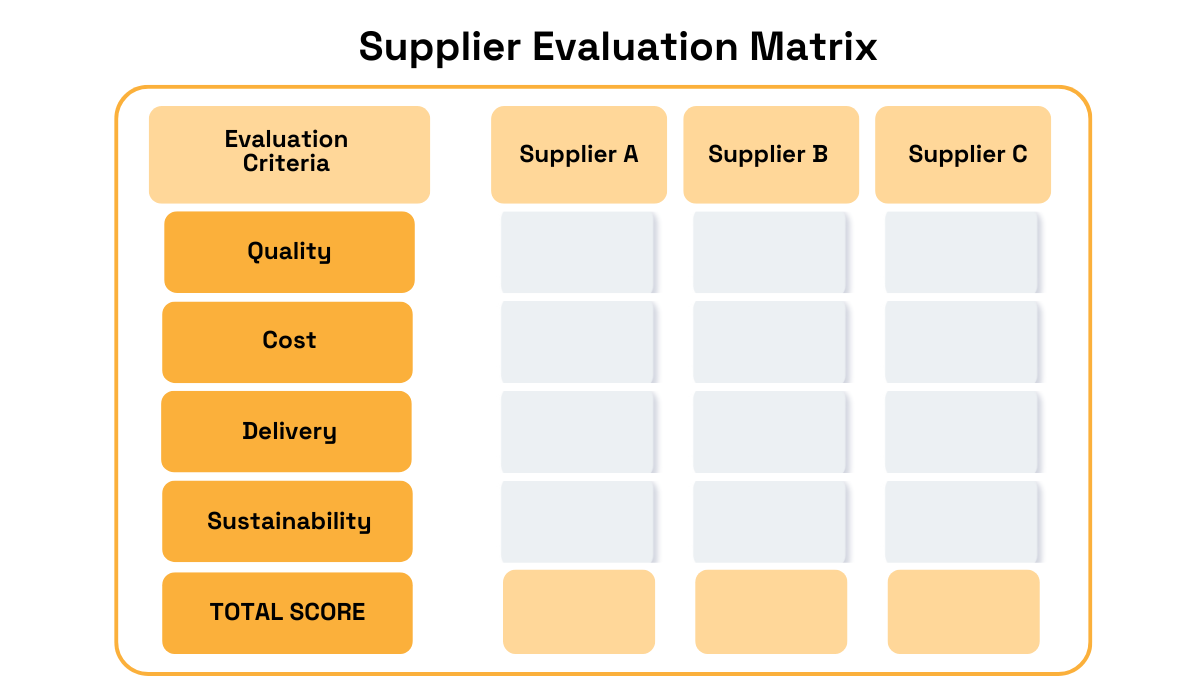
Step 1: Set Up Your Spreadsheet
Create columns for: Supplier Name, Criterion, Weight, Rating (1-5), and Score (Weight x Rating).
Step 2: Define Criteria and Weights
List your key criteria. For your beauty mini-market, let's use:
- Product Quality & Authenticity: (Weight: 40%) - This should be your highest priority.
- Price & Payment Terms: (Weight: 20%)
- Reliability (Shipping & Service): (Weight: 25%)
- MOQ Flexibility: (Weight: 15%)
Note: These weights are suggestions. Feel free to adjust them based on your business strategy.
Step 3: Create a Rating Scale
Define what your 1-5 scale means for each criterion. For example, for MOQ Flexibility:
- 5: Very low MOQ (<$500), willing to negotiate for first order.
- 3: Moderate MOQ ($500-$1500), some flexibility.
- 1: Very high MOQ (>$3000), rigid policies.
Step 4: Evaluate and Score
As you research each supplier on your long list and ask them the key questions from section 2, fill in the ratings. Multiply the rating by the weight to get a score for each criterion. Finally, total the scores for each supplier.
| Supplier Name | Criterion | Weight | Rating (1-5) | Score |
|---|---|---|---|---|
| Supplier A | Quality | 40% | 5 | 2.0 |
| Price | 20% | 3 | 0.6 | |
| Reliability | 25% | 4 | 1.0 | |
| MOQ | 15% | 2 | 0.3 | |
| Total | 3.9 | |||
| Supplier B | Quality | 40% | 4 | 1.6 |
| Price | 20% | 4 | 0.8 | |
| Reliability | 25% | 5 | 1.25 | |
| MOQ | 15% | 5 | 0.75 | |
| Total | 4.4 |
In this example, even though Supplier A has perfect quality, Supplier B wins overall due to its excellent reliability, flexible MOQ, and better pricing. This is the kind of objective decision-making this tool enables.
Conclusion
You've now moved from a simple list of names to a powerful evaluation framework. By systematically assessing suppliers against the core pillars of quality, price, reliability, and MOQ, you can make an informed, data-driven decision that will set your business up for success.
Key Takeaways:
- Supplier evaluation must balance four key criteria: Price, Quality, Reliability, and Minimum Order Quantity (MOQ).
- Never sacrifice quality for a lower price, as it can damage your reputation and lead to legal issues.
- A Supplier Scorecard is a practical tool that removes emotion and bias, allowing for an objective comparison between potential partners.
- Always ask specific, probing questions about authenticity, hidden fees, shipping performance, and MOQ flexibility before committing to a supplier.
Preview of the Next Lesson:
Once you have your short list of top-tier suppliers, the next step is to formalize the relationship. In our next lesson, we will focus on how to negotiate payment terms and delivery schedules with suppliers, ensuring the partnership works for your cash flow and operational needs from day one.