Introduction
Welcome back! In our last lesson, we focused on using data to assess potential store locations, moving from a qualitative checklist to a quantitative, evidence-based analysis of foot traffic and demographics. Now that you know how to identify a promising spot, the next crucial step is securing it.
This brings us to today's learning outcome: to identify the key terms in a commercial lease agreement.
As someone coming from a digital marketing background, you're accustomed to terms of service and online agreements. However, a commercial lease is a far more complex, long-term, and legally binding contract that will define your rights, responsibilities, and major costs for years to come. Getting this wrong can be one of the most expensive mistakes a new retailer can make.
This lesson is designed to demystify this critical document. We'll break it down into manageable parts, define the legal jargon in plain language, and give you a structured way to approach any lease you're presented with. By the end of this lesson, you will be able to read a commercial lease and identify the core components that will have the biggest impact on your new beauty mini-market.
1. The Foundation: Who Pays for What?
Before diving into specific clauses, we need to understand the fundamental structures of commercial leases. The primary difference between them lies in how operating expenses—like property taxes, insurance, and maintenance—are handled.
Typical Commercial Lease Terms That Everyone Should Know
To start, let's watch a clear explanation of the most common lease structures. This video from commercial real estate expert Tyler Cauble breaks down how rent is calculated in each type, which is the most important financial aspect to grasp first.
Watch the section from 00:21 to 02:39. Focus on understanding the difference between a Triple Net (NNN), a Full-Service Gross (FSG), and a Modified Gross (MG) lease.
To summarize and visualize what you just learned:
- Gross Lease (or Full-Service Gross): You pay a single, all-inclusive flat rent. The landlord pays for the operating expenses. This offers predictability for you, but the rent is often higher to cover the landlord's risk.
- Net Lease: You pay a lower base rent plus some or all of the operating expenses. This is very common in retail.
- Single Net (N): You pay base rent + property taxes.
- Double Net (NN): You pay base rent + property taxes + insurance.
- Triple Net (NNN): You pay base rent + property taxes + insurance + common area maintenance (CAM). This is the most common type for standalone retail spaces and strip malls. You are responsible for almost all costs associated with your space.
This table provides a great visual summary of the tenant's responsibilities under each structure.
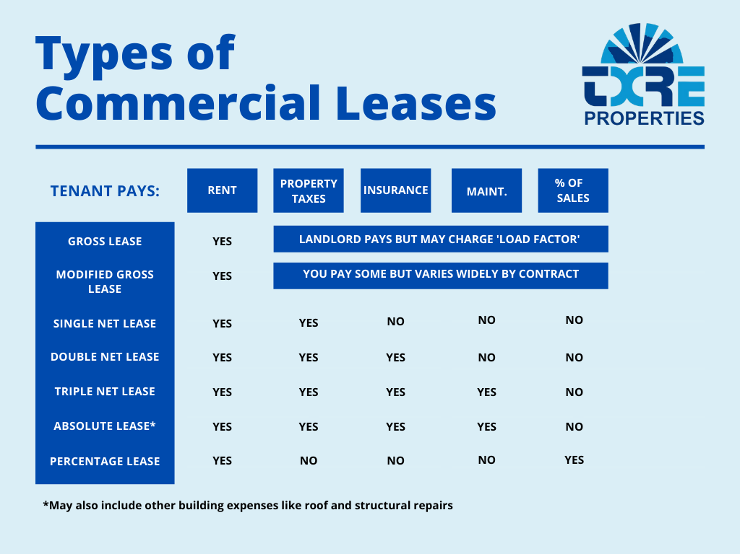
For a new business, knowing which type of lease you are signing is critical for budgeting your startup costs and monthly expenses accurately.
2. The Anatomy of a Commercial Lease
A commercial lease can be a dense, lengthy document. To make it approachable, we'll use a fantastic resource as our guide. It's a checklist designed specifically for small business owners like you. It not only defines the terms but also explains what to expect from a landlord's perspective and what you might be able to negotiate.
Commercial Lease Checklist for Small Businesses
This 'Commercial Lease Checklist for Small Businesses' from Communities Rise will be our primary reference for the rest of the lesson. It's detailed and practical. For now, just familiarize yourself with its structure.
First, read the introduction on page 3 to understand how the checklist is structured ('Definition', 'What to expect', 'What can the tenant negotiate?'). Then, look at the Table of Contents on page 4 to see the full scope of terms we'll be exploring. Don't read the whole document yet; we'll tackle it in sections.
Now, let's use this checklist to break down the most essential terms, grouping them into logical categories.
A. The Core Deal: What, Where, How Long, and For How Much?
This group of terms defines the absolute basics of your agreement.
- The Parties: The Lessor (Landlord) and Lessee (you, the Tenant).
- Description of the Premises: The lease must explicitly state the exact address and suite number you are renting. It often includes the square footage, which is used to calculate your rent and share of expenses.
- Lease Term: The length of the lease (e.g., 3, 5, or 10 years).
- Key Dates: These are often confusing but critical. Read the section below in your checklist to understand the difference.
Commercial Lease Checklist for Small Businesses
A lease isn't just one date. You'll see an 'Effective Date,' a 'Commencement Date,' and a 'Rent Commencement Date.' They are not always the same. This section of the checklist clarifies what each one means.
Read the section 'The "Effective Date" vs. the "Commencement Date" vs. the "Rent Commencement Date"' on pages 6-7.
- Rent and Additional Rent: This clause details your financial obligations, including:
- Base Rent: The fixed monthly amount.
- Rent Escalation: How your rent will increase over the term (e.g., a fixed percentage annually). This is a crucial clause for long-term financial planning.
- Operating Expenses / Common Area Maintenance (CAM): In a net lease, this is the "additional rent" you pay for your share of the property's upkeep.
- Percentage Rent: Common in malls, this requires you to pay a percentage of your gross sales over a certain threshold. It's important to know if this is in your lease.
B. The Physical Space: Condition and Customization
This section covers the state of the property when you get it and what you're allowed to do to make it your own. For a beauty mini-market, this is extremely important as you'll need to install specific shelving, lighting, and displays.
- Condition of the Premises: This describes the state of the space upon delivery. Is it a "move-in ready" vanilla shell, or is it a cold dark shell that requires a complete build-out? Understanding this tells you how much work and money will be needed before you can even open.
- Tenant Alterations: This clause outlines the rules for making changes to the space. Landlords will almost always require approval for significant changes, especially structural ones.
- Tenant Improvement (TI) Allowance: This is a crucial negotiating point. It is an amount of money the landlord gives you to help pay for the build-out of your space.
Commercial Lease Checklist for Small Businesses
Let's dive back into the checklist to understand these physical-space terms in more detail. Pay close attention to the 'What can the tenant negotiate?' sections.
Read the following three sections: 'Condition of the Premises' (page 5), 'Tenant Alterations' (pages 7-8), and 'Tenant Improvement Allowance' (pages 8-10).
C. Your Rights and Protections
These clauses define your rights as a tenant and protect your business operations.
- Permitted Use: This clause specifies exactly what you can use the space for (e.g., "retail sale of cosmetics and beauty products"). It's vital this is broad enough to cover your business but specific enough to trigger the next, very important clause.
- Exclusive Right (or Exclusivity): This is one of the most valuable clauses for a retail tenant. It prevents the landlord from leasing space in the same property to a competing business. For your beauty mini-market, this would stop the landlord from renting another unit to a direct competitor like another multi-brand beauty store.
- Quiet Enjoyment: This is a legal term ensuring the landlord will not interfere with your right to operate your business in the space, as long as you are following the lease terms.
- Options (to Renew or Expand): An option to renew gives you the right to extend your lease for another term. This is valuable if your business is successful and you want to stay.
D. Risks and Contingencies
This final group of terms covers what happens when things don't go as planned. It's essential to understand these to know your risks.
Commercial Lease Agreement - EXPLAINED
This short video provides a quick, high-level list of many of the essential terms that should be in any lease, covering some of the risks and responsibilities.
Watch the section 'Essential terms in a commercial lease agreement' from 00:51 to 01:51. This will give you a rapid-fire list to frame your thinking before we read the details.
Now let's use the checklist to understand three of the most important risk-related clauses:
- Assignment and Subletting: What happens if you need to get out of the lease early or want to rent out a portion of your space? An assignment transfers the lease to a new tenant. A sublease means you remain responsible, but another tenant occupies the space and pays you rent. Landlords typically want strict control over this.
- Default and Cure: This outlines what happens if you breach the lease (e.g., fail to pay rent). A "cure" period is a critical negotiated term that gives you a window of time to fix the problem before the landlord can take legal action, like eviction.
- Subordination, Non-Disturbance, and Attornment (SNDA): This is a complex but vital clause. In short, it protects you if your landlord defaults on their mortgage and the bank forecloses on the property. The "Non-Disturbance" part of the agreement ensures that the bank (as the new owner) will honor your lease and not evict you, as long as you are not in default.
Commercial Lease Checklist for Small Businesses
These terms can seem intimidating, but they are critical for managing your business risk. Let's read the relevant sections in the checklist.
Read the following three sections: 'Assignment/Subletting' (pages 11-13), 'Tenant "Defaults"' (pages 13-14), and 'Subordination of the Lease' (pages 10-11).
3. Final Advice: Don't Go It Alone
You've now been introduced to the most significant terms in a commercial lease. While this knowledge is powerful, a lease is a legal document with long-term consequences. It is always recommended to have a professional review it.
- Independent Legal Advice (ILA): The single most important takeaway is to have a lawyer who specializes in commercial real estate review your lease before you sign it. They will spot unfavorable clauses and help you understand your risks.
- The Letter of Intent (LOI): Before you even get the full lease, you will typically negotiate a Letter of Intent. This is a shorter, non-binding document that outlines the main business terms (rent, term, TI allowance, exclusivity, etc.). Getting these key points agreed upon in the LOI makes the formal lease negotiation much smoother.
Conclusion
In this lesson, we dissected the commercial lease agreement, transforming it from an intimidating legal document into a series of understandable business terms. You now have a framework for identifying the clauses that will most profoundly shape the future of your retail store.
Key Takeaways:
- Lease Structure is Step One: The difference between a Gross and a Triple Net (NNN) lease has massive implications for your budget. Always clarify who pays for operating expenses.
- The Devil is in the Details: Terms like Rent Escalation, Permitted Use, and Tenant Improvements directly impact your profitability and operational freedom.
- Protect Your Business: Clauses like Exclusivity, Options to Renew, and SNDA are crucial for protecting your investment and securing the future of your location.
- Know Your Risks: Understand the clauses on Default, Cure periods, and Assignment/Subletting to know your obligations and options if circumstances change.
- Always Seek Professional Advice: Your knowledge is for preparing you to have an intelligent conversation with a commercial real estate lawyer, not to replace them.
Preview of the Next Lesson:
Identifying these terms is the first step. The next is influencing them in your favor. In our next lesson, we will focus on how to negotiate basic lease terms for a retail space, turning your new knowledge into actionable negotiation strategies.