Hello! In our last lesson, we focused on the 'S' (Subject) in our S-V-O sentence structure, learning about nouns and pronouns. This foundation is crucial because the subject determines the form of the verb that follows.
Today, we move to the 'V' (Verb) and start with the most common and essential verb in the English language: the verb 'to be'. This verb is special because its form changes depending on the subject. Mastering its use is a fundamental step toward building correct and clear sentences for your everyday writing and the IELTS test. In this lesson, you will learn how to use the present tense forms of 'to be'—am, is, and are—in affirmative (positive) statements, negative statements, and questions.
Part 1: Affirmative Form: Stating Facts with am, is, are
The verb 'to be' is used to describe states, conditions, or facts. For example, it can describe a person's job, nationality, or feelings. In the present tense, it has three forms: am, is, and are. The form you use depends on the subject of the sentence.
Here is the basic rule that connects back to our previous lesson on pronouns:
- I → am (
I am a student.) - He / She / It → is (
She is a doctor.,It is cold.) - You / We / They → are (
You are tall.,They are friends.)
In everyday English, both in speaking and informal writing (like emails to friends), we often use contractions. A contraction is a shorter way to say two words.
- I am → I'm
- He is → He's / She is → She's / It is → It's
- You are → You're / We are → We're / They are → They're
The following video provides a very clear explanation of these rules with examples.
Simple Present Be verb (Affirmative, Negative, Questions)
This video from Laura's English School clearly introduces the verb 'to be' and explains how to use its affirmative forms with the correct pronouns.
Please watch from the beginning of the explanation. The instructor will explain what the verb 'be' is used for and then show you the full form and the short form (contraction) for each subject pronoun.
To review these rules in a written format, you can study the explanation and table from the British Council.
Present simple: 'to be' | LearnEnglish
This resource provides a clear grammar table and examples for the affirmative forms and their contractions.
In the "Grammar explanation" section, review the table, focusing on the 'Affirmative' column. Then, read the section titled "Contractions" to see the examples of how full forms are shortened.
Part 2: Negative Form: Using not
To make a sentence with 'to be' negative, you simply add the word not after the verb (am, is, or are).
The structure is: Subject + am/is/are + not + ...
I am not a teacher.He is not at home.They are not busy.
Just like with affirmative sentences, we often use contractions for negative forms. There are two common ways to do this, except for "I am not":
- is not → isn't
- are not → aren't
- am not → I'm not (Note:
amn'tis not used in modern English).
So, you can write He is not happy in two shorter ways: He's not happy or He isn't happy. Both are correct and very common.
Let's watch the next part of the video to see this in action.
Simple Present Be verb (Affirmative, Negative, Questions)
This part of the video explains how to form negative sentences and their contractions.
Watch from this section on the negative form. Pay close attention to the two different ways you can form contractions for is not and are not.
For a written summary of these rules, the British Council resource is very helpful.
Present simple: 'to be' | LearnEnglish
This section clearly lays out the rules for forming negative sentences with 'to be'.
Read the section titled "Negatives". Notice the examples showing the different contraction options, such as She's not a student and She isn't a student.
Part 3: Question Form and Short Answers
To ask a yes/no question using 'to be', you invert (swap) the subject and the verb.
- Affirmative:
You are tired.→ Question:Are you tired? - Affirmative:
She is from China.→ Question:Is she from China?
The structure is: Am/Is/Are + Subject + ...?
When answering these questions, we usually use short answers to avoid repetition. For example:
Q: "Are you a student?"
A: "Yes, I am." (Instead of "Yes, I am a student.")
Q: "Is he busy?"
A: "No, he isn't." (Instead of "No, he is not busy.")
Important Rule: Do not use contractions in affirmative (yes) short answers.
- Correct:
Yes, he is. - Incorrect:
Yes, he's.
You can, however, use contractions in negative (no) short answers (No, he's not. or No, he isn't.).
The final segment of the video explains this very clearly.
Simple Present Be verb (Affirmative, Negative, Questions)
This section demonstrates how to form questions and how to respond with correct short answers.
Watch the video from this part about questions. Focus on how the word order changes from a statement to a question, and the rules for forming yes and no short answers.
Summary and Practice
You have now learned the three main forms of the verb 'to be' in the present tense. This chart provides a great summary of everything we've covered.
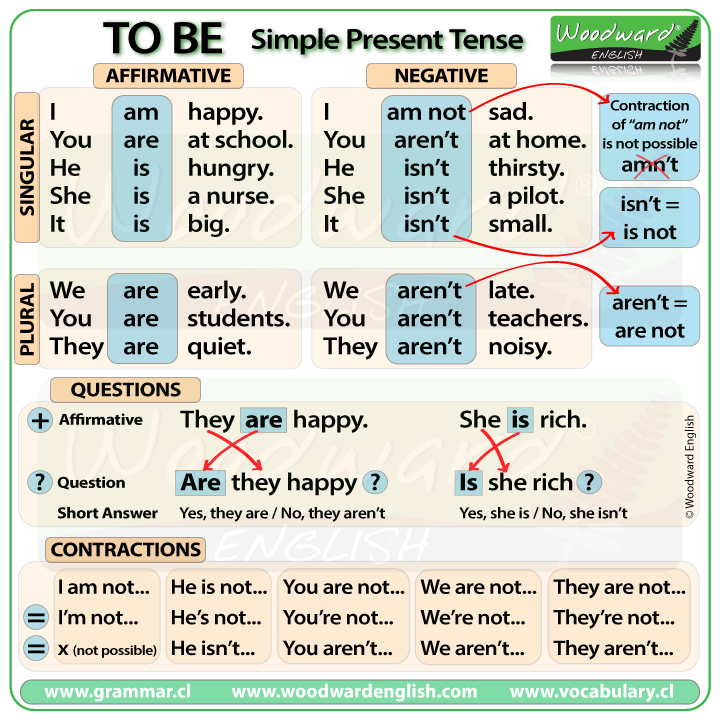
Let's practice what you have learned.
Activity 1: Fill in the Blanks
Complete the sentences with the correct form of 'to be': am, is, or are.
- My friend, Wei, _____ from Shanghai.
- I _____ very excited about learning English.
- My parents _____ not here; they _____ on vacation.
- _____ this your book?
- We _____ students at the same university.
Answers:
- is
- am
- are, are
- Is
- are
Activity 2: Change the Sentences
Rewrite each sentence first as a negative sentence, and then as a question.
- He is a good writer.
- They are ready for the test.
Answers:
- Negative:
He is not (isn't) a good writer.Question:Is he a good writer?- Negative:
They are not (aren't) ready for the test.Question:Are they ready for the test?
Key Takeaways
In this lesson, you've mastered the foundational verb 'to be'.
- Affirmative: Use
am,is, oraredepending on the subject (I am,He is,They are). - Negative: Add
notafter the verb (He is not) and use contractions likeisn'tandaren't. - Questions: Invert the subject and the verb (
Is he...?). - Short Answers: Respond with
Yes, I am.orNo, she isn't., remembering not to use contractions in positive short answers.
This skill is absolutely essential for almost every sentence you will write in English.
In our next lesson, we will expand on what you've learned about questions. We will look at how to form yes/no questions with other verbs (not just 'to be') and introduce wh-questions (using words like what, where, and who) to ask for more detailed information.