Welcome back! In our last two lessons, we learned how to find the parts of a sentence (Subject-Verb-Object) and how to build simple sentences using the SVO pattern. You've learned the basic blueprint for English sentences.
Today, we will look more closely at the first and most important block: the Subject. The subject tells us who or what the sentence is about. To make your writing clear and interesting, you need to choose the right kind of word for your subject. In this lesson, we will explore three types of words you can use as a subject: common nouns, proper nouns, and pronouns. Mastering these will help you avoid common errors and is a key step toward writing well for your daily life and for the IELTS test.
Part 1: Naming the World - Common and Proper Nouns
First, let's understand what a noun is. A noun is simply a word that names a person, a place, a thing, or an idea. There are two main types of nouns we use for subjects.
- Common Nouns: These are general names. For example,
city,teacher,book. - Proper Nouns: These are specific names. For example,
Shanghai,Mr. Zhang,Harry Potter.
The most important rule for writing is that proper nouns are always capitalized, while common nouns are not (unless they are the first word in a sentence). This simple rule can greatly improve the quality of your writing.
This image gives a clear visual comparison between common and proper nouns.

Now, let's solidify these definitions by reading a short explanation.
Nouns and Pronouns (Video & Practice Questions)
This text from Mometrix Academy provides clear, simple definitions for common and proper nouns.
First, read the section on "Common Nouns". Focus on the definition and the examples given, such as this one. Next, read the section on "Proper Nouns". Pay close attention to the definition and the capitalization rule. Also, notice the example comparing the common noun road to the proper noun Tomball Lane.
To see many more examples and hear the difference explained, the following video is very helpful. The instructor gives lots of pairs of common and proper nouns to make the concept easy to understand.
Improve Your Writing: Common & Proper Nouns
This video from "Learn English with Rebecca" clearly explains the difference between common and proper nouns and why capitalization is so important for writers.
First, watch the main explanation from the definitions of common and proper nouns. The key idea is general versus specific. Then, watch the series of examples from the comparison part. Notice how city (common) becomes London (proper), and company (common) becomes Microsoft (proper). This will help you recognize them in your own reading and writing.
Part 2: Making Writing Smoother with Pronouns
Imagine writing this sentence: "My friend is named Wei. Wei lives in Beijing. Wei is a student." It sounds repetitive and unnatural.
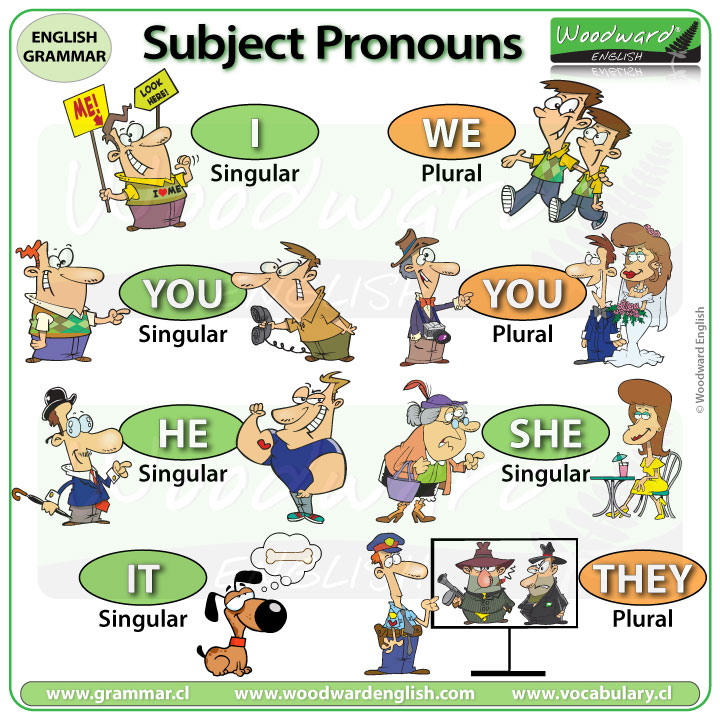
To fix this, we use pronouns. Pronouns are short words that replace nouns. In the example above, we can write: "My friend is named Wei. He lives in Beijing. He is a student." This sounds much better.
The pronouns we use as subjects are called subject pronouns. This image shows all of them.
Let's read a quick definition before seeing them in action.
Nouns and Pronouns (Video & Practice Questions)
This section of the Mometrix text explains the purpose of pronouns.
Please read the first two paragraphs under the main heading "Pronouns". Focus on the definition: "words that take the place of nouns". The example about 'Tina' clearly shows why pronouns are so useful.
Now, let's watch a video that shows exactly how to choose the correct subject pronoun to replace a noun.
Learn Subject Pronouns | Basic English Grammar Course
This video from Shaw English Online gives a very basic and clear introduction to each subject pronoun.
Watch from the beginning to this point. The teacher will explain each pronoun (I, he, she, it, we, you, they) and then show you how to replace nouns like Jenny, Jack, and the cat with the correct pronoun. Pay attention to when to use it versus they.
Part 3: Practice Your Skills
Now it's your turn to act as a writer. Let's practice using these different types of subjects correctly.
Activity 1: Choose the Correct Subject
For each sentence, choose the best word to fill in the blank. Think about whether the subject should be a pronoun or a proper noun, and remember to check for correct capitalization.
-
My sister lives in New York. _____ is a designer.
- a) she
- b) She
- c) Sister
-
_____ is the capital of China.
- a) beijing
- b) It
- c) Beijing
-
My friends and I love movies. _____ often go to the cinema.
- a) They
- b) We
- c) Friends
Answers:
- (b)
She. The word starts a new sentence, so it must be capitalized. It replaces "My sister."- (c)
Beijing. This is a specific city, so it's a proper noun and must be capitalized.- (b)
We. The subject is "My friends and I," which includes "me," so the correct pronoun isWe.
Activity 2: Correct the Sentences
The following sentences have mistakes with nouns and pronouns. Rewrite them correctly.
- my teacher is from canada.
- The car is new. she is blue.
- i have a dog. Dog is named Lucky.
Corrected Sentences:
- My teacher is from Canada. (
Mymust be capitalized because it starts the sentence.Canadais a proper noun.)- The car is new. It is blue. (A car is a thing, so we use the pronoun
it.)- I have a dog. It is named Lucky. (
Iis always capitalized. The pronoun fordogisit.)
Lesson Summary
Today we focused on the 'S' in our S-V-O sentence structure. You've learned about the different kinds of words that can be the hero of your sentence.
- Nouns name people, places, and things.
- Common Nouns are general (
student,country) and are not capitalized unless they start a sentence. - Proper Nouns are specific (
Wang Wei,China) and are always capitalized. This is a very important rule for good writing. - Pronouns (
I,he,she,it,we,they) replace nouns to make your writing flow better.
By choosing the right subject and using capitalization correctly, you have already made your writing much clearer and more professional. This is a fundamental skill that will help you in all your writing tasks, including the IELTS exam.
In our next lesson, we will move to the 'V' (Verb) in our sentence structure. We'll start with the most essential verb in English: the verb 'to be' (am, is, are) and learn how to use it correctly.